
How to Cat-Proof Your Home: A Complete Safety Guide for Cat Owners
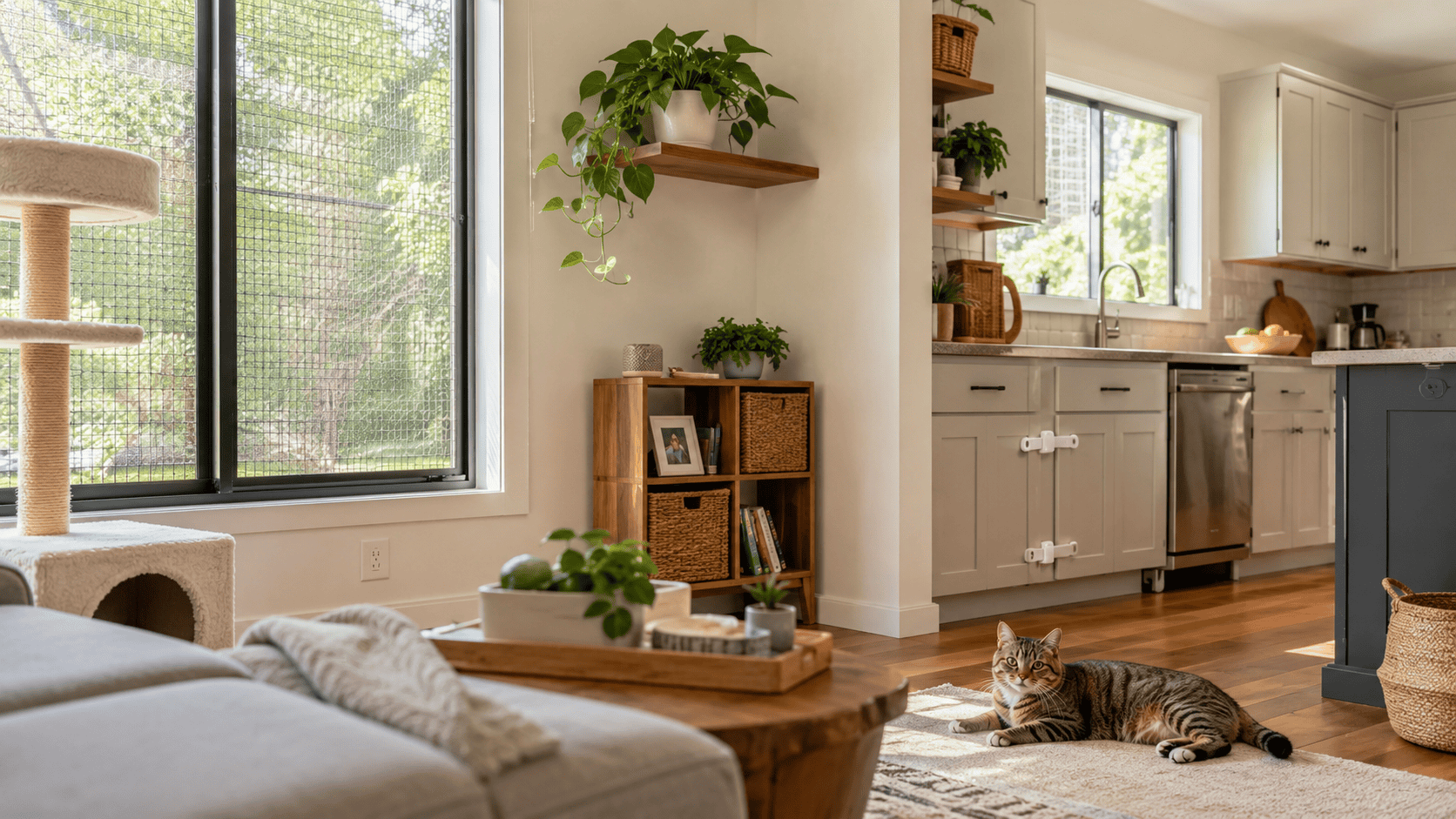
Quick Answer: How to Cat-Proof Your Home
To cat-proof your home, walk through every room and ask what your cat can climb, chew, swallow, open, knock over, hide inside, or escape through. Start with the highest-risk spaces: the kitchen, bathroom, laundry area, windows, balconies, entryways, and outdoor areas. Then remove or secure the common hazards inside those spaces, including cords, toxic plants, cleaners, medications, trash, open appliances, and small swallowable objects. Finally, give your cat safe alternatives for climbing, scratching, hiding, watching, and exploring so your home stays safe without taking away the things cats naturally need.
There is a moment every cat owner eventually experiences.
You look across the room and see your cat doing something that makes your soul briefly leave your body.
Halfway into a cabinet. Nose inside a shopping bag. Pawing at a charging cable. Sitting in the dryer like it is a luxury cave. Balancing on a windowsill with the confidence of a tiny circus performer who pays no rent and has no sense of consequences.
That is why learning how to cat-proof your home matters.
It is not about turning your house into a cold, joyless space where your cat is not allowed to touch anything. A cat-safe home is simply a home set up by someone who understands cats.
They climb. They squeeze. They chew. They hide. They test gaps. They investigate smells. They make questionable decisions with absolute confidence. Your job is not to stop your cat from being curious. Your job is to make sure their curiosity does not lead them straight into something dangerous.
This guide covers every area of your home, with deeper detail on rooms that do not have their own standalone guide, and links to the full room-specific posts for the areas where the risk is highest. If you are trying to figure out how to make your house safe for a cat without turning the place upside down, this room-by-room approach keeps the process practical.
Table of Contents
Why Cat-Proofing Your Home Matters
Cats make indoor life look easy. They nap in sunbeams. Stretch on the couch. Blink slowly like wise little monks. Then, five minutes later, they are chewing a plant you forgot existed or trying to crawl behind the fridge like they have urgent business with the dust.
The danger is that many household risks do not look dangerous to us. A hair tie looks harmless. A lily looks pretty. A laundry dryer looks empty. A cracked-open window looks refreshing. A dangling cord looks like nothing special.
To a cat, those same things can become toys, hiding places, escape routes, chew targets, or snacks.
Cornell University’s Feline Health Center notes that ordinary homes can contain plants, human medications, household chemicals, and certain foods that pose a hazard to cats. VCA Hospitals explains that cats can be poisoned not only by eating something toxic, but also through inhalation or skin contact, with grooming creating an additional risk after topical exposure. [1][2]
That is the part many people miss. A cat does not need to drink floor cleaner to be exposed. They can walk across a wet surface, lick their paws, and ingest the residue later. A cat does not need to eat an entire toxic food. A cat does not need to be “bad” to get into trouble. They just need to be a cat in a room designed by humans.
How to Look at Your Home Like a Cat
Before you go room by room, stop looking at your home like a person. Look at it like a cat.
A counter is not a counter. It is a lookout tower. A cabinet is not storage. It is a mysterious cave. A window is not ventilation. It is a live bird documentary. A laundry basket is not laundry. It is a nest. A charging cable is not a cable. It is a suspicious tail.
Once you see the home this way, cat-proofing becomes much easier. You are not randomly hiding things. You are removing the rewards and risks that make unsafe behaviour worth repeating.
Walk through each space and ask:
- What can my cat climb?
- What can my cat chew?
- What can my cat swallow?
- What can my cat open?
- What can my cat knock over?
- Where can my cat hide or get trapped?
- Where can my cat escape?
That simple mindset is the foundation of a genuinely cat-safe home, and it is the easiest way to understand how to cat-proof your house without missing the small hazards hiding in plain sight.
1. Cat-Proof Your Kitchen
The kitchen is one of the highest-risk areas in the home because it combines everything cats love with everything that can hurt them. Smells. Counters. Trash cans. Warm appliances. Running water. Cabinets. Basically, from your cat’s point of view, the kitchen is a theme park with snacks.
The problem is that kitchens also contain hot stoves, sharp knives, toxic foods, cleaning products, small packaging pieces, appliance cords, and trash that may include bones, string, plastic, or spoiled food.
To make the kitchen safer: keep counters clear of food, store toxic ingredients securely, cover or lock the trash, keep cleaners in latched cabinets, manage appliance cords, and keep your cat back from the stove while cooking. If your cat is a counter-surfer, do not rely on shouting “down” twenty times a day. Remove the reward from the counter and give your cat a safer place to watch you cook.
The kitchen is not just about stopping paw prints near the cutting board. It is about preventing one careless moment from becoming a vet emergency.
Read More: How to Cat-Proof Your Kitchen: Counters, Cabinets, Trash, and Safety Tips
2. Cat-Proof Your Bathroom
Bathrooms look small and harmless, but they are full of odd little hazards. Toilet bowls, medications, razors, cotton buds, dental floss, hair ties, cleaning products, wet floors, and open cabinets can all become problems.
The biggest rule is simple: close what should be closed. Close the toilet lid. Close cabinets. Put medications away immediately. Store razors and grooming tools where your cat cannot reach them. Do not leave dental floss, hair ties, or cotton items scattered on the counter.
A bathroom does not need to be dramatic to be risky. It only needs to have small, interesting things sitting exactly where a cat can reach them.
Read more: Bathroom Safety for Cats: How to Cat-Proof Your Bathroom
3. Cat-Proof Your Laundry Area
Laundry areas are easy to underestimate until you remember one thing: cats love warm, enclosed spaces. That makes washers and dryers especially important. A dryer full of warm laundry may look like the most perfect nap cave your cat has ever discovered.
PetMD specifically warns that cats may explore washers and dryers while looking for small, cosy hiding spaces, and recommends keeping appliances closed when not actively loading or unloading them. [3]
Before starting a washer or dryer, check inside. Every time. Make it a habit, not something you do only when you remember.
Also secure detergent pods, bleach, fabric softeners, dryer sheets, and stain removers. Some cats chew fabric, strings, or soft plastic packaging. Others climb into laundry baskets and get carried around unnoticed like furry laundry.
Read more: Laundry Room Dangers for Cats: Hidden Risks Every Cat Owner Should Know
4. Cat-Proof Your Yard or Outdoor Space
A yard can feel safe because it is part of your home. But to a cat, outdoor space is still full of escape routes, plants, chemicals, tools, gaps, insects, and animals.
Check fencing, gates, balcony doors, garden gaps, sheds, outdoor furniture, ponds, pools, and storage areas. Remove or block access to toxic plants, pesticides, fertilizers, snail bait, rodent bait, sharp garden tools, and chemicals.
For cats who enjoy fresh air, a catio, enclosed patio, cat-proof fencing, or supervised leash time is safer than simply opening the door and hoping for the best. The aim is not to say every cat must be trapped indoors forever. It is to recognize that outdoor freedom without boundaries can become dangerous very quickly.
Read more:
How to Cat-Proof Your Yard (Without Turning It Into a Prison Yard)
Toxic Houseplants for Cats: 12 Common Plants to Remove From Your Home
5. Cat-Proof Your Living Room
The living room is where many cats spend the most time, which is exactly why it deserves careful attention. It is the room where cats climb shelves, chew cords, bat small objects under furniture, swat at blind cords, investigate candles, leap onto unstable surfaces, and occasionally decide your décor would look better on the floor.
Cords and cables
TV cables, lamp cords, gaming wires, chargers, and extension cords should be tucked away, covered, or blocked. The Anti-Cruelty Society recommends unplugging electrical cords when possible and using cord protectors if cords must remain plugged in. [4]
Height and unstable furniture
Cats like vertical space, but not every tall surface is safe. Secure wobbly shelves, move fragile items away from edges, and make sure bookcases or tall furniture cannot tip if your cat jumps onto them. Anchor tall bookcases and shelving units to the wall if possible, especially with heavier cats or kittens who are still learning their own weight.
Candles, fireplaces, and open flames
Never leave open flames unattended with a cat in the room. A tail, whisker, or curious paw can get too close before your cat realises heat is not a toy. Use flameless candles when you need the ambience without the risk, and always put a fireplace guard in place.
Recliners and large furniture gaps
Cats may crawl inside or underneath recliners, sofas, and other large furniture, especially if they are small, shy, or newly adopted. Check before reclining, and be mindful of gaps behind large furniture that can become dangerous hiding spots.
Blind cords and window coverings
Looped blind cords are a strangulation risk. Replace looped cords with cordless blinds or use a cord wind-up clip to keep them out of reach. This matters most in homes with kittens, but is worth addressing regardless of your cat’s age.
Small objects on low surfaces
Coffee tables, shelves, and side tables tend to collect items that become cat toys the moment you leave the room: hair ties, rubber bands, small figurines, pen caps, coins. A quick sweep before you go out is faster than a vet visit.
6. Cat-Proof Your Bedroom
The bedroom feels calm, which is exactly why we forget how many small things live there. Hair ties. Jewellery. Medication. Earplugs. Charging cables. Drawer gaps. Open wardrobes. Loose threads. Under-bed storage. Nightstand clutter. Windows left slightly open at night.
Nightstand and medication
A cat does not know your bedside painkiller is not a toy. They will bat it off the table, chew on it, and possibly ingest it. Clear your nightstand before sleeping. Keep medications in drawers or cabinets, never beside the bed.
Small accessories
Store jewellery, hair ties, and small accessories in containers with lids. Hair ties, dental floss, rubber bands, string, and yarn are among the household objects cats may swallow, and swallowed items can lead to intestinal blockage. Earplugs and earbuds are also frequent offenders. [6][10]
Cables and chargers
Manage charging cables so they are not dangling over the edge of tables. A cable that charges your phone overnight is also a cable your cat may decide to chew in the dark.
Wardrobes and closets
Check closets and drawers before closing them, especially if your cat is a hider. Some cats can slip into a wardrobe silently and sit there like a tiny ghost while you search the entire house in a quiet panic. Get into the habit of a quick visual check before you close any door.
Kittens and heavy bedding
For kittens or very small cats, be mindful of heavy bedding, deep storage boxes under the bed, and gaps between furniture. Their confidence arrives long before their judgment.
7. Cat-Proof Your Home Office or Craft Area
Home offices and craft areas are underrated danger zones. They are full of tiny, interesting objects: paper clips, rubber bands, staples, thumbtacks, pen caps, tape, glue, sewing thread, needles, yarn, craft wire, beads, and printer cords.
If your cat likes batting objects off desks, this room is a playground. If your cat likes chewing or swallowing things, it is a problem.
Store small supplies in closed drawers or lidded containers. Keep sewing and craft materials fully packed away after use. Do not leave thread, yarn, ribbon, or string-like materials unattended. Long, thin objects such as string, yarn, thread, and tinsel can become linear foreign bodies, which are especially dangerous in cats. [7][10]
Also check office cords. Laptop chargers, monitor cables, printer wires, and desk lamp cords often hang exactly where a bored cat can reach them. A cord management box or cable sleeve costs almost nothing and removes a recurring risk.
8. Cat-Proof Hallways, Entryways, and Doors
Entryways are less about objects and more about escape. This is where groceries come in, guests arrive, delivery drivers appear, children forget to close doors, and cats suddenly develop the speed of a cartoon thief.
Door-dashers
If your cat is a door-dasher, your entryway needs a system. Use a second barrier if possible, such as a hallway door, screen door, baby gate, or temporary separation before opening the main door. Some owners keep a designated room to put their cat in before opening the front door, particularly for scheduled deliveries.
Visitor rules
Make sure visitors know the rule: do not leave the door open. That sounds obvious, but many escape stories start with “someone only opened the door for a second.” If you have guests with children, a note or a verbal reminder can prevent a stressful evening.
Bags and entryway clutter
Keep bags, shoestrings, umbrellas, and small entry-table items tidy. Cats love investigating bags left on the floor, especially if they smell like outside, food, or another animal. A bag that once carried fresh fish is basically a treasure chest to your cat.
Hallway hazards
Long hallways themselves are usually lower risk, but check for loose carpeting edges, exposed tack strips, gaps under doors that a curious paw might get wedged into, and anything stored on hallway shelving within reach. If your cat is a runner, hallways can also become sprinting zones, which matters if you have elderly residents or young children in the house.
9. Cat-Proof Windows, Balconies, and High Places
Windows and balconies deserve serious attention because cats are excellent climbers, but not always excellent risk calculators. A window screen may look secure until a cat leans, pushes, or launches at a bird. A balcony gap may look too small until your cat proves otherwise.
Secure all reachable windows. Check screens regularly. Do not assume a standard insect screen is strong enough to hold a cat under pressure. For balconies, use cat-safe mesh, netting, or panels suitable for your building and climate.
This is especially important in apartments and high-rise homes, where one weak window or balcony gap can become a serious fall risk. High-rise syndrome refers to the injuries cats can suffer after falling from high places, often from windows or balconies, and even a cat who seems alert after a fall may still need urgent veterinary assessment. [8]
Inside the home, stabilize tall furniture and avoid placing tempting launchpads near unsafe windows. If your cat loves heights, give them safe vertical options: cat trees, sturdy shelves, window perches, and climbing furniture designed for cats.
Do not remove the view. Make the view safer.
Read more: Cat-Proof Balcony: Keep Cats Safe Without Taking Away the Fun
Whole-Home Safety Habits That Make Cat-Proofing Easier
A cat-safe home is not created in one dramatic afternoon and then forgotten. It is built through small habits. Use this cat-proofing checklist as a quick reminder of the everyday home safety for cats habits that matter most.
- Close cabinets after use
- Check washers and dryers before starting them
- Secure windows before leaving the room
- Put medications away immediately
- Store cleaners after use
- Clear dropped items from the floor
- Unplug or cover tempting cords
- Check hiding spots before closing closets
- Look behind furniture if your cat suddenly disappears
- Do a quick sweep before leaving the house
This matters because many cat owners worry about unsupervised time. The answer is not to live in a bare room with one chair and no joy. The answer is to make the risky things harder to access before your cat gets bored, curious, or energetic.
Cat-Proofing Without Turning Your Home Into a Prison
Many cat-proofing guides get the tone wrong. They make it sound like your cat’s whole life should be blocked, banned, sealed, and supervised until your home looks like a storage unit.
That is not the goal. Cats need to climb. They need to scratch. They need to hide. They need to watch birds through windows. They need to explore. They need to feel like the home belongs to them too.
So the smarter approach is not just “no.” It is “not there — here.”
- Not the kitchen counter, but this cat tree
- Not the blind cord, but this wand toy
- Not the cabinet, but this tunnel
- Not the couch arm, but this scratching post
- Not the unsafe balcony gap, but this secured perch
- Not the plastic wrapper, but this puzzle feeder
When you remove unsafe access, replace it with something safe and satisfying. A bored cat will create entertainment. A cat with good options is less likely to invent chaos from your charger cable and a bread clip.
Cat-Proofing for Different Life Stages
Kittens
Kittens need the most intense cat-proofing. They chew more. Climb badly. Misjudge jumps. Squeeze into gaps. Explore with their mouths. Fall asleep in strange places. Get trapped in rooms. Investigate appliances. And somehow, they do all this while looking innocent enough to avoid prosecution.
For kittens, focus especially on: cords, small objects, appliances, open toilets, unstable furniture, toxic plants, windows and balconies, cabinet access, and hiding spaces you cannot reach. Cat-proofing for kittens should always assume they will investigate first and think later.
Adult Cats
Adult cats are usually more predictable, but predictable does not mean harmless. An adult cat may have established habits: counter surfing, cabinet opening, cord chewing, plant nibbling, or door dashing.
For adult cats, cat-proof around the behaviour you actually see. Do not cat-proof for an imaginary cat. Cat-proof for the cat you live with.
Senior Cats
Senior cats need a different kind of safety. They may not be launching themselves onto cabinets anymore, but they may slip more easily, misjudge jumps, or struggle with stairs.
For senior cats, think about: non-slip surfaces, lower resting spots, easier litter box access, night lights, stable ramps or steps, and reducing fall risks. A senior-friendly home is still cat-proofed. It is just focused less on chaos prevention and more on comfort, access, and stability.
Room-by-Room Cat-Proofing Checklist
| Area | Main Concern | Quick Safety Check |
|---|---|---|
| Kitchen | Heat, food, trash, cleaners | Clear counters, secure stove area, lock trash and cabinets |
| Bathroom | Medication, water, razors, small items | Close toilet lid, store products, clear counters |
| Laundry Area | Machines and chemicals | Check washer/dryer before use, secure detergents |
| Yard / Outdoor | Escape, plants, chemicals | Secure fencing, remove toxins, supervise access |
| Living Room | Cords, candles, shelves, recliners | Cover cords, stabilise furniture, manage flames and gaps |
| Bedroom | Hair ties, medication, chargers | Clear nightstands, close drawers, manage cables |
| Office / Craft Area | Small supplies and cords | Store clips, thread, needles, and chargers in closed containers |
| Entryway / Hallway | Door escape | Use barriers, warn guests, keep bags and shoes tidy |
| Windows / Balconies | Falls and escape | Secure screens, block gaps, supervise balcony access |
What to Do If Your Cat Gets Into Something Dangerous
Even with the best setup, accidents can still happen.
If your cat eats, licks, chews, touches, or inhales something potentially dangerous, do not sit there scrolling random comments trying to diagnose it yourself.
Call your veterinarian, an emergency clinic, or an animal poison control helpline. Try to identify: what your cat got into, how much they may have eaten or touched, when it happened, whether there is packaging or a label, and whether symptoms have started.
Do not induce vomiting unless a professional tells you to. Do not give home remedies. Do not wait for symptoms if the item is known to be dangerous.
Fast action matters more than trying to look calm on the internet.
Final Thoughts
A cat-proof home is not a perfect home.
It is not a home where your cat never climbs, never investigates, never knocks anything over, never squeezes into a suspicious gap, and never looks directly at you while doing the exact thing you asked them not to do.
That home does not exist.
A cat-proof home is a home where the dangerous stuff has been thought through before your cat finds it first. The stove is managed. The cords are tucked away. The windows are secured. The cabinets close properly. The washer and dryer are checked. The plants are safe. The trash is not an open invitation. The entryway has a plan.
And your cat still gets to be a cat. Still nosy. Still dramatic. Still convinced every room belongs to them. Still supervising your life like a tiny furry landlord.
That is the balance. Not fear. Not overcontrol. Just love with a little foresight.
Because cats will always be curious. The least we can do is make sure the home is ready before they prove it again.
Frequently Asked Questions
How do I cat-proof my home before getting a cat?
Start by securing the obvious hazards first: toxic plants, open windows, loose cords, medications, cleaners, trash, small objects, and appliances. Then prepare one safe room with food, water, litter, scratching options, hiding spots, and a comfortable resting area. Cat-proofing your home for a new cat is easier when you let them explore gradually, because the room-by-room approach helps you spot hazards before your cat does, rather than during a stressful first week.
What is the first room I should cat-proof?
Start with the room where your cat will spend the most unsupervised time. For many owners, that is the living room or bedroom. After that, focus on the kitchen, bathroom, laundry area, windows, and entryways, as these areas tend to carry the highest risks. There is no single right answer — it depends on your cat’s personality, age, and your home’s layout.
How do I cat-proof a room?
To cat-proof a room, start low and work upward. Check floors, cords, drawers, shelves, windows, plants, furniture gaps, and anything small enough to chew or swallow. Then ask whether your cat has a safe place to scratch, climb, hide, and rest, because removing a hazard works better when you replace it with something they are allowed to use.
How do I kitten-proof my home?
Think smaller, lower, and more chaotic than you would for an adult cat. Block tiny gaps, secure cords, remove small objects, close appliances, remove toxic plants, store chemicals, close toilet lids, and supervise access to high places. Kittens often find hazards adult cats have ignored for years. The biggest shift with cat-proofing for kittens is assuming they will investigate everything, because they will.
Do indoor cats still need a cat-proof home?
Yes. Indoor cats are safer from traffic and predators, but they can still get hurt inside the home. Common indoor risks include toxic foods, plants, cleaning products, medications, cords, appliances, windows, balconies, and small swallowable items. The best indoor cat safety tips are usually simple habits: close appliances, secure windows, put hazards away, and check the room from your cat’s point of view. Being indoors reduces external risks but does not remove household ones.
How do I cat-proof a small apartment?
In a small space, you cannot close off many rooms, so storage and smart layout matter more. Secure windows and balconies, cover cords, remove toxic plants, store cleaners and medications, and keep counters clear. Create safe climbing spaces with vertical options like a tall cat tree or wall-mounted shelves. The goal is less about closing off zones and more about managing every surface and storage area carefully, which is often the most realistic way to make your house safe for a cat in an apartment.
How do I make my home safe for cats when I am away?
Before leaving, clear counters, check appliances, close windows, secure trash, put away food, store small objects, and make sure your cat has water, litter access, safe resting spots, and enrichment. If your cat is a kitten, senior, unwell, or a known troublemaker, confine them to a prepared safe room when needed. A tired cat with puzzle feeders and a comfortable spot is significantly less inventive than a bored one.
What household items are most dangerous for cats?
Common household hazards for cats include toxic plants (especially lilies), human medications, cleaning products, pest-control chemicals, certain foods (onions, garlic, grapes, xylitol, chocolate), cords and string-like items, small swallowable objects, open appliances, unsecured windows, candles, and some essential oils. The exact risk depends on the cat, the item, and the level of exposure — but lilies in particular are worth treating as an absolute no in any home with cats. [5][9][10]
Can I cat-proof my home without restricting my cat from everything?
Yes, and you should. Good cat-proofing is about removing unsafe access and replacing it with safe alternatives. A cat tree instead of the counter. A scratching post instead of the couch arm. A window perch instead of an unsecured ledge. Cats do not need to be banned from exploring — they need the exploration to happen in a space that was ready for them.
Are essential oils dangerous for cats?
Many essential oils and liquid potpourri products are poisonous to cats, including tea tree, peppermint, citrus, cinnamon, pine, sweet birch, wintergreen, and ylang ylang oils. Cats metabolise some compounds differently from humans, so exposure can become risky through ingestion, skin contact, or inhalation. If you use a diffuser, do so only in a room your cat cannot access, and ensure good ventilation. [9]
How do I stop my cat from chewing cords?
Cord protectors, cable sleeves, and bitter apple spray are the most commonly used options. Keeping cords tucked away behind furniture or run through wall channels is the most reliable approach. If your cat is an active cord chewer, it is worth investigating whether they are bored or under-stimulated, as cord chewing can be a sign of pica or insufficient environmental enrichment.
Sources:
- Cornell Feline Health Center — Common Cat Hazards
- VCA Hospitals — Household Hazards: Toxic Hazards for Cats
- PetMD — How to Cat-Proof Your Home
- Anti-Cruelty Society — Cat-Proofing Your Home
- ASPCA — Toxic and Non-Toxic Plant List: Cats
- PetMD — Intestinal Blockage in Cats
- VCA Hospitals — Linear Foreign Body in Cats
- Animal Medical Center — High-Rise Syndrome in Cats
- VCA Hospitals — Essential Oil and Liquid Potpourri Poisoning in Cats
- VCA Hospitals — Ingestion of Foreign Bodies in Cats
Related articles:
1. How to Cat-Proof Your Yard (Without Turning It Into a Prison Yard)
2. Laundry Room Dangers for Cats: Hidden Risks Every Cat Owner Should Know
3. Cat-Proof Balcony: Keep Cats Safe Without Taking Away the Fun
4. Bathroom Safety for Cats: How to Cat-Proof Your Bathroom
5. How to Cat-Proof Your Kitchen: Counters, Cabinets, Trash, and Safety Tips
6. How to Cat-Proof Your Couch Without Ruining Your Living Room