
How to Cat-Proof Your Couch Without Ruining Your Living Room
Affiliate disclosure:This page contains affiliate links. I may earn a commission on qualifying purchases at no extra cost to you.
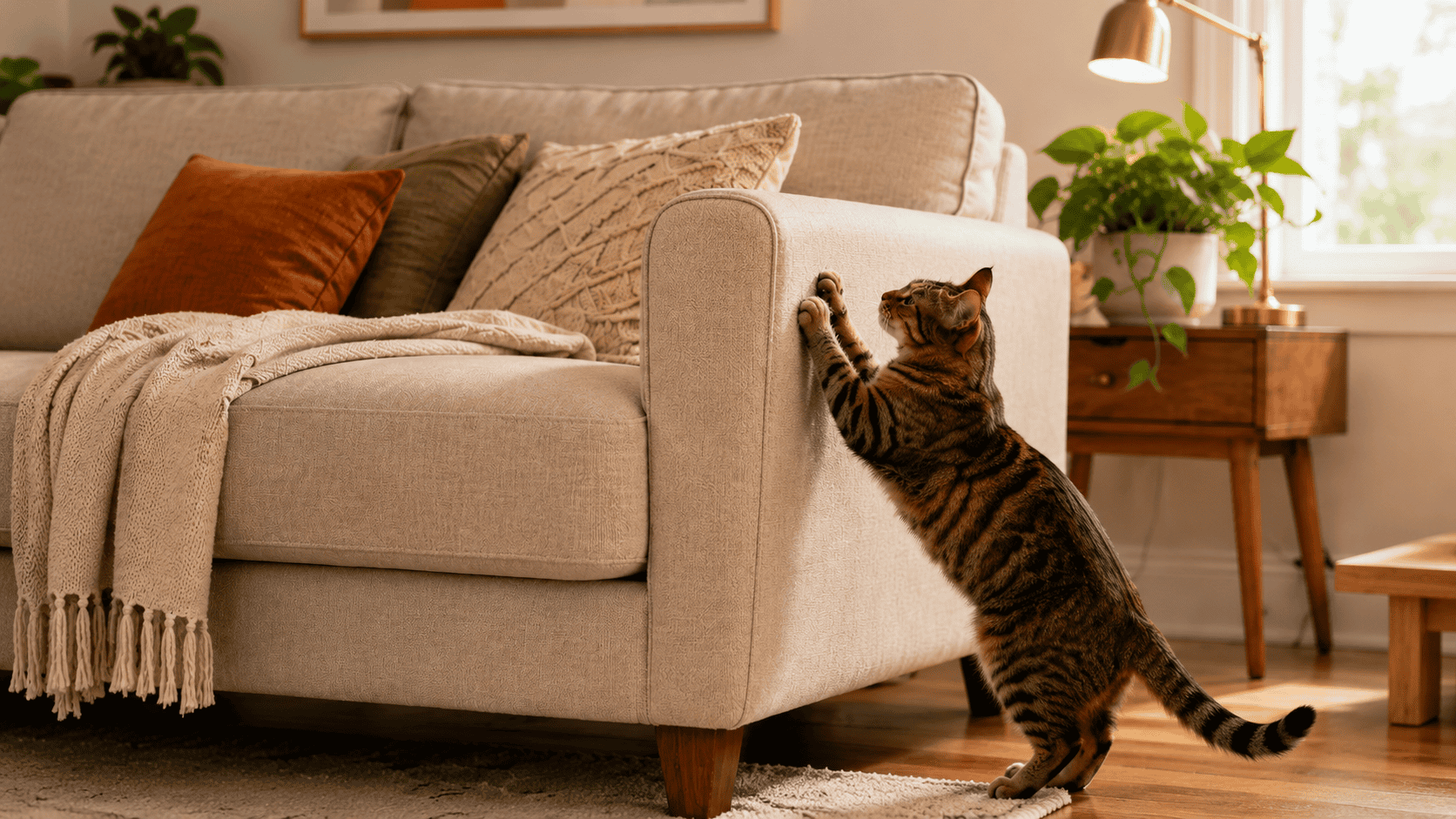
Quick Answer: How Do You Cat-Proof a Couch?
To cat-proof a couch, protect the areas your cat already targets using corner guards, couch arm covers, thick covers, or double-sided furniture tape. Then place a sturdy scratching post or pad directly beside those spots — in a texture your cat actually wants to use. Trim your cat’s claws regularly to reduce damage, and consider nail caps for persistent scratchers if your cat tolerates them. Use cat-safe deterrents or temporary texture barriers, such as furniture tape or foil, to make the couch less appealing while you redirect the habit. Reward your cat every time it uses the scratcher instead. If you’re buying new furniture, choose a smooth, tight-weave fabric that claws can’t hook into easily. No single method does the job alone — the combination of protection, redirection, and consistency is what actually works.
You bought the couch for humans. Your cat looked at it and saw a luxury scratching station.
It starts small — a few pulls at the armrest, one corner that looks a bit rough. Then you catch it in full stretch, claws deep in the fabric, and you realise the couch you just paid for is already being remodelled. It’s one of the most common furniture frustrations cat owners deal with, and one that most standard advice handles badly.
Here’s the honest version: you can’t stop your cat from scratching — scratching is a biological need, not a character flaw — but you can make your couch far less appealing, protect the spots that matter most, and give your cat something it genuinely prefers to use instead. This guide covers why cats choose the couch in the first place, why the scratching post you already own might be failing, which protection products help (and which ones have real limits), and how to handle the trickier situations — the cat that scratches at night, the new couch you’re determined to protect from day one.
Scratching is instinct, not spite. The goal isn’t to suppress it — it’s to redirect it, protect the right spots, and make the better option obvious to your cat.
Table of Contents
Why Cats Scratch the Couch in the First Place
Scratching isn’t misbehaviour. It’s a built-in feline need that serves several purposes at once. [1][2]
- Claw maintenance: Scratching strips away the outer sheath of the claw, exposing the sharper layer underneath. It’s not sharpening so much as renewal.
- Scent and territory marking: Cats have scent glands between their paw pads. Every scratch deposits their scent invisibly and leaves a visible mark — both signals that say “this is mine.”
- Full-body stretching: When a cat scratches vertically, it’s extending its spine and working its shoulder and back muscles. The couch arm, at exactly the right height, offers a better stretch than most scratching posts do.
- Emotional expression: Cats scratch more when they’re excited, anxious, or marking familiar territory. A cat that scratches when you come home is often communicating, not misbehaving.
Understanding these functions matters because it changes the solution. You’re not trying to stop a bad behaviour — you’re trying to offer a better surface for a behaviour that will happen regardless. [1][2]
Why Cats Always Go for the Couch Corners and Arms First
Cats don’t damage couches randomly. They tend to fixate on corners, armrests, and seams for specific reasons: these spots are structurally stable (important for a good scratch), often near pathways or resting spots, at the right height for a full stretch, and already carry the cat’s scent from rubbing and contact. Once a cat has scratched a spot once, the scent marker draws it back. The habit forms quickly.
This is also why moving the couch to a different wall rarely solves the problem — the cat has already claimed it.
Why Your Cat Scratches the Couch Even With a Scratching Post
This is the section most cat owners actually need. The advice “buy a scratching post” is not wrong — it’s just incomplete. Many cats that have scratching posts still choose the couch, and there are usually specific, fixable reasons why. [1][2]
- The post is too short. A scratching post needs to be at least as tall as your cat at full vertical stretch — typically 90–100 cm / around 3 feet. Most budget posts fall well short of this. A cat that can’t get a full stretch from the post will keep going back to the couch arm, which can.
- The post wobbles. Cats lean hard on scratching posts. If it rocks, they lose trust in it. One bad wobble and many cats write off that post permanently.
- The texture is wrong for your cat. Sisal is the most widely recommended material — and many cats love it — but some prefer cardboard, carpet, or even bare wood. If your cat consistently ignores a sisal post and scratches a fabric couch, it may simply prefer soft fabric resistance over rope. [1][2]
- The angle is wrong. Some cats are horizontal scratchers by preference — they like to stretch along the floor, not up a post. If your cat goes for the base of the couch or scratches flat surfaces, a floor-level cardboard pad or angled scratcher may be what it actually needs.
- The post is in the wrong room. A scratching post tucked in a spare bedroom or utility corner won’t compete with a couch in the living room. Posts need to be in the spaces cats actually use — prominent, visible, socially significant. [2][3]
- The couch already smells like your cat. Every scratch deposits scent. Once the couch has become a familiar scent-marked territory, it’s a stronger pull than a neutral new post. This is why the post needs to go next to the couch, not in a different spot.
- There was no reward for using the scratcher. Cats don’t inherently understand that using the post is “correct.” Positive reinforcement — treats, praise, play immediately after use — teaches that association quickly.
The fix is rarely “get a better scratching post.” It’s usually about matching the post to what your cat is already showing you it likes, and placing it where the problem actually happens.
The Couch Areas Cats Usually Target First
Knowing where cats tend to focus helps you protect before damage spreads. The most common targets:
- Armrests and upper corners — sturdy, vertical, at full-stretch height
- Front-facing side panels — visible from the room; good for territorial marking
- Seams and edges — texturally satisfying; claws catch and tear more easily
- The area closest to where you sit — your scent is concentrated here; cats often scratch near what smells most like their home
- Spots near entry points or their sleeping area — high-traffic zones they feel ownership over
If your cat is scratching throughout the home — near windows, doorways, multiple walls — it may be experiencing stress or insecurity rather than a simple scratching habit. That’s worth addressing differently, and a vet or feline behaviourist can help. [3]
How to Protect Your Couch Right Now
If damage is happening today, the first step is immediate physical protection of the spots your cat is already using — not a whole-room overhaul. Cover the target areas before worrying about anything else.
- Clear couch corner guards: Transparent scratch-deterrent panels that attach to armrests and corners. Discreet and effective for the exact spots cats target most.
- Thick washable covers or throws: Draped over high-risk areas, these create a physical barrier and protect the fabric underneath. Choose smooth, tightly woven fabric — avoid loose throws that cats can still hook into. [6][7]
- Couch arm covers: Fitted covers for armrests specifically. Better than a loose throw for the areas cats scratch most consistently.
- Double-sided furniture tape: Applied to the surface your cat scratches, the sticky texture discourages contact. Use tape made for furniture specifically; regular double-sided tape leaves residue. It’s a temporary deterrent, not a permanent fix.
- Aluminium foil: Unglamorous but effective for some cats. The texture and sound are off-putting. Not a long-term solution, but useful to break an active habit.
Important: protection alone won’t solve the problem. Any deterrent you use on the couch needs to be paired with a better option directly beside it. You’re redirecting the behavior, not just blocking it.
Do Cat-Proof Couch Covers Actually Work?
They help — with conditions. Couch covers are good at protecting against fur, light scratching, and spills. A thick quilted slipcover can absorb some claw contact. But a determined scratcher will scratch through a thin blanket-style cover without much effort, and loose-weave throws can actually give claws something to hook into.
For cats that scratch hard and repeatedly, targeted corner guards or arm covers do more than a full slipcover, because they protect exactly where the damage happens. The most effective setup for serious scratchers: targeted couch arm protectors or clear guards on the damage spots, combined with a sturdy scratcher right beside them.
Put the Scratching Post Where the Damage Happens
This is the single most important change most cat owners haven’t made.
The scratching post should be placed directly beside — ideally touching or overlapping — the spot your cat is already scratching. Not across the room. Not in a tidier corner of the living room. Right there, next to the arm of the couch that’s already roughed up.
Cornell University’s feline health guidance is specific on this: redirect scratching by placing the post next to the area the cat already targets. Once the cat is consistently using the post, it can be moved gradually — but only after the habit is formed, and only a few inches at a time. [2]
A scratching post in the right location often outperforms a better scratching post in the wrong one.
Match the Scratcher to What Your Cat Already Likes
Watch how and where your cat scratches. That observation tells you exactly what to buy.
- Scratches vertically, pulls downward: A tall sisal post at full-stretch height. At least 90 cm / 3 feet, wide stable base.
- Scratches along the floor or base of furniture: A flat horizontal cardboard scratcher or sisal mat. Some cats simply prefer to scratch low.
- Goes for fabric/upholstery texture specifically: Try a fabric-covered angled scratcher, or one with a carpet surface.
- Scratches in multiple styles: Offer both a tall post and a flat pad. Cats can have more than one preference, and more options means fewer reasons to revisit the couch.
The best scratcher is not the one that looks nicest in the room. It’s the one your cat actually uses. [1][2]
Couch Covers, Guards, Tape, and Sprays: What Actually Works?
No single product is a complete solution. Here’s an honest comparison:
| Protection Method | What It Does Well | Its Limits |
|---|---|---|
| Couch covers / slipcovers | Good for fur, spills, light scratching. Washable. | Won't stop a determined scratcher. Fit matters a lot. |
| Clear corner guards | Target the exact spots cats damage most. Discreet. | Only covers corners and arms — not the whole couch. |
| Double-sided furniture tape | Effective short-term deterrent on specific spots. | Leaves residue. Cats may adapt after a few weeks. |
| Cat scratch sprays (citrus/deterrent) | Can discourage light scratching on treated areas. | Unreliable on their own. Results vary cat by cat. |
| Nail caps (Soft Paws) | Prevent damage while cat still scratches naturally. | Reapplication every 4–6 weeks. Not all cats tolerate them. |
| Regular nail trims | Reduces damage significantly. Easy and free. | Doesn't stop scratching — just limits the impact. |
The most effective approach combines two or three of these: protect the couch physically, offer a good scratcher directly beside it, and reinforce correct use consistently. Think of each product as one vote in your favour — none of them wins the election alone.
Best Couch Material for Cats That Scratch
No fabric is truly cat-proof. But some are significantly better than others at surviving cats — either because claws can’t hook in easily, or because damage is less visible or easier to repair.
| Material | Why It Can Help | What to Know |
|---|---|---|
| Microfiber | Tight weave; claws can't hook in easily. Easy to clean. Good for fur. | Can pill over time. Not immune to a determined scratcher. |
| Tight-weave fabric (polyester, canvas) | Less satisfying to claw than loose or nubby weaves. Durable. | Varies by weave density. Always check before buying. |
| Velvet / velvet-style | Surprisingly resistant for many cats; claws don't hook as well. | Some cats will still scratch it. Not truly cat-proof. |
| Leather / faux leather | Easy to wipe clean. Cats often can't get a good grip. | Claws can puncture or score it. Marks show clearly. |
| Removable slipcovers | Washable; replaceable if damaged. Flexible option. | Fit varies. Some cats scratch the slipcover too. |
| Loose weave, bouclé, tweed, chenille | None — avoid these. | Claws hook easily into loops and fibres. High-risk choice. |
The honest summary: smooth, tight-weave fabrics are harder for cats to damage because there’s less for claws to catch. Loose, looped, or heavily textured fabrics are the riskiest. Basically, if your cat can hook a claw into it, your couch is already negotiating from a weak position. If you’re buying new furniture and live with an active scratcher, this is the most important decision you can make before the damage starts. [6][7]
How to Protect a New Couch Before Your Cat Claims It
The best time to establish scratching habits is before a new couch arrives, not after the damage has started. Cats form scratching preferences quickly, and a freshly scented piece of new furniture is unusually appealing.
- Set up scratching posts beside where the new couch will sit before it arrives, or on the same day
- Apply corner guards or arm covers to the highest-risk spots from the start
- Rub a little catnip onto the scratching post to draw your cat toward it in the first week
- Use throws or couch covers on the arms during the first few weeks as a habit forms
- Reward any use of the scratcher with immediate treats or praise — build the association early
The window when a cat is forming new habits is much easier to work with than the one where you’re trying to break an established routine. Protecting from day one costs far less effort than reversing weeks of damage.
How to Stop Cats From Scratching the Couch at Night
Night scratching usually comes down to a few things: excess energy that didn’t get burned off during the day, nocturnal activity, a routine the cat has learned (scratching at a certain time reliably gets a response), or — in some cases — habit around early morning feeding. Recent research also links higher undesired scratching with playfulness and nocturnal activity. [4] None of these require a dramatic fix, just a consistent one.
- Play before bed: A 10–15 minute interactive play session in the evening burns off energy and reduces the drive to scratch for stimulation overnight. Wand toys, laser pointers, and chase toys work well.
- Don’t react: If your cat scratches and you get up, talk to it, feed it, or shoo it away, you’ve just taught it that couch scratching at 3am produces results. Silence and consistency matter here more than any product.
- Make the couch less accessible overnight: A couch cover, tape on the arm, or even a lightweight furniture protector on the high-risk corner can reduce success and therefore motivation.
- Provide overnight scratching options: A scratcher near the cat’s sleeping area means there’s an appropriate outlet available when the urge strikes at night.
- Adjust feeding schedule if relevant: Some cats scratch to wake their owner before early morning feeding. Shifting dinner slightly later, or using an automatic feeder, can break this cycle
Is Your Cat Scratching the Couch — or Training You?
Cats are good at learning what works. If scratching the couch reliably produces attention — even negative attention — some cats will keep doing it because attention is the goal, not the scratch.
Cats Protection notes that some cats learn couch scratching specifically because it gets a reaction from their owner. [3] The recommended response is to ignore the scratching entirely and reward the cat only when it uses the appropriate scratcher. Any reaction to couch scratching, including scolding, can reinforce the behaviour.
If your cat makes eye contact with you while scratching — or only does it when you’re in the room — this is likely what’s happening. The fix is removing the reward: no reaction to couch scratching, consistent reward for scratcher use.
What Not to Do When Your Cat Scratches the Couch
- Don’t yell or scold: Verbal punishment doesn’t teach a cat what to do instead. It can make the cat anxious, and anxious cats often scratch more. [2][4]
- Don’t spray water: Water spray can teach a cat to avoid scratching when you’re present — which just means it scratches when you’re not. It doesn’t address the cause.
- Don’t hide the scratching post: A scratcher in the spare room is not a solution. It needs to be where the cat spends time.
- Don’t rely on sprays alone: Scent deterrents vary enormously in effectiveness. Some cats ignore them entirely. They’re useful as part of a strategy, not as a standalone fix.
- Don’t declaw: The AVMA strongly discourages elective declawing. It’s not a nail trim — it’s the surgical removal of the last joint of each toe, and it can cause chronic pain and lasting behaviour changes. There are better options. [5]
- Don’t expect one product to fix everything: Cat-proofing a couch is a system: deterrent + alternative + reinforcement. One element alone rarely holds.
A Simple 7-Day Couch Protection Plan
This is a practical starting point, not a strict protocol. Adjust based on your cat’s response.
| Day | Focus | What to Do |
|---|---|---|
| Day 1 | Identify the exact damage spots | Walk around your home. Note which arm, corner, seam, or panel your cat returns to. This is your target zone. |
| Day 2 | Protect those areas now | Apply clear corner guards, double-sided furniture tape, or a thick throw over the high-risk spots immediately. |
| Day 3 | Place a scratcher beside the damage | Don't move it to the spare room. Put it directly next to — or in front of — the spot your cat already scratches. |
| Day 4 | Test a different texture or angle | If sisal isn't working, try a flat cardboard scratcher or an angled pad. Match what the couch offers: texture, resistance, height. |
| Day 5 | Reward every correct scratch | Treats, praise, or a brief play session the moment your cat uses the scratcher. Timing matters more than effort. |
| Day 6 | Stop reacting to couch scratching | No yelling, no water spray, no chasing. Any reaction — even a negative one — can teach a cat that couch scratching gets results. |
| Day 7 | Review and adjust | Keep what's working. If the post is being ignored, reposition it. If tape helped, leave it in place for another week. |
By day seven, you should have a clearer picture of what your cat responds to. Most cats show meaningful improvement within two to three weeks if all three elements — deterrent, alternative, reward — are consistently in place
The Real Secret to Cat-Proof Your Couch
Cat-proofing a couch isn’t a one-and-done fix — it’s a system, and it works best when all three parts are in place at once: protect the damage spots, offer something better right beside them, and reward the right choice consistently.
Most of the advice that fails does so because it addresses only one of those three. Tape without a scratcher just moves the problem. A scratcher without deterrents on the couch competes on unequal terms. Deterrents and scratchers without reinforcement rely on luck.
The 7-day plan in this guide gives you a starting framework, but your cat will tell you what’s working faster than any schedule will. A cat that starts reliably using the scratcher by week two is a cat whose scratching habit has already shifted. Keep the scratcher in place even after the behaviour improves — removing it is the most common reason the couch scratching comes back.
The couch and the cat can coexist. It just takes a strategy that respects what your cat actually needs, rather than one that tries to talk it out of being a cat.
Frequently Asked Questions
How do I stop my cat from scratching the couch?
The most effective approach combines three things: protecting the specific spots your cat targets (with corner guards, tape, or a cover), placing a scratching post directly beside those spots, and rewarding every correct use of the scratcher with treats or praise. No single product or method works well in isolation — the combination is what creates lasting change. How long it takes depends on your cat’s age, how established the habit is, and how well the scratcher matches what your cat actually likes to scratch.
Why does my cat scratch the couch even with a scratching post?
Usually because the post doesn’t match what the couch offers. Common reasons: the post is too short for a full stretch, it wobbles, the texture is wrong for your cat’s preference, it’s in the wrong room, or the couch already carries your cat’s scent as a territory marker. Try moving the post directly beside the damaged couch area, and test a different material (cardboard, carpet, angled scratcher) if sisal isn’t working. The ASPCA recommends offering multiple surfaces and textures because cats have individual preferences. [1]
What is the best couch material for cats?
Microfiber and other tight-weave fabrics are generally the most cat-resistant because claws can’t hook into the surface easily. Velvet-style fabrics also hold up reasonably well for many cats. Leather and faux leather are easy to wipe clean, but claws can score the surface. Loose-weave fabrics — bouclé, chenille, tweed — are the highest-risk choices because loops and fibres catch claws easily. No fabric is truly cat-proof; the material choice reduces damage but doesn’t eliminate the need for scratchers and other deterrents. [6][7]
Do cat-proof couch covers really work?
They help, with caveats. Couch covers do a good job protecting against fur, spills, and light scratching. A thick quilted cover adds a layer of physical protection. But a determined scratcher can work through a thin or loose cover, and some covers actually give cats something to hook into. For serious scratchers, targeted corner guards or arm covers on the specific damage spots tend to work better than a full slipcover. The most effective setup pairs physical protection of the damage area with a better scratching option immediately beside it.
Does double-sided tape stop cats from scratching furniture?
It can reduce scratching on the treated area, at least initially. Cats dislike the sticky sensation on their paws, and most will avoid a surface covered in furniture tape. The limitation is that it’s a deterrent, not a solution — without a good scratcher placed directly beside the couch, the cat usually moves to a different spot. Some cats also habituate to the tape over time. Use furniture-specific tape to avoid leaving residue, and treat it as one part of a broader strategy rather than a standalone fix.
How do I protect a new couch from cats?
Start before the couch arrives if you can. Set up scratching posts in the spots where the couch will sit, apply corner protectors to the arms from day one, and reward any use of the scratcher immediately. The first few weeks are when your cat is forming new habits — it’s much easier to establish the scratcher as the preferred option before the couch has been claimed than after. Throws or arm covers during this initial period add physical protection while the habit forms.
How do I stop my cat from scratching the couch at night?
Night scratching is usually driven by energy, boredom, routine, or — if it happens just before morning feeding — hunger. An interactive play session before bed helps burn off energy. Making the couch less accessible overnight (tape, cover, or a light barrier on the arm) removes the easy option. Most importantly: don’t react when the scratching happens, because any response can teach the cat that this behaviour gets results. A scratcher placed near the cat’s sleeping area gives it an appropriate option if the urge strikes overnight. [3][4]
Should I trim my cat’s claws to protect my couch?
Yes, but it’s one part of the solution, not the whole answer. Regular claw trimming — every two to three weeks — reduces the damage each scratch causes, which buys time and protects fabric while you work on redirecting the behaviour. Trimmed claws don’t eliminate scratching; cats still need and want to scratch. Nail caps (like Soft Paws) are another option that reduce damage while allowing the cat to scratch naturally, though they require reapplication every four to six weeks.
Is leather or fabric better for cats?
Both have tradeoffs. Leather and faux leather are easy to wipe clean and offer less grip for claws — many cats find the surface less satisfying to scratch. But claws can score or puncture leather, and those marks are often very visible. Fabric in a tight weave (microfiber, polyester canvas) is generally less likely to be scratched aggressively than loose-weave or textured fabric, and minor snags are less noticeable. Ultimately, neither is cat-proof — the choice of material should be considered alongside scratchers, deterrents, and your individual cat’s habits.
Can I completely cat-proof a couch?
Not completely, no. Scratching is a biological need and it won’t be eliminated — the goal is redirection, not prevention. What you can achieve is a couch that sustains very little damage because your cat has a preferred scratching outlet it uses reliably. That’s a realistic outcome with consistent effort, the right scratcher, and physical protection on the high-risk spots. Most cat owners who succeed at this don’t have a cat that stopped scratching — they have a cat that scratches the post instead.
Sources
[1] ASPCA — Destructive Scratching
[2] Cornell Feline Health Center — Feline Behavior Problems: Destructive Behavior
[3] Cats Protection — Why Do Cats Scratch?
[4] Salgirli Demirbas YS et al. — Evaluating undesired scratching in domestic cats: a multifactorial approach to understand risk factors
[5] AVMA — Declawing of Domestic Cats
[6] Architectural Digest — This Might Just Stop Your Cat from Scratching Your Sofa to Bits
[7] Better Homes & Gardens — 5 Pet-Friendly Fabrics to Shield Furniture from Stains and Scratches