;

How to Cat-Proof Your Kitchen: Counters, Cabinets, Trash, and Safety Tips

cat siiting on a stove counter in the kitchen

Quick Answer
To cat-proof your kitchen, remove the rewards that draw cats to counters, lock away toxic foods and cleaners, keep trash securely covered, block access to hot stoves, manage appliance cords, rinse sinks after cooking, and give your cat a safe elevated perch away from food prep areas. The goal isn’t a daily shouting match over the counter. It’s making the counter boring, the dangerous spots harder to reach, and the safe alternatives genuinely worthwhile.

There is a special kind of confidence cats have in the kitchen.

You can be mid-chop, pasta boiling, back turned for three seconds — and suddenly your cat is there. Not watching politely from the doorway. On the counter. Looking at you like you’re the unreasonable one for being surprised.

That’s why learning how to cat-proof your kitchen isn’t really about paw prints near the cutting board. It’s about making one of the most tempting rooms in the house safer for a creature who treats every elevated surface like a throne, every crinkly wrapper like a toy, and every unattended plate like an open invitation.

The kitchen is full of things cats love: warmth, smells, movement, running water, the interesting contents of your cabinets, and your undivided attention. Unfortunately, it’s also full of things that can hurt them — hot stoves, sharp knives, toxic foods, cleaning products, covered trash they’re determined to uncover, appliance cords, and tiny objects that fit neatly in a cat’s mouth.

This isn’t about turning your kitchen into a sterile, cat-free zone. It’s about making the dangerous spots harder to reach, the risky stuff harder to access, and the counter itself genuinely less interesting than whatever safer option you’ve given your cat instead.

That’s a very achievable goal. Here’s how to get there.

Why Cats Are So Obsessed With the Kitchen


cat-proof your kitchenCats don’t jump onto kitchen counters because they’re plotting against your dinner. (Mostly.)

They jump up because kitchens offer height, warmth, food smells, activity, and proximity to whatever their human is doing. Cats gravitate toward elevated spots naturally — height gives them a better view of the room and a sense of control over their environment. A counter also puts them at nose level with food smells, running water, and your hands. That combination is genuinely irresistible to a curious cat.

And then there’s the attention factor. Even negative attention counts. “Get down. No. Down. I said down.” That’s still interaction, and interaction is rewarding.

This is why keeping cats off kitchen counters isn’t a one-trick problem. Some cat owners report trying foil, double-sided tape, air deterrents, spotless counters, and still watching the cat return after a few days. The counter isn’t just one problem — it’s a whole reward system: food, height, warmth, curiosity, and the reliable appearance of a very annoyed human. The fix has to be a system too.

The Real Issue Isn’t Just Cats on Kitchen Counters

A cat on the counter is annoying. A cat on the counter next to a hot stove, an uncovered knife, a garlic sauce, raw dough, open dish soap, or a trash bag they’ve figured out how to open is the real problem.

Kitchen safety for cats starts before the counter argument. Some owners eventually make peace with the fact that their cat will sneak onto a surface when no one’s watching. That’s not defeat — it’s realism. A safer kitchen assumes your cat might get curious at the worst possible moment and has already removed the things that could turn that moment into an emergency.

Because cats don’t need a long window. They need one bite, one lick, one paw on a hot burner, one rubber band, one scrap of string from the trash. That’s the whole reason to cat-proof your kitchen properly — not to win the counter battle, but to make sure curiosity doesn’t end in a vet visit.

How to Cat-Proof Your Kitchen: The Complete Guide

1. Remove the Rewards That Make Counters Worth Visiting

The fastest way to make a counter interesting is to leave something interesting on it.

Crumbs. A smear of butter. Chicken scraps. A plate “just for a minute.” A treat bag left out. A cutting board with meat residue. A plastic wrapper that makes a perfect crinkly sound. Your cat doesn’t see clutter — your cat sees opportunity.

If the counter occasionally pays off, your cat will keep checking it. That’s not a character flaw. It’s just how reward-based behaviour works.

So the first part of cat-proofing your kitchen is boring but powerful: stop letting the counter reward them. Wipe food residue after cooking. Put leftovers away immediately. Don’t leave plates out. Keep bread, treats, and snacks in sealed cabinets or containers. Wash pans where your cat can’t investigate the smell. Don’t leave scraps in the sink.

Most importantly: never feed your cat from the counter. Not even once. If your cat gets one exciting result from that surface, the counter has become a vending machine — one that might not pay out every time, but that your cat is happy to keep trying. Removing food rewards is usually more effective than any deterrent you can buy.

2. Give Your Cat a Better Place to Watch You

A lot of counter-surfing isn’t about the food at all. It’s about the view. Cats want to watch what you’re doing. They want to supervise the chopping, assess the smells, judge your cooking choices, and act as though your entire kitchen routine requires feline oversight.

So give them a legal viewing spot. A cat tree near the kitchen entrance. A stool in a safe corner. A wall shelf positioned away from heat sources. A window perch. A small mat on the floor where they reliably get treats when they stay there while you cook.

Placement matters. Don’t put the perch next to the stove, right beside the prep counter, or anywhere that makes it basically a launchpad to the surface you’re protecting. Give your cat height, but give it to them away from the heat, the knives, and the food.

The Anti-Cruelty Society recommends removing food rewards and making off-limit surfaces unattractive, and suggests pet-safe deterrents such as double-sided tape or motion-activated devices when needed [5]. But any deterrent works better when your cat also has somewhere genuinely appealing to go. “No” is clearest when there’s a “yes” right nearby.

3. Cats and Hot Stoves: Why the Stove Is the Strictest No-Go Area
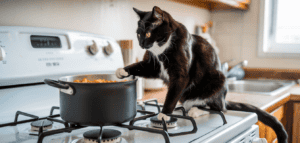
cat siiting on a stove counter in the kitchenThe stove is the strictest no-go area in the kitchen — not because we’re being dramatic, but because a wrong jump can hurt a cat within seconds.

Gas flames, boiling water, splattering oil, hot electric burners, and glass cooktops that stay warm long after you’ve turned them off all create real risk. Cat owners accounts of kittens burning paws on electric stoves, cats stepping on touch-sensitive controls while owners were out of the room, and the specific anxiety of a young cat who doesn’t yet understand that warm doesn’t mean safe.

When cooking, keep your cat out of the kitchen if you can. Close the door, use a baby gate, or redirect them with a treat puzzle or play session in another room before you start. Turn pan handles inward. Use back burners when possible. Let burners cool fully before you leave. For induction or glass cooktops, check whether there’s a control lock feature — cats stepping on touch panels is a real concern and worth addressing.

The stove is not a “we’ll see how it goes” zone. It’s the place for barriers, supervision, and no food smells left behind as an invitation.

4. Store Toxic Foods Before Curiosity Gets Involved

Kitchens contain a lot of foods that are safe for people and genuinely dangerous for cats.

The ASPCA’s Animal Poison Control Center lists several foods to avoid letting pets access, including chocolate, caffeine, alcohol, grapes, raisins, onion, garlic, xylitol, and raw yeast dough — and recommends contacting a veterinarian or poison control immediately if you suspect your pet has eaten something harmful [1]. Cornell Feline Health Center’s common cat hazards guide also covers toxic household foods and the warning signs of poisoning [2].

In a kitchen, the exposure is rarely a full meal. It’s a lick of sauce made with onion. A raisin that fell off the counter. A chocolate crumb. A bit of raw bread dough. A coffee cup left close to the edge. Put ingredients away as you cook. Clear plates quickly. Keep pantry doors shut. Store chocolate, sweetened products, and anything with onion or garlic in sealed cabinets or the fridge. Don’t assume packaging will stop a determined cat — some of them are extremely motivated.

Some cats ignore human food entirely. Others act as though they’ve been personally appointed to quality-check every meal. Cat-proof your kitchen for the second kind.

5. How to Cat-Proof a Kitchen Trash Can (Before Your Cat Does It for You)

Kitchen trash is revolting to us. To a cat, it’s a cabinet with upgraded smells.

Food scraps, bones, wrappers, string, plastic packaging, coffee grounds, meat trays, twist ties, and tin can lids all end up in there. The risks range from choking and intestinal obstruction to cuts, toxic ingestion, and access to small objects that look exactly like toys. Cat owners describe cats tipping lightweight bins, prying up lids, and learning to fish things out through gaps. The solution is physical, not conversational.

Use a bin with a tight-fitting or locking lid. Choose something heavy enough not to tip. If your cat is persistent and creative, keep the bin inside a lower cabinet with a childproof latch. Empty strong-smelling scraps quickly — don’t let the bin sit as an overnight invitation. And watch the small stuff that doesn’t make it into the bin: twist ties, rubber bands, bread clips, and plastic film all look like excellent toys from a cat’s perspective.

A cat-safe kitchen is often just a kitchen where the gross, risky stuff isn’t reachable. Not glamorous. Very effective.

6. Cat-Safe Kitchen Cleaning: What to Use and How

Cleaning products create a hidden risk that’s easy to overlook because cats don’t drink from spray bottles. They walk on surfaces and lick their paws. Cat-safe kitchen cleaning isn’t about avoiding all products — it’s about knowing which ones need extra care and how to use them without leaving residue your cat will pick up later.

VCA Hospitals explains that common household cleaners — including kitchen and bathroom surface cleaners — can be toxic to cats, with effects ranging from stomach upset to chemical burns, respiratory signs, or organ damage depending on the product and exposure level [3]. The ASPCA’s poisonous household products guide notes that most cleaning products can be used safely in homes when label directions are followed, but that undiluted bleach and concentrated products can cause injury if ingested, and that pets should be kept out of treated areas until surfaces are dry and the odour has dissipated [4].

You don’t need to fear cleaning your kitchen. You just need to clean with a cat in mind. Keep your cat out of the room while cleaning. Let surfaces dry before your cat returns. Rinse food prep areas after using spray cleaners. Store everything — sprays, detergents, dishwasher tablets, degreasers, disinfectants, floor cleaners — in latched cabinets. Use childproof locks if your cat has learned to open lower cabinet doors (more of them have than you’d expect).

Don’t forget the floor. A cat walking across a freshly mopped surface and then grooming is still getting an indirect dose of whatever was in that mop water. The surface is part of the exposure, not just the bottle

7. Don’t Ignore the Sink

cat looking at some left over food in the kitchen sinkThe sink seems harmless until you look at what’s actually in it.

Food residue. Soapy water. Knives. Forks. Broken glass. Raw meat drippings. Dish soap. Coffee dregs. Small scraps that smell like something worth investigating. Some cats are drawn to sinks because they’re cool and curved and sometimes come with running water. Others are just attracted to the smell. Either way, an open, uncleaned sink can become part water bowl, part hazard zone, part late-night buffet.

Rinse the sink after cooking. Don’t leave sharp knives soaking where a cat can step or bat at them. Deal with broken glass immediately. Keep dirty pans covered or out of reach when they contain anything tempting. Don’t leave standing water with soap or food residue sitting for hours.

If your cat loves the sink because of running water, give them a cat water fountain placed somewhere boring and safe — not on the counter, not beside the stove. Let the sink become uninteresting by giving them the better option elsewhere.

8. Manage Cords, Appliances, and Tiny Objects

Kitchen counters collect small hazards in addition to the obvious ones. Rubber bands. Twist ties. Bread clips. Bottle caps. Plastic tabs from food bags. Foil. Sponge pieces. Any of these can be batted, chewed, or swallowed by a cat who has decided it’s a toy.

Then there are appliance cords. Toasters, blenders, mixers, coffee machines, air fryers, kettles, and any device on a counter that stays plugged in creates chewing and pulling risks. Unplugging appliances when they’re not in use is one of the simplest things you can do. Push cords back out of reach. Use cord covers if your cat is a chewer. Unpack groceries and put away any packaging, twist ties, and small bits before your cat gets curious about what you brought home.

A lot of cat-proofing the kitchen is just cleaning up the tiny stuff before your cat turns it into a hobby.

9. Cat-Proof Kitchen Cabinets Your Cat Has Learned to Open
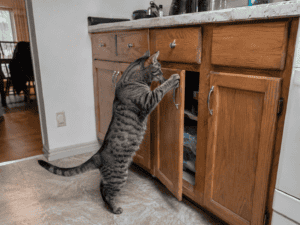
cat opening cabinet in kitchenIf your cat has figured out how to open lower cabinet doors — and plenty of them do — standard cabinet contents become accessible: cleaning products, pantry food, trash bags, and whatever else you store at floor level.

Cat owners with this specific problem describe cats repeatedly getting into lower cupboards and pantry shelves, sometimes returning immediately after being removed. The long-term fix is childproof cabinet locks or roller catch latches. These are inexpensive, widely available, and genuinely effective for most cats. For particularly determined animals, strap locks or magnetic locks are harder to defeat.

The pantry is worth special attention. If your cat can access bulk food, open bags, or anything perishable stored at a low level, you’re dealing with both a food-security issue and a potential toxin exposure. Latched cabinets remove the problem entirely.

10. Be Realistic About Deterrents for Counter Surfing

Foil may help. Double-sided tape may help. Textured mats may help. Motion-activated deterrents may help. None of them are magic.

Consistent feedback from cat owners is that deterrents alone — even combined — rarely stop counter surfing permanently if the underlying reward system is still in place. A cat who finds the counter empty and mildly uncomfortable will often wait it out, then try again. A cat who finds the counter unrewarding, slightly unpleasant, and genuinely less appealing than the cat tree in the corner has more reasons to stay off.

Deterrents work best as part of a broader setup: remove the food reward, add the safe alternative perch, reward the good spot, block the dangerous areas, and apply deterrents only where needed. Stay consistent.

Also: don’t become the only deterrent. If your cat only stays off the counter when you’re standing there, they’ve learned to manage your presence, not to avoid the counter. The kitchen needs to be unrewarding even when you’re not in it.

11. The One Rule That Changes Everything: No Food Rewards Up High
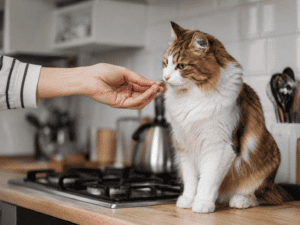
feeding cat on kitchen counterThis is the easiest rule to explain and the hardest to follow.

Don’t feed your cat from the counter. Don’t let them lick plates on the counter. Don’t leave treats on the counter while cooking. Don’t toss a treat to the floor to get them down — this one feels harmless, but what your cat learns is: jump up, human pays me to leave.

You have accidentally created a counter-surfing loyalty programme. It might not pay out every time, but your cat is happy to keep checking.

Instead, reward what you actually want. Treats happen on the floor. On the cat tree. On the stool. On the kitchen mat. Counter equals nothing. Safe spot equals good things. That is the entire message, and it works better than almost anything else.

What to Do If Your Cat Eats Something Dangerous

If your cat eats something toxic or gets into a cleaner, don’t scroll through random advice trying to decide whether it’s serious.

Call your veterinarian, an emergency clinic, or ASPCA Poison Control at (888) 426-4435. The ASPCA’s Animal Poison Control Center advises noting the amount ingested and contacting a professional immediately if you suspect your pet has eaten anything harmful [1]. Cornell’s feline health guidance is equally clear: call your vet immediately, and if unavailable, find an emergency clinic or poison control hotline [2].

Try to identify what your cat ate, how much, and when. Keep the packaging if you have it — photograph the label if it’s a cleaner. Don’t induce vomiting unless a professional tells you to. Don’t give home remedies. Don’t wait for symptoms if the item is known to be dangerous.

Possible signs after a toxic exposure include vomiting, drooling, breathing changes, weakness, tremors, unusual behaviour, burns around the mouth, loss of appetite, or sudden hiding — but symptoms vary depending on the substance. Fast professional guidance is always the right move.

How to Make a Kitchen Safe for Cats: Quick Checklist

If you want a fast reference before cooking, entertaining, or doing a deep clean, here’s everything that matters in one place.

✓ Keep counters free of food scraps, crumbs, dishes, and packaging
✓ Store toxic foods (chocolate, onions, garlic, grapes, xylitol) in sealed cabinets or the fridge
✓ Never feed your cat from the counter — not even once
✓ Give your cat a safe perch away from the stove and prep areas
✓ Keep your cat out of the kitchen while cooking
✓ Use back burners when possible; turn pan handles inward
✓ Let burners cool fully before leaving the kitchen
✓ Lock touch controls if your stove or cooktop has them
✓ Use a covered, heavy trash can or store the bin in a cabinet
✓ Keep cleaners, dishwasher tablets, and sprays in latched cabinets
✓ Rinse and dry the sink after cooking or cleaning
✓ Don’t leave sharp knives soaking where a cat can paw at them
✓ Unplug countertop appliances and manage cords
✓ Clear twist ties, rubber bands, bread clips, and small objects immediately
✓ Save your emergency vet and ASPCA Poison Control numbers (888) 426-4435 somewhere you can find them fast

Final Thoughts

A cat-proof kitchen isn’t built around the fantasy that your cat will suddenly stop being interested in the most interesting room in the house.

They are cats. They will smell the chicken. They will hear the wrapper. They will notice the sink. They will investigate the cabinet you opened for half a second. They will appear on the counter with the calm confidence of someone who co-owns the place.

So the better question isn’t “how do I make my cat stop being curious?” — you won’t. The better question is: “how do I make sure their curiosity doesn’t lead them straight into something dangerous?”

Remove the food rewards. Block access to the stove. Lock away toxic foods and cleaners. Cover the trash. Manage the cords. Keep the sink clear. Give them a legal perch to watch the action from. Then let the kitchen become what it should be.

Not a battlefield. Not a daily argument.

Just a safer room where your cat can still be nosy, dramatic, deeply involved in your cooking process — and a lot less likely to turn dinner prep into an emergency.

Because with cats, peace doesn’t come from expecting them to behave like small reasonable adults. It comes from knowing exactly what they’re like, and setting up the room before they prove you right again

Frequently Asked Questions

Why does my cat jump on the kitchen counter?

Cats jump on counters because counters offer height, food smells, warmth, running water, and proximity to whatever you’re doing. For many cats, the counter also delivers attention — even the annoyed, “get down” kind counts as interaction. If the counter has ever produced a food reward, they’ll keep checking it. The behaviour is logical even when it’s infuriating.

How do I keep cats off kitchen counters?

Start by removing food rewards: wipe counters after cooking, store food away immediately, and never feed your cat from the surface. Then give your cat an appealing alternative — a cat tree, wall shelf, or stool in a safe spot nearby. Deterrents like double-sided tape, textured mats, or motion-activated sprays can help, but they work better when the counter has stopped being rewarding in the first place. Some cats respond quickly; others take a few weeks of consistent effort.

Is it safe for cats to be on kitchen counters?

It’s not ideal, particularly near food prep areas, hot stoves, sharp knives, toxic foods, and cleaning product residue. Even if you can’t prevent your cat from jumping up completely, you can make the kitchen meaningfully safer by removing hazards and cleaning surfaces before food preparation. A clean, food-free counter is a much lower-risk counter.

How do I stop my cat from jumping on the stove?

Treat the stove as a strict no-go zone and act accordingly. Keep your cat out of the kitchen while cooking using a door, gate, or redirect to another room. Use back burners when possible and turn pan handles inward. Let burners cool fully before leaving the room. If your stove has touch controls, check for a control-lock feature. For kittens especially, supervised separation during cooking is worth the effort.

What kitchen foods are toxic to cats?

Risky kitchen foods include chocolate, caffeine, alcohol, grapes, raisins, onions, garlic, xylitol (found in many sweetened products), and raw yeast dough. The ASPCA and Cornell Feline Health Center both list these as substances to keep away from cats [1][2]. Exposure doesn’t always require a full serving — a small amount of something like onion or xylitol can cause serious harm.

Are kitchen cleaning products dangerous for cats?

Some can be, especially when cats walk on recently cleaned surfaces and then groom, inhale fumes in an enclosed space, or access concentrated products. VCA Hospitals and the ASPCA both note that most cleaning products used properly and fully dried before a cat re-enters the area are lower risk — but undiluted bleach, concentrated disinfectants, and essential oil-based products warrant extra caution [3][4]. Store cleaners in latched cabinets and let surfaces dry completely.

How do I keep my cat out of the kitchen trash?

Use a covered, heavy bin that can’t be tipped or pried open easily. For persistent cats, the most reliable solution is keeping the bin inside a latched lower cabinet. Empty strong-smelling scraps regularly rather than letting them accumulate. Watch for small non-food items — twist ties, plastic wrap, string — that can be as hazardous as the food scraps themselves.

My cat keeps opening kitchen cabinets. What do I do?

This is a genuine problem for many cat owners, especially with lower cabinets and pantry doors. Childproof cabinet locks, roller catches, strap locks, or magnetic locks are the most effective solutions — they’re inexpensive and available at any home hardware store. Applying a deterrent spray to cabinet handles can help initially, but physical locks are more reliable for cats who are motivated and persistent.

Do foil and double-sided tape actually keep cats off counters?

They can, for some cats, for a while. Both exploit cats’ preference for comfortable, predictable surfaces. The limitation is that they’re often most effective early and wear off as the cat habituates, and they do nothing if the underlying food rewards are still present. They work best as part of a broader approach: remove the reward, offer a better alternative, apply deterrents, and stay consistent.

Is it safe to use essential oil sprays in the kitchen with cats?

Exercise caution. VCA Hospitals notes that some essential oils, including tea tree oil, can cause poisoning in cats through ingestion or topical exposure, and may lead to serious effects including liver injury [3]. Essential oil diffusers and sprays in small, enclosed spaces like kitchens are worth avoiding if you’re unsure about concentration and your cat’s exposure level.

Sources

  1. ASPCA Animal Poison Control Center —People Foods to Avoid Feeding Your Pets
  2. Cornell Feline Health Center, Cornell University College of Veterinary Medicine —Common Cat Hazards
  3. VCA Animal Hospitals —Household Hazards — Toxic Hazards for Cats
  4. ASPCA Animal Poison Control Center —Poisonous Household Products
  5. The Anti-Cruelty Society —Keeping Cats Off Countertops and Tables