
Male vs Female Siamese Cats: Key Differences in Personality, Size & Temperament

Quick Facts:
Male Siamese cats tend to be more openly affectionate and attention-seeking. Female Siamese cats tend to be slightly more independent, offering warmth on their own terms. Both are vocal, intelligent, and people-oriented — those are breed traits, not gender traits. Neutering or spaying narrows most of the behavioural differences significantly. And individual personality will almost always matter more than gender. Choose based on your lifestyle and what you genuinely want from a cat.
If you’ve spent any time researching Siamese cats, you’ve probably come across a version of this question. It sounds simple. It isn’t. The honest answer is that the differences between a male and female Siamese cat are real — but they’re more subtle than most articles suggest, and they shift considerably once either cat is neutered or spayed.
I’ve spent years around this breed, and what I’ve consistently found is that individual personality tends to matter more than gender. That said, there are genuine tendencies worth understanding before you choose — especially if you have a specific lifestyle in mind. Whether you’re a first-time owner, have young children, work from home, or already have another cat in the house, knowing the typical male vs female Siamese temperament differences can help you make a more informed decision.
Here’s what those differences actually look like, what they mean in practice, and how to decide which is the better fit for your home.
Table of Contents
Male vs Female Siamese Cats: At a Glance
| Trait | Male Siamese (general tendency) | Female Siamese (general tendency) |
|---|---|---|
| Size | Larger, typically 8–12 lbs | Smaller, typically 6–8 lbs |
| Build | Broader, more muscular | Slender, finer features |
| Affection style | Openly demanding, follows you everywhere | Warm but tends to choose her moments |
| Vocality | Often louder and more assertive | Equally expressive, wider range of tones |
| Independence | Lower — dislikes extended time alone | Slightly higher, but still people-oriented |
| Playfulness | Tends to be boisterous and high-energy | Playful but often more measured |
| Territorial behaviour | More pronounced before neutering | Present mainly when in heat, generally milder |
| After neutering/spaying | Calmer; behavioural differences narrow | Calmer; behavioural differences narrow |
| Health watch | Urinary blockage risk; testicular cancer if unneutered | UTI frequency; pyometra/mammary risk if unspayed |
| Lifespan | 12–15 years (influenced more by care than gender) | 12–15 years (influenced more by care than gender) |
Physical Differences: Size, Build, and Facial Features
The physical differences between a male and female Siamese are real but fairly modest. Unless you see them side by side, you might not notice much.
Male vs Female Siamese cats Size
Males tend to be noticeably larger — typically weighing between 8 and 12 lbs with a broader, more muscular frame. Females usually run leaner, between 6 and 8 lbs, with the same long, elegant Siamese build but in a more delicate form. The CFA breed standard describes the Siamese body as long and svelte for both sexes, and that holds across genders. [1]
The size difference is most obvious when you see a male and female from the same litter together. In isolation, a large female and a small male can look nearly identical.
Facial Features
 Males tend to have a broader head with a wider jawline and slightly more prominent features. Females carry the same characteristic Siamese wedge-shaped face, but with finer, more refined lines. It’s a subtle difference — most people unfamiliar with the breed won’t spot it, but it becomes easier to read the more time you spend around both.
Male vs Female Siamese Cats Personality Differences
This is where the comparison actually matters for most people. The physical differences between male and female Siamese cats are minor. The personality tendencies are worth understanding — with the important caveat that these are patterns, not guarantees. Individual cats vary considerably.
Are Male Siamese Cats More Affectionate?
Male Siamese cat personality tends toward the overtly affectionate end of the spectrum. They often want to be with you — not just in the same room, but involved in whatever you’re doing. In my experience, males can tip into demanding fairly quickly. If you’re working and not paying attention, a male Siamese will generally find a way to change that.
Female Siamese cat personality is warm and engaged, but tends to operate on slightly different terms. Females often decide when the interaction happens rather than seeking it constantly. Many owners actually prefer this dynamic — affection that feels chosen rather than insisted upon.
Real-life truth: If you want a cat that will seek you out regardless of what you’re doing, a male Siamese often fits that description. If you’d prefer a cat that initiates contact on its own schedule, a female tends to be the better match. Neither is better — they suit different people.
Are Female Siamese Cats More Independent?
Somewhat, yes — though “independent” is a relative term when applied to any Siamese cat. Female Siamese cats tend to handle solitude marginally better and are somewhat more likely to initiate affection on their own terms rather than in response to yours. But they’re still deeply people-oriented. Neither gender is well-suited to long hours alone without company or enrichment.
Vocality
Both male and female Siamese cats are highly vocal — that’s the breed, not the gender. The CFA describes the Siamese as unsurpassed in communicating with humans, and in practice that means expect noise. [2]
Males often tend to vocalise more loudly and with more insistence. Females are equally expressive but tend toward a wider variety of tones — from quiet chirps to full-volume requests. When a female is in heat, the volume increases sharply and the sound becomes distinctly urgent. If you’re considering an unspayed female, factor that in.
Whether male or female Siamese cats are more vocal overall is hard to say definitively — in my experience, it comes down to individual personality as much as anything else.
Playfulness and Energy
Males often play harder — more boisterous, more likely to initiate rough-and-tumble games, and tending to carry that kitten energy well into adulthood. Females are equally playful but often at a slightly lower intensity. Both genders are intelligent enough that an under-stimulated Siamese will find its own entertainment, and you probably won’t enjoy it.
Handling Time Alone
Male Siamese tend to cope less easily with long periods alone. They form strong bonds and can show signs of anxiety — excessive vocalisation, following you around before you leave, or restless behaviour — when left without company for extended stretches. Females handle solitude slightly better on the whole, though neither gender is suited to being routinely left for most of the day. If that’s your situation, a second cat is worth considering regardless of which gender you choose.
Male vs Female Siamese After Neutering or Spaying
This section matters more than most articles acknowledge. The behavioural differences between male and female Siamese cats are most pronounced in intact animals. Once either cat is neutered or spayed, the gap narrows considerably — and for some traits, it largely disappears.
Neutered Males
An unneutered male Siamese will typically spray, mark territory, and become increasingly driven by the urge to mate as he reaches sexual maturity. The territorial behaviour and aggression that comes with this can be significant. Neutering reduces testosterone and usually produces a noticeably calmer, more settled cat — without changing the core Siamese personality. The warmth and sociability remain; the problematic behaviours largely do not. [3]
Neutering is generally recommended before sexual maturity, typically between 4 and 6 months of age.
Spayed Females
Unspayed female Siamese cats cycle into heat regularly, and the behavioural changes during those periods — persistent vocalisation, restlessness, and attempts to escape — are disruptive enough that most owners don’t live with an unspayed female for long. Spaying eliminates heat cycles and significantly reduces the risk of pyometra and mammary tumours. [3]
After spaying, females typically become more consistent and settled in temperament. The “independent but affectionate” personality that Siamese females are known for tends to come through most clearly after spaying.
The practical takeaway: Most of the sharper behavioural differences between male and female Siamese cats are hormonal rather than fixed. Neuter or spay, and what you’re left with is mostly individual personality — which matters more anyway.
Health Differences: What to Watch For
Shared Health Concerns
Both male and female Siamese are equally prone to the same breed-level health concerns: respiratory conditions including feline asthma, and dental and periodontal disease are among the most commonly seen. [2]
Two genetic conditions are worth knowing about specifically. Progressive retinal atrophy (PRA) is inherited in Siamese cats — the UC Davis Veterinary Genetics Laboratory notes the CEP290 mutation occurs in approximately 33% of Siamese cats tested, making it a meaningful risk in this breed. [6] Amyloidosis, a condition in which abnormal proteins accumulate in the liver and other organs, is an inherited disease seen in Siamese and Oriental Shorthair cats and can be fatal if organ damage progresses. [7] Neither condition is gender-specific. Genetic screening by reputable breeders reduces but does not eliminate both risks.
Gender-Specific Health Issues
In unneutered males, testicular cancer is a genuine risk, along with the injury risk that comes with territorial fighting. Neutering eliminates both. [3]
Unspayed females face a significant risk of pyometra — a potentially life-threatening uterine infection — particularly as they age. Mammary tumours are also more common in unspayed females. Spaying significantly reduces both risks. [3]
Urinary Health: Two Different Risks
It’s worth separating two distinct urinary issues here, because they affect male and female Siamese cats differently.
Female Siamese tend to be more prone to urinary tract infections. This is largely anatomical — a shorter urethra makes it easier for bacteria to reach the bladder. UTIs in females are generally treatable with prompt veterinary attention. [4]
Male cats are less prone to UTIs, but when urinary problems do occur in males, they carry a higher risk of dangerous urethral obstruction. Unlike a straightforward infection, a urethral blockage in a male cat can escalate into a medical emergency quickly and requires urgent veterinary care. [4] [5]
In short: females are more prone to urinary infections; males face a greater risk if a urinary blockage develops. The male blockage scenario is the more time-critical of the two.
Lifespan
Sex alone is generally less influential on lifespan than genetics, indoor living, diet, and consistent veterinary care. Both male and female Siamese typically live between 12 and 15 years, and well-cared-for cats reaching their late teens is not uncommon. Individual health history and circumstances will always vary.
How to Tell If a Siamese Kitten Is Male or Female
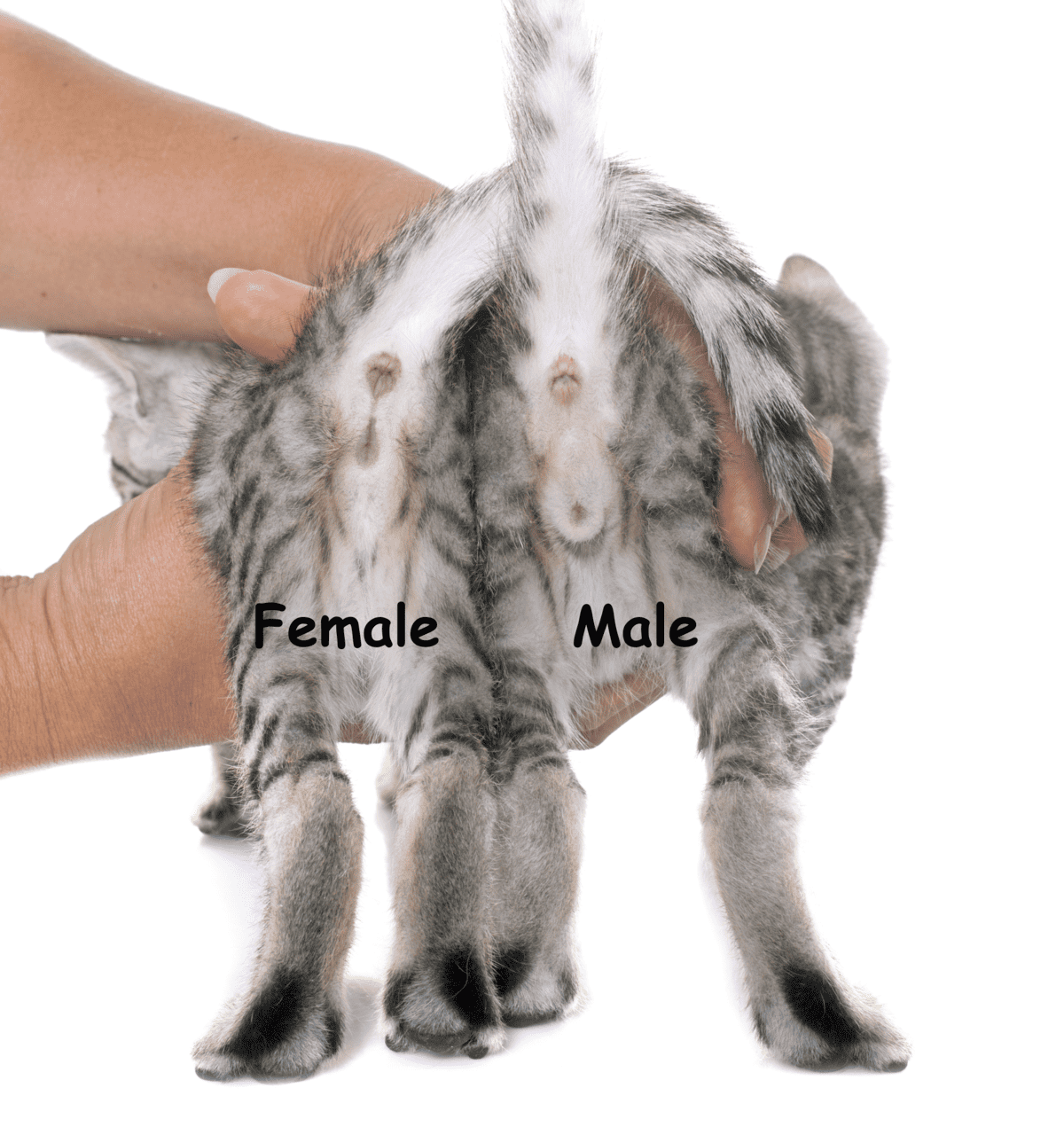 Sexing a young Siamese kitten is genuinely tricky, especially in the first few weeks of life. The most reliable method is examining the distance between the anus and the genital opening.
In males, that gap is noticeably greater — roughly double what you’d see in a female. In females, the two openings are close together, and the genital opening has a vertical, slit-like shape. In males, the opening is rounder, and in kittens old enough, you may be able to feel the testicles positioned between the anus and the genital opening.
If you’re uncertain, your vet can confirm with a quick examination. It’s worth verifying early rather than finding out three months down the line.
Should I Get a Male or Female Siamese Cat?
There’s no universal answer — but there are useful tendencies to consider based on your situation. The table below is a practical guide, not a rulebook. Individual cats vary, and an early introduction and proper socialisation will matter as much as gender in most of these scenarios
| Your situation | Tendency to consider |
|---|---|
| You want maximum affection and don't mind a demanding cat | Male often fits this profile |
| You prefer affection that comes on the cat's own terms | Female often fits this profile |
| You work from home and want constant company | Male tends to seek this more actively |
| You're out for long hours regularly | Either — but seriously consider getting two cats |
| You have young children | Either — individual temperament and early socialisation matter more |
| You already have a male cat at home | A female tends to integrate more smoothly, though not always |
| You already have a female cat at home | A male is often the easier introduction, though not guaranteed |
| First-time cat owner | Either — but go in aware that Siamese are demanding regardless of gender |
| You want a less insistent cat | Neither is quiet, but a female may be marginally less relentless |
| You live in an apartment | Either — both adapt well if given adequate enrichment and company |
Male vs Female Siamese Cat: Pros and Cons
Male Siamese Cat
| Pros | Cons |
|---|---|
| Often openly affectionate, bonds deeply | Can be demanding and clingy |
| Energetic, entertaining companion | Higher-energy play can be overwhelming |
| Tends to be very social with visitors | Handles solitude less easily |
| Warm and consistent once neutered | Unneutered males spray and can be territorial |
Female Siamese Cat
| Pros | Cons |
|---|---|
| Affectionate, often on her own terms | Can seem aloof if you want constant contact |
| Slightly more independent day to day | In-heat behaviour is intense if unspayed |
| Often integrates well with other cats | Can be territorial with other females |
| Warm and settled once spayed | Higher UTI frequency than males |
Choosing Between a Male and Female Siamese
If you want a cat that treats affection as a full-time activity, follows you from room to room, and makes sure you always know it’s there — lean toward a male Siamese. If you’d rather have a cat that’s just as loving but gives you slightly more breathing room and tends to choose its own moments for connection — lean toward a female.
Beyond that: neuter or spay, give your Siamese real stimulation and company, and you’ll have a cat that’s excellent regardless of gender. The Siamese personality — vocal, clever, loyal, and completely people-focused — runs deeper than any gender tendency will.
Final Verdict
After years with this breed, the question I’d actually ask isn’t “male or female” — it’s “what kind of cat owner are you?” A male Siamese will push into your life with cheerful insistence and never really leave. A female Siamese will love you just as much, but with a little more dignity about it.
Either way, you’re getting one of the most personality-rich cats in existence. The gender is a small variable compared to the breed itself. Make sure you’re ready for the Siamese — the demanding, vocal, fiercely loyal version of cat ownership that comes with this territory — and the male vs female question will more or less sort itself out.
Frequently Asked Questions
Are male or female Siamese cats more affectionate?
Male Siamese cats are often more openly and persistently affectionate. Female Siamese cats tend to be equally loving but more selective about timing. After neutering or spaying, this difference narrows. Individual personality will always vary.
Are male Siamese cats more affectionate than female Siamese cats?
In general tendency, yes — males tend to seek out contact more actively and more often. But “more affectionate” depends on what you’re looking for. A female Siamese who chooses to sit with you can feel just as meaningful as a male who’s been following you all day.
Are female Siamese cats more independent?
Somewhat. Female Siamese cats tend to handle time alone a little better and often initiate affection on their own schedule. But independence is relative with this breed — both males and females are people-oriented by nature.
Are male or female Siamese cats more vocal?
Both are very vocal — that’s the Siamese breed. Males tend to vocalise more loudly and insistently. Females have a wider tonal range and can be just as expressive, particularly when in heat. Whether one gender is definitively more vocal than the other often comes down to the individual cat.
What is the difference between male and female Siamese cats in terms of size?
Males typically weigh 8–12 lbs with a broader, more muscular build. Females usually weigh 6–8 lbs with a leaner, finer frame. Both have the same long, elegant Siamese body type — the difference is mainly in scale.
Should I get a male or female Siamese cat?
If you want maximum affection and an openly attentive companion, a male Siamese often fits that description. If you’d prefer a cat that’s warm but slightly more self-directed, a female tends to suit that better. Either way, neuter or spay — it makes both more settled and easier to live with.
Do male and female Siamese cats act differently after neutering or spaying?
Yes, noticeably. Unneutered males tend to spray and can be aggressive. Unspayed females have disruptive heat cycles. Both settle considerably after the procedure, and most of the sharper gender-based differences narrow as a result.
Is a male or female Siamese better for families with children?
Either can work well in a family setting. Males are often more actively engaged and playful, which suits energetic older children. Individual temperament and early socialisation tend to matter more than gender in these situations.
Is a male or female Siamese cat better with other cats?
A male-female pairing tends to integrate most smoothly, though this is a tendency rather than a guarantee. Two neutered males can work well with a careful introduction. Two females can sometimes be more territorial with each other. Early socialisation and proper introduction matter as much as gender.
How do I tell if a Siamese kitten is male or female?
Check the distance between the anus and genital opening. In males it’s roughly double the distance seen in females. The female genital opening is a vertical slit; the male opening is rounder. If you’re unsure, your vet can confirm quickly.
Which Siamese gender is easier for first-time owners?
Either can be a good first Siamese, but go in knowing that this breed is demanding regardless of gender. If you want a slightly lower-intensity introduction, a spayed female is marginally the easier starting point. But the Siamese personality itself is the bigger variable — prepare for that first.
Sources
[1] Cat Fanciers’ Association (CFA) — Siamese Breed Standard
[2] Cat Fanciers’ Association (CFA) — Siamese Breed Profile
[3] Cornell Feline Health Center — Spaying and Neutering
[4] Cornell Feline Health Center — Feline Lower Urinary Tract Disease
[5] American Veterinary Medical Association (AVMA) — Feline Lower Urinary Tract Disease (FLUTD)
[6] UC Davis Veterinary Genetics Laboratory (VGL) — Progressive Retinal Atrophy (PRA rdAc) — Siamese breed information
[7] Merck Veterinary Manual — Amyloidosis in Cats