;

Is My Cat Part Siamese? How to Tell From Looks, Personality, and DNA

Is my cat part Siamese

Quick Answer:
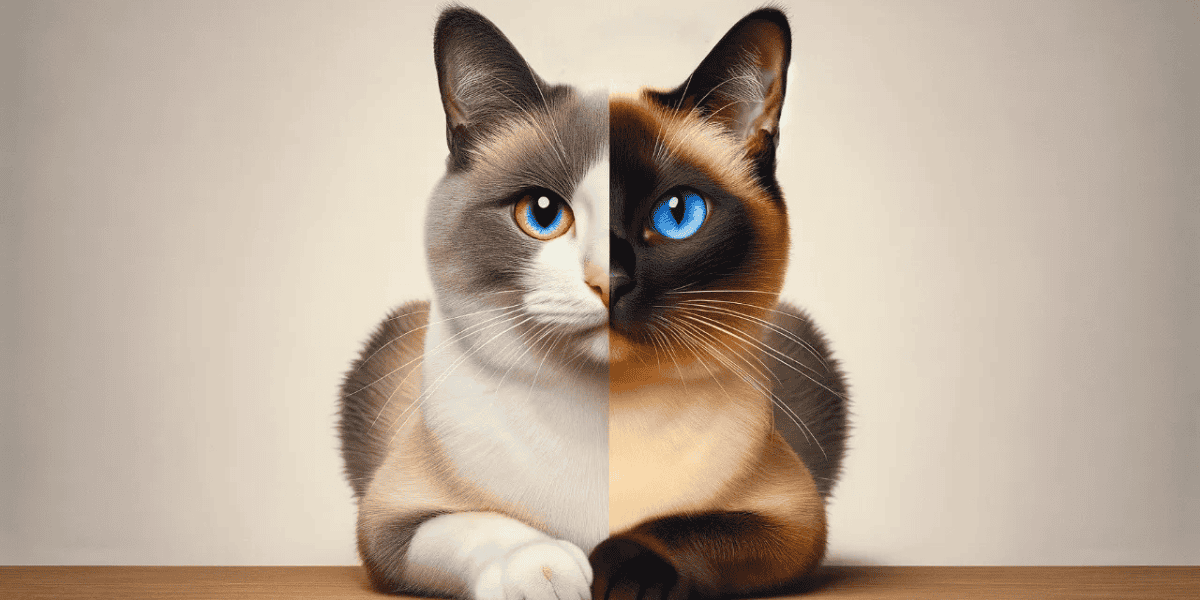
If your cat has color points (darker ears, face, paws, and tail), blue eyes, a lean build, large ears, and a very vocal, people-oriented personality, it may be part Siamese. But color points alone do not prove Siamese ancestry. Many pointed cats have no recent Siamese lineage, so a cat DNA test is the best way to confirm whether your cat is part Siamese.

The first time I really looked at my cat Cleo — I mean really looked — I got suspicious. Bright blue eyes. Dark ears and tail against a pale body. A voice she was entirely too willing to use. I started doing what any curious cat owner would do: I fell down the internet rabbit hole of “is my cat part Siamese?”

I found a lot of articles. Most of them said: look for blue eyes, look for points, look for a vocal personality. Which is fine, as far as it goes. But none of them told me the thing I actually needed to know: that plenty of cats tick every one of those boxes and have no Siamese ancestry whatsoever.

So this is a more honest version of that article. It covers the seven signs that genuinely suggest Siamese heritage — what they mean, what they don’t mean, how they stack up against each other, and what to do if you actually want a definitive answer. Whether you’ve just adopted a rescue cat with a suspicious face, or you’ve been staring at your cat for years wondering, this should give you something more useful than a checklist.

Table of Contents

Is My Cat Part Siamese? Key Facts at a Glance

Is My Cat Part Siamese? At a Glance
Most reliable sign Combination of color points + blue eyes + vocal/clingy personality
Least reliable sign alone Blue eyes (common in many breeds and mixes)
Pointed = Siamese? No — most pointed cats worldwide are not Siamese
Confirm ancestry Cat DNA test (see DNA section below)
DNA test cost Approx. $90–$130 USD
Common Siamese look-alikes Balinese, Tonkinese, Himalayan, Snowshoe, Colorpoint Shorthair

What Is a Siamese Mix Cat, Exactly?

A Siamese mix is a cat with Siamese ancestry somewhere in its lineage — not a purebred Siamese. That might mean one Siamese parent, or a great-great-grandparent who was Siamese, or something in between. The gene pool gets diluted with every generation, which is why Siamese mixes can look dramatically different from each other.

What makes this complicated is that the most recognizable Siamese trait — the pointed coat pattern — is caused by a recessive gene that isn’t exclusive to Siamese cats. According to researchers at the UC Davis Veterinary Genetics Laboratory, the pointed coloring (known as the Siamese colorpoint restriction) is carried by cats across many domestic populations, particularly those with Asian ancestry. A pointed domestic shorthair you rescued from a shelter could carry the gene with no modern Siamese in its direct lineage at all. [1]

This is the part most “is my cat part Siamese” articles gloss over. The signs below are real indicators — but they’re clues, not proof.

7 Signs Your Cat May Be Part Siamese

Sign 1: Color Points — Darker Ears, Face, Paws, and Tail

siamese cat- sealed pointThis is the most visually distinctive Siamese trait, and the one people notice first. A pointed coat means the extremities of the body — ears, face mask, paws, and tail — are noticeably darker than the main body color. In purebred Siamese, the CFA recognizes four classic point colors: seal point (near-black), chocolate point (warm brown), blue point (cool gray), and lilac point (pale pinkish gray). [2]

The science behind it is genuinely fascinating. The pointed pattern is caused by a mutation in the tyrosinase (TYR) gene — the enzyme responsible for melanin production. This mutated version is temperature-sensitive: it shuts down at the warmer core body temperature but activates at the cooler extremities. That’s why the ears, paws, and tail develop pigment and the body stays pale. [3]

It’s also why Siamese kittens are born almost entirely white. In the womb, the mother’s body heat keeps tyrosinase inactive across the whole body. Points only begin to emerge in the first few weeks of life as cooler areas start to develop pigment.

In a Siamese mix, the color points may be present but softer — less defined contrast, slightly muted tones, or irregular distribution. Cleo’s points were real but subtle; not the sharp seal-point mask of a purebred, more of a suggestion.

The important caveat: pointed coloring is a recessive gene found in domestic cat populations across Southeast Asia and beyond, and it spread globally long before formal cat breeds existed. The vast majority of colorpoint cats worldwide are not descended from modern pedigree Siamese. [4] In other words, your cat can have perfect seal points and be a pure domestic shorthair with no Siamese on its pedigree.

Sign 2: Blue Eyes

Siamese Blue eyesBlue eyes are the first thing people notice, and the trait most associated with Siamese cats in the public imagination. They’re also the most commonly misread sign.

Blue eyes in Siamese cats are directly linked to the same TYR mutation that causes pointing. Because melanin production is restricted across the body, the eye lacks the pigment needed to produce other colors. The CFA breed standard describes the ideal Siamese eye as a deep, vivid blue — the richer the better in show cats. [2] [5]

But blue eyes appear in plenty of other cats too — white cats (through a completely separate gene), some Turkish Angoras, Ragdolls, and various domestic mixes. Blue eyes alone are not evidence of Siamese heritage. What makes them more meaningful is when they appear alongside the pointed coat pattern, because that specific combination is linked to the TYR gene.

Cleo had both. That put pointing and blue eyes together, which is a stronger signal than either one on its own

Sign 3: Wedge-Shaped Head and Large Ears

siamese cat large ears and wedged-shaped headThe modern Siamese has a very specific head shape: a long, narrow wedge that tapers from the forehead to a fine muzzle, with large, wide-set ears that follow the line of the wedge. The GCCF describes it as width between the ears narrowing in perfectly straight lines to a fine muzzle. [6] When you look at a purebred Siamese straight-on, the head and ears form a near-perfect triangle.

In a Siamese mix, this tends to be diluted. You might see ears that are slightly larger than average, or a face that trends angular rather than the classic apple-round of a domestic shorthair, without fully committing to the Siamese wedge. Cleo’s head was more angular than my previous cats — not dramatically so, but noticeably.

Worth knowing: there are actually two types of Siamese. The modern show-style Siamese has the extreme wedge head described above. The Traditional or Thai Siamese has a rounder, more moderate head shape. So “doesn’t have a perfect wedge head” doesn’t rule out Siamese heritage, especially in a mix.

Sign 4: Slender, Elongated Body

Slender bodies of Siamese catThe Siamese body type is distinctive: long, lean, tubular, and surprisingly muscular for how slight it looks. The GCCF describes it as a cat that should feel much heavier than it appears — graceful and elegant, with longer hind legs than front. [6] The tail is long and tapers finely.

In a Siamese mix, this body type often softens. You might see a cat that’s leaner than average but not as long or tubular as a purebred. Cleo was slender, but not strikingly so — her build suggested mix rather than purebred.

Body shape is probably the least reliable visual sign on its own, because it’s influenced by many genes and can vary enormously. But paired with pointing and the right head shape, it adds to the picture.

Sign 5: Vocal and Talkative

Ask any Siamese owner and they’ll tell you: the voice is the personality. The CFA describes the Siamese as unsurpassed by any other breed in communicating with humans, noting they are experts at making their desires known. [5] This isn’t just frequent meowing — Siamese cats have a wide repertoire of sounds, including a famously loud, low, insistent call that owners describe as somewhere between a baby crying and an extremely opinionated housemate.

For Siamese mixes, this trait often carries through, though usually at a lower intensity. A particularly vocal cat isn’t proof of Siamese heritage, but it’s a meaningful behavioral clue, especially when combined with the physical signs above.

Cleo was vocal in her own way — not constant, but deliberate. She had specific sounds for food, for attention, for being disturbed from sleep. That felt Siamese-adjacent, even if she’d never win a volume contest with a purebred.

Sign 6: Clingy, People-Oriented Personality

The Siamese temperament is extreme by breed standards. The CFA puts it plainly: a Siamese wants to be with you, on you, or actively involved in whatever you might be doing. [5] These are cats that follow you room to room, demand to be involved in whatever you’re doing, and often don’t cope well with being left alone for long stretches.

This level of people-orientation is partly why Siamese cats were historically described as “dog-like.” They form strong bonds with specific people and often pick a favorite. They’re not typically the cat that sits on the opposite side of the room doing its own thing.

In a mix, this trait tends to express itself as a cat that’s warmer and more interactive than average — seeks you out, wants to be in the same room, talks to you. Not necessarily as intense as a purebred, but noticeably more sociable than most domestic cats.

Sign 7: Intelligence and Playful Nature

Siamese cats are widely regarded as one of the most intelligent cat breeds. The CFA notes they are often considered the most intelligent of cats, with an ability to learn commands, manipulate objects, and engage in complex interactive play well into adulthood. [5]

What this looks like in practice: a cat that figures out how to open doors or cupboards, invents games with objects that weren’t designed as toys, and keeps up sustained interactive play well past the kitten phase. They tend to need more mental stimulation than the average domestic cat and can become destructive or excessively vocal if bored.

Siamese mixes often inherit a degree of this — curiosity, quick learning, a preference for interactive play over solo lounging. It’s a soft sign rather than a definitive one, but it adds to the picture when the physical traits are already pointing in the same direction.

Breeds Commonly Mistaken for Siamese

Before you conclude your cat is part Siamese, it’s worth knowing which breeds share similar traits. Several of these are Siamese-derived; others just look similar due to independent genetic convergence.

Breed Points? Blue eyes? Vocal? Commonly confused with Siamese?
Siamese Yes Always Very Yes — the original
Balinese Yes Always Very Yes — longhaired Siamese
Tonkinese Yes (mink) Aqua Very Yes — Siamese × Burmese
Himalayan Yes Always Quiet Yes — Persian × Siamese
Birman Yes Always Moderate Yes — partial Siamese lineage
Snowshoe Yes Always Vocal Yes — Siamese × American SH
Colorpoint SH Yes Always Very Yes — Siamese variant (CFA)
Ragdoll Yes Always Quiet Indirect (Birman lineage)
Domestic SH (pointed) Yes Sometimes Varies Often no — gene is widespread

The key distinction: a cat can look Siamese without being Siamese. The pointed gene is ancient, widespread, and not owned by any single breed.

Interactive Quiz

Is Your Cat
Part Siamese?

Answer 8 questions about your cat's looks and personality.
We'll tell you how strong the Siamese signals really are.

Question 1 of 8

Question 1

The Only Way to Know for Certain: Cat DNA Testing

Visual signs are useful starting points. They’re not definitive. If you want to know whether your cat genuinely has Siamese ancestry — rather than just the gene for pointed coloring — a DNA test is the only reliable method.

It’s worth being honest about what DNA tests can and can’t do. Most domestic cats are what genetics researchers call “super-mutts” — they’ve bred freely for generations, and their genetic makeup doesn’t map neatly onto breed categories the way dog DNA does. Breed ancestry results are informative rather than definitive, and the accuracy of any test depends heavily on the size and quality of the company’s reference database.

That said, for a cat with visible Siamese-type traits, a DNA test can tell you whether the Siamese colorpoint gene (cs/cs) is present, whether there’s a genetic match to Siamese or Siamese-derived breeds in the database, and whether there are any health markers worth discussing with your vet.

Recommended DNA Tests

Wisdom Panel Complete for Cats — The largest feline breed database of any consumer test, screening for 70+ breeds and populations. Also screens for 45+ genetic health conditions and 25+ physical traits. Results in approximately 2–3 weeks. Cost: approx. $129.99. wisdompanel.com

Basepaws Breed + Health DNA Test — The cat-focused specialist. Basepaws (now backed by Zoetis, the world’s largest animal health company) screens for 43 genetic health conditions, 25+ traits, and compares your cat’s DNA against 21 prominent breeds and four breed groups. It also includes a dental health report — unique among cat DNA tests. Results in approximately 4–6 weeks. Cost: approx. $99. basepaws.com

Both tests use a simple cheek swab — no vet visit required. Send the swab to the lab and receive your results online within a few weeks.

One honest note: purebred cats represent less than 5% of the global cat population. If your cat is a rescue or a domestic shorthair with no known history, the test may come back showing mixed heritage without a clear Siamese match — not because the Siamese gene isn’t there, but because the database match can’t pinpoint a specific breed ancestor several generations back. The health screening results are generally more reliable than the breed ancestry results for mixed-breed cats.

Final Thoughts: What Do the Signs Actually Mean?

Looking back at Cleo, the signs were real. Blue eyes, soft points, larger ears than average, a more angular face, a voice she used deliberately, a personality that followed me around the apartment. Did that mean she was part Siamese? Possibly. Did it prove it? No.

The seven signs above are meaningful clues, not a verdict. Any single one of them can appear in cats with no Siamese ancestry at all. The more of them that appear together — especially the combination of pointing, blue eyes, and that particular clingy-vocal personality — the stronger the case gets.

The truth is, the signs can point you in the right direction, but they can’t prove ancestry on their own. A cat can look unmistakably Siamese and still have no recent Siamese lineage at all. So if you’re asking, “Is my cat part Siamese?” the honest answer is: maybe. The strongest clues come from the full picture, but only DNA can turn suspicion into something closer to certainty.

Frequently Asked Questions

How can I tell if my cat is part Siamese without a DNA test?

Look for a combination of color points, blue eyes, a lean body, large ears, a wedge-shaped head, and a vocal, social personality. The more of these traits appear together, the stronger the case. But these are clues, not proof — many non-Siamese cats share the same traits, so visual assessment alone can’t confirm ancestry.

Can a cat look Siamese without being Siamese?

Yes — and this is more common than most people realize. The pointed gene (cs/cs) exists across domestic cat populations worldwide, not just in Siamese lineages. A fully pointed domestic shorthair with blue eyes could have no modern Siamese ancestry at all. [1]

Is a colorpoint cat always Siamese?

No. The Siamese colorpoint restriction is a specific recessive gene variant. Many breeds carry it, including cats with no modern Siamese in their pedigree. The pointing pattern predates formal cat breed development by centuries. [1]

Do Siamese mix cats always have blue eyes?

Not necessarily. Blue eyes in Siamese cats are linked to the cs/cs genotype. In a mix, if the cat inherits only one copy of the gene (C/cs), it will be a carrier but won’t display the pointing pattern or blue eyes. Eye color in mixes can range from blue to aqua to gold depending on which genes are expressed.

What are the breeds most commonly mistaken for Siamese?

Tonkinese, Birman, Snowshoe, Himalayan, and Balinese are the most common — all of which are actually Siamese-derived breeds. Plain domestic shorthairs carrying the pointed gene are also frequently mistaken for Siamese mixes.

What is the difference between a Siamese and a Thai cat?

The Thai cat (also called the Traditional Siamese or Old-Style Siamese) is the original Siamese breed type from Thailand, with a rounder face and more moderate body type. The modern Siamese has been selectively bred over decades toward a more extreme wedge head and longer, leaner body. TICA and the WCF now register them as separate breeds.

Can a vet tell if my cat is part Siamese?

A vet can note Siamese-type physical traits, but they cannot confirm ancestry from appearance alone. The only definitive method is a DNA test. If health conditions associated with Siamese cats (such as progressive retinal atrophy or amyloidosis) are a concern, your vet can discuss whether genetic screening is appropriate.

Should I use a cat DNA test to confirm Siamese ancestry?

If you’re curious, yes — it’s the only reliable method. Keep expectations realistic: breed ancestry results for mixed-breed cats are informative rather than definitive. Health marker screening, on the other hand, is genuinely useful regardless of what the breed results show.

Why does my cat have blue eyes and dark points but isn’t Siamese?

Because the pointed gene is recessive and widespread. Two copies of the Siamese colorpoint variant (cs/cs) produce the pattern — but this genotype can be present in any domestic cat population, not just Siamese lineages. [1]

Picture of Anna Joseph

Anna Joseph

is the cat lover behind Catsfanatic. With decades of hands-on experience caring for hundreds of cats, she shares practical advice, cat care tips, and real-life insights for fellow cat lovers.

Sources & Further Reading

[1] UC Davis Veterinary Genetics Laboratory. Colorpoint Restriction — Test Information. vgl.ucdavis.edu

[2] Cat Fanciers’ Association. Siamese Breed Standard. cfa.org

[3] Lyons et al. (2005). Tyrosinase mutations associated with Siamese and Burmese patterns in the domestic cat. PubMed

[4] UC Davis Veterinary Genetics Laboratory. Feline Coat Color — C Locus Allelic Series. vgl.ucdavis.edu

[5] Cat Fanciers’ Association. Siamese Breed Profile. cfa.org

[6] Governing Council of the Cat Fancy. Siamese Breed Profile. gccfcats.org

[7] Basepaws. Breed + Health Cat DNA Test. basepaws.com

[8] Wisdom Panel. Complete for Cats. wisdompanel.com