
Do Siamese Cats Get Along With Other Cats?
Quick Answer
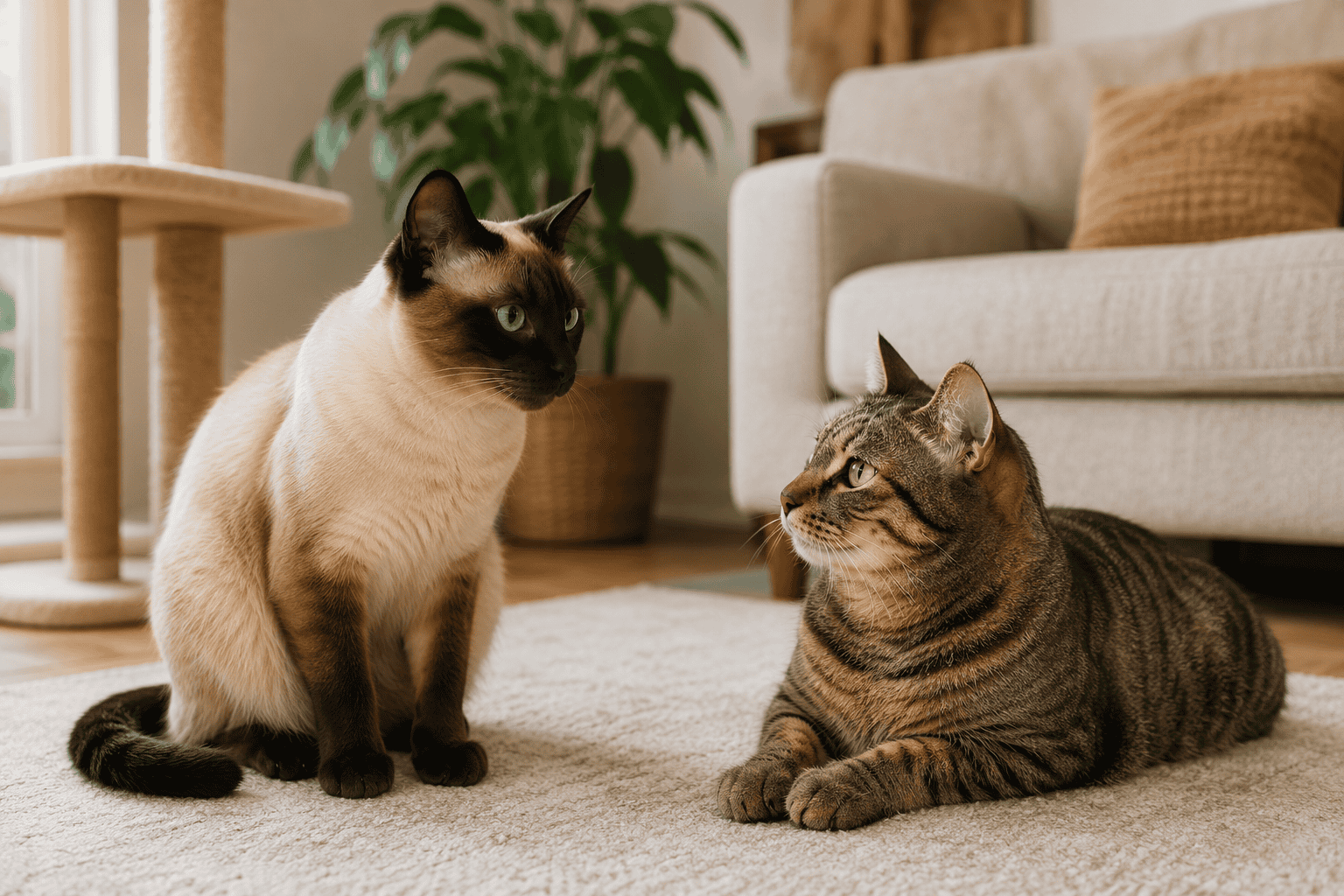
Siamese cats can get along with other cats, but it’s not guaranteed. They’re sociable by nature, yet also territorial and sensitive to disruption. Success depends on each cat’s personality, age, and energy level — and on how carefully you handle the introduction. Some Siamese become inseparable from a feline companion. Others tolerate coexistence at best.
Siamese cats are famously social. They follow you from room to room, narrate their entire day at high volume, and treat your lap as permanently reserved. So you’d think adding a second cat would be straightforward — just give the social butterfly a friend, right?
Not quite.
Sociability with people doesn’t automatically transfer to other cats. A Siamese who demands your constant attention can be exactly the cat who makes a newcomer’s life miserable. Their intensity — which makes them so compelling as companions — can just as easily tip into jealousy, resource guarding, and relentless pursuit of a cat who’d rather be left alone.
That said, plenty of Siamese cats thrive with feline companions. Some genuinely seem happier with a second cat in the house. The question isn’t whether it’s possible — it’s whether it’s likely to work for your Siamese, and what you can do to give it the best chance.
This article covers what makes Siamese cats complex housemates, how to assess your individual cat’s readiness, what the introduction process actually involves, and how to know if a new cat is a good match.
What Makes Siamese Cats Different in a Multi-Cat Home
Understanding the Siamese personality is the starting point for any honest answer here.
They don’t do well with boredom or loneliness. Siamese cats bond deeply with their people and can become vocal, clingy, or destructive when they’re under-stimulated. This is part of why people consider getting a second cat — hoping the new arrival will keep the Siamese occupied. Sometimes that works. But a second cat isn’t a guaranteed fix for a cat whose real need is more engagement from you.
They’re territorial, even while being affectionate. Siamese cats can be possessive about their owner’s attention, their sleeping spots, and their space. They may not mind sharing the house in principle but draw hard lines around the people and places they consider theirs. A new cat who wanders into those zones — even innocently — can trigger a sharp reaction.
Their energy can overwhelm quieter cats. Siamese cats stay playful well into adulthood and tend to pursue interaction with enthusiasm. If the other cat doesn’t match that energy — or is elderly, timid, or recovering from stress — the dynamic can quickly become one-sided. What the Siamese experiences as play, the other cat may experience as harassment.
They’re vocal when stressed. If introductions go badly, you won’t have trouble knowing it. But there’s also subtler behavior to watch: a Siamese blocking a new cat from the litter box, hoarding resting spots, or staring another cat down until it retreats. Not all conflict is loud. [1]
Before You Decide: Health Checks First
Before you even consider adding a new cat, take a practical step that many articles skip: make sure both cats are medically ready for the process.
Your resident Siamese should have had a recent veterinary check. If they’re managing a health condition, recovering from illness, or a senior cat with underlying concerns, this is the moment to talk to your vet about whether introducing another cat is advisable right now. Stress from a poorly managed introduction can worsen existing health problems, and the introduction process itself requires the resident cat to be in a stable, reasonably settled state. [2][3]
The new cat also needs a vet check before arriving — and specifically, should be screened for contagious diseases that could be passed to your Siamese. A new cat that appears healthy can carry conditions your resident cat has no immunity to. Sorting this before the two cats share any space is far simpler than dealing with illness after. [2][3]
This isn’t a minor procedural detail. It’s a baseline that makes everything else in the introduction process safer and more likely to succeed.
Does Your Siamese Actually Need a Companion?
Before you commit, it’s worth being honest about what’s driving the decision.
If your Siamese seems lonely or bored, a second cat might help — but so might more interactive play, puzzle feeders, or rearranging the environment to add vertical space and stimulation. A cat that vocalizes constantly because it wants your attention isn’t necessarily going to feel better with another cat around. It may simply redirect that energy toward pursuing the new cat instead.
If your Siamese has lived alone for years, changing that now requires realistic expectations. Older cats can adjust, but the process is slower and less predictable. A cat that’s been the sole pet for a decade has strong territory habits. That doesn’t make it impossible — it means you need to go especially slowly.
If your Siamese has had positive experiences with other cats, that’s genuinely encouraging. Previous exposure — in a foster home, a breeder’s environment, or an earlier part of their life — makes a real difference to how they handle a new introduction.
If your Siamese has been aggressive toward other cats before, that history matters and shouldn’t be minimized. It doesn’t rule out trying, but it means building in more structure and being prepared to change course.
How to Introduce a New Cat to a Siamese
The introduction process is where most multi-cat problems originate. Rushing it — or skipping steps — creates the kind of early tension that’s very hard to undo.
The FelineVMA is clear that even with the most careful approach, some cats simply don’t want to live with others. [3] The goal of a structured introduction is to give both cats the best possible chance — not to guarantee friendship.
Here’s how to do it properly.
Set Up a Separate Space for the New Cat
Before the new cat arrives, prepare a room your Siamese doesn’t use. It should have everything the new cat needs: food, water, a litter box, a scratching post, comfortable resting spots, and somewhere to hide. Use new items or ones that already belong to the new cat — not your Siamese’s belongings. Your Siamese will smell the familiar scent on shared items and may react badly; the new cat will smell an unfamiliar cat and feel threatened. [2][3]
Keep the new cat in this room until they’re clearly settled — eating normally, using the litter box, moving around comfortably, and showing relaxed behavior when you visit.
Swap Scents Before Any Visual Contact
Scent is how cats identify friend from threat. The goal of scent swapping is to make both cats familiar with each other’s smell before they ever meet face to face. [3]
Take a piece of bedding from each cat and place it in the other’s space. Watch how both cats react. Relaxed curiosity is a good sign. Growling, hissing, or active avoidance of the bedding suggests you need to slow down significantly before moving forward.
You can also use a cloth to gently rub each cat around their cheeks and chin, then let the other cat investigate the cloth. Do this over several days until neither cat reacts with alarm.
Let Each Cat Explore the Other’s Territory
Once scent swapping is going well, confine your Siamese to one part of the house and let the new cat explore freely — and vice versa. This allows each cat to gather more information about the other through scent, without any risk of a direct confrontation. [3]
Introduce Visual Contact Through a Barrier
The first time the cats actually see each other should be through something they can’t cross — a baby gate, a glass door left ajar, or a purpose-built mesh barrier. [3][5]
Keep these sessions short. The FelineVMA’s step-by-step introduction guide recommends identifying each cat’s favorite treats or activities beforehand, and using them here: feed both cats or engage them in play at a comfortable distance from the barrier, so each cat begins to associate the other’s presence with something positive. Gradually move bowls or toys a little closer only when both cats remain calm. If you see negative reactions — intense staring, growling, or a tense frozen posture — increase the distance again and try a shorter session the following day. [3]
Allow Supervised Physical Access
Once both cats are comfortable seeing each other through the barrier without showing stress, you can open it — when both cats are otherwise preoccupied. Don’t push them together. The aim at this stage is simply that they can be in the same space without one cat fleeing or the other escalating. [3][5]
Cornell University College of Veterinary Medicine notes that the key principle with territorial aggression in cats is never to rush the introduction or reintroduction, and to treat any signs of aggression as a signal to slow down, not push through. [1] If your Siamese starts chasing, staring down, or blocking the new cat, separate them and return to the previous stage rather than simply waiting for the behavior to pass.
Build Up Gradually — and Watch for Subtle Signs
Increased time together should be earned, not assumed. Watch for the less obvious warning signs: one cat consistently losing access to a resource (the litter box, a resting spot, the food bowl), a cat that stops eating or hides more than usual, or your Siamese becoming more clingy with you than before. These can be signs that the dynamic is causing stress even when there’s no outright fighting.
Use positive reinforcement during peaceful moments — calm behavior near each other can be quietly rewarded — but don’t force proximity. Two cats who share a home in peace without being bonded companions is a completely valid outcome. Not every introduction ends in cuddle partners, and that’s fine. [3]
What “Normal” Looks Like vs. When to Be Concerned
Hissing and growling in the early days of an introduction is expected. It’s not a sign you’ve ruined things. What matters is the trajectory: are things gradually improving, or is one cat consistently distressed?
Normal early reactions: hissing on first visual contact, a period of avoidance, occasional swatting with no injury, slow warming up over days or weeks.
When to pause and step back: Hissing or growling doesn’t mean you should push forward and wait for it to resolve. The right response is usually to return to the last stage where both cats were calm and give them more time there before trying again. If the cats aren’t ready to move to the next step, moving anyway almost always sets things back.
Signs to take seriously: one cat blocking another from the litter box or food; sustained stalking or chasing that doesn’t de-escalate; injury; one cat hiding for extended periods without improvement; inappropriate elimination starting after the new cat arrived. [1][4]
Silent conflict is worth understanding. Ohio State University’s Indoor Pet Initiative describes how the more assertive cat may never need to fight openly — instead, simply approaching or staring is enough to drive the other cat away from food, the litter box, or a resting spot. The threatened cat may stop eating in certain areas, hide more, or develop health problems before the conflict is even recognized as conflict. [4]
If your Siamese begins urinating outside the litter box after a new cat arrives, don’t assume it’s purely behavioral. Rule out a medical cause first, then address the stress component. Tension between cats can absolutely trigger this, but so can a urinary tract issue or other health problem that happens to coincide. [1]
If things aren’t improving after several weeks of careful introductions, contact your vet. They can refer you to a qualified veterinary behaviourist who specializes in intercat conflict. [1]
What Kind of Cat Tends to Work Well With a Siamese?
There’s no breed label that tells you whether a specific cat will get along with your Siamese. Individual personality is a far better predictor than breed. VCA Animal Hospitals notes that there’s no certain way to know whether any unrelated cat will be compatible in a household — what matters is personality, play drive, confidence, and history with other cats. [5]
That said, some traits in a potential companion tend to set introductions up better.
Matching energy is the most important factor. A Siamese paired with a very sedentary, elderly, or easily overwhelmed cat is likely to create a one-sided dynamic where the Siamese’s enthusiasm becomes a source of chronic stress for the other cat. A cat with a similar activity level and play drive is a much better starting point.
Confidence matters more than friendliness. A timid cat who is easily intimidated can find a territorial Siamese genuinely overwhelming, even if the Siamese isn’t being aggressive — just persistent. A cat with a more settled, socially experienced temperament is less likely to be rattled by the Siamese’s intensity.
Positive prior experience with cats. A cat that has successfully lived with other cats before is a stronger candidate than one with no social history or a history of conflict.
Age, but not in a simple way. A kitten isn’t automatically the right choice for an adult Siamese. Some adult Siamese love kittens; others find them exhausting or react with hostility. A kitten is also more vulnerable if the Siamese decides to play rough. An adult cat with a known temperament is often easier to assess for compatibility before committing.
On sex: there’s no strong evidence that one sex is a better match for a Siamese than another. Personality is a better predictor than sex.
Do Siamese Cats Get Along With Other Siamese Cats?
Two Siamese cats often do well together, especially when introduced young or simultaneously. Their communication styles, energy levels, and need for interaction tend to align. Two Siamese are likely to play together, groom each other, and keep each other occupied during the hours you’re not home.
That said, two territorial, high-intensity cats in one space can also amplify conflict if introductions go badly. The same rules apply: introduce slowly, don’t rush, and give both cats their own resources
Final Verdict
Siamese cats can absolutely live happily with other cats. They’re social, they’re often bored without enough stimulation, and the right feline companion can genuinely enrich their life. But the Siamese’s intensity — the same thing that makes them such compelling companions — means that a badly matched pairing or a rushed introduction can go badly and be difficult to repair.
The questions that matter most aren’t about breed — they’re about your individual Siamese’s history, temperament, and needs. A sociable cat with positive experiences around other cats and no strong territorial tendencies has a good chance of welcoming a companion. A cat that’s been the sole pet for years and shows possessive behavior needs a much more careful approach — and a vet check for both cats is the right first step before anything else.
If you decide to go ahead, take the introduction slowly. Give both cats their own resources. Watch for the subtle signs of stress, not just the obvious ones. And set realistic expectations: two cats who share a home in peace, without ever grooming each other or sleeping together, is a success. That’s a good life for both of them.
For a complete overview of the breed — personality, size, grooming needs, and lifespan — see our full guide on Siamese Cat: Temperament, Size, Care, Lifespan & More
Frequently Asked Questions
Do Siamese Cats Get Along With Other Cats?
Siamese cats aren’t inherently aggressive, but they can show territorial behavior — particularly when a new cat arrives in their space or they perceive a threat to their bond with their owner. This may look like hissing, chasing, staring down, or blocking access to resources. Managed introductions reduce the likelihood of this becoming a lasting problem, but it depends heavily on the individual cat.
Do Siamese cats get jealous of other cats?
“Jealousy” isn’t quite the right framing, but Siamese cats do exhibit behaviors that look a lot like it: interrupting interactions between you and the new cat, becoming clingier, guarding resting spots, or nudging the other cat away from food. These behaviors are about resource competition and territory — and they’re common enough in Siamese cats that you should plan for them rather than be surprised.
Should I get a second cat for my Siamese?
It depends on your Siamese’s personality and history. A sociable cat with positive prior exposure to other cats and no strong territorial tendencies is a much better candidate than a cat who has always been the sole pet and shows possessive behavior around you or its space. If you’re unsure, talk to your vet about your specific cat’s temperament before committing.
Do Siamese cats get lonely?
Siamese cats are unusually people-dependent for a domestic cat breed, and they can genuinely struggle with being alone for long periods. Whether another cat is the answer depends on whether loneliness is truly the issue. If your Siamese becomes distressed when you leave, a second cat may not fully solve that — the attachment is to you, not just to company in general. More interactive enrichment, play sessions, and scheduled attention are worth trying first.
Can a Siamese cat live with a kitten?
Some Siamese cats do very well with kittens; others find them annoying or react with hostility, especially if the kitten is persistent and the Siamese needs to retreat. A kitten’s small size also means it can be injured if play becomes rough. If you’re considering a kitten, assess your Siamese’s temperament honestly first. A bouncy, sociable Siamese who has been good with other cats before is a far safer bet than a territorial adult with no prior positive experience.
How long does it take Siamese cats to get along with a new cat?
There’s no fixed timeline. Some cats are comfortable with each other within a few weeks; others need several months of careful management. The FelineVMA notes that introductions may take days, months, or longer for some cats. The process should be driven by both cats’ behavior, not by how long it’s been. Pushing the timeline almost always sets things back. [3]
What if my Siamese never accepts the new cat?
It happens. Some cats — regardless of how carefully introductions are handled — simply don’t want to share their home. If both cats remain stressed despite weeks of structured introductions and professional input, rehoming one of them is a kinder outcome than forcing long-term coexistence under chronic stress. Two cats who are unhappy is not better than one cat who is content.
Can Siamese cats share a litter box?
They shouldn’t have to. The standard recommendation for multi-cat households is one litter box per cat, plus one extra — placed in different locations. Siamese cats can be territorial about elimination areas, and a single shared box can quickly become a source of conflict or cause one cat to avoid it altogether. The FelineVMA’s guidelines specifically recommend one litter box per cat plus one extra, positioned so resources are visually separated. [3]
Will two Siamese cats meow more?
Probably, yes. Siamese cats are among the most vocal breeds, and two of them will communicate with each other and with you. The upside is that having a companion may reduce the demand-meowing directed at you, because the social need is being partly met through feline interaction. The overall volume in your home is likely to go up.
Are Siamese cats good with dogs?
Siamese cats can coexist well with dogs, particularly with a careful introduction and a dog that respects the cat’s space. Their confidence and assertiveness mean they’re less likely than some breeds to be intimidated by a dog — but the introduction still needs to be gradual and supervised.
More on Siamese Cats
How to Train a Siamese Cat
Male vs Female Siamese Cats
Pros and Cons of Siamese Cats
Sources
[1] Cornell University College of Veterinary Medicine. “Feline Behavior Problems: Aggression”
[2] Cornell University College of Veterinary Medicine. “Choosing and Caring for Your New Cat”
[3] Feline Veterinary Medical Association (FelineVMA). “Step-by-Step Guide: How to Introduce a New Cat to Other Cats in Your Home”
[4] The Ohio State University Indoor Pet Initiative. “Conflict Between Cats”
[5] VCA Animal Hospitals. “Considerations When Getting a Second Cat”