
Why Do Cats Purr? Understanding Cat Purrs — and What That Little Rumble Is Actually Telling You
Quick Answer: Why Do Cats Purr?
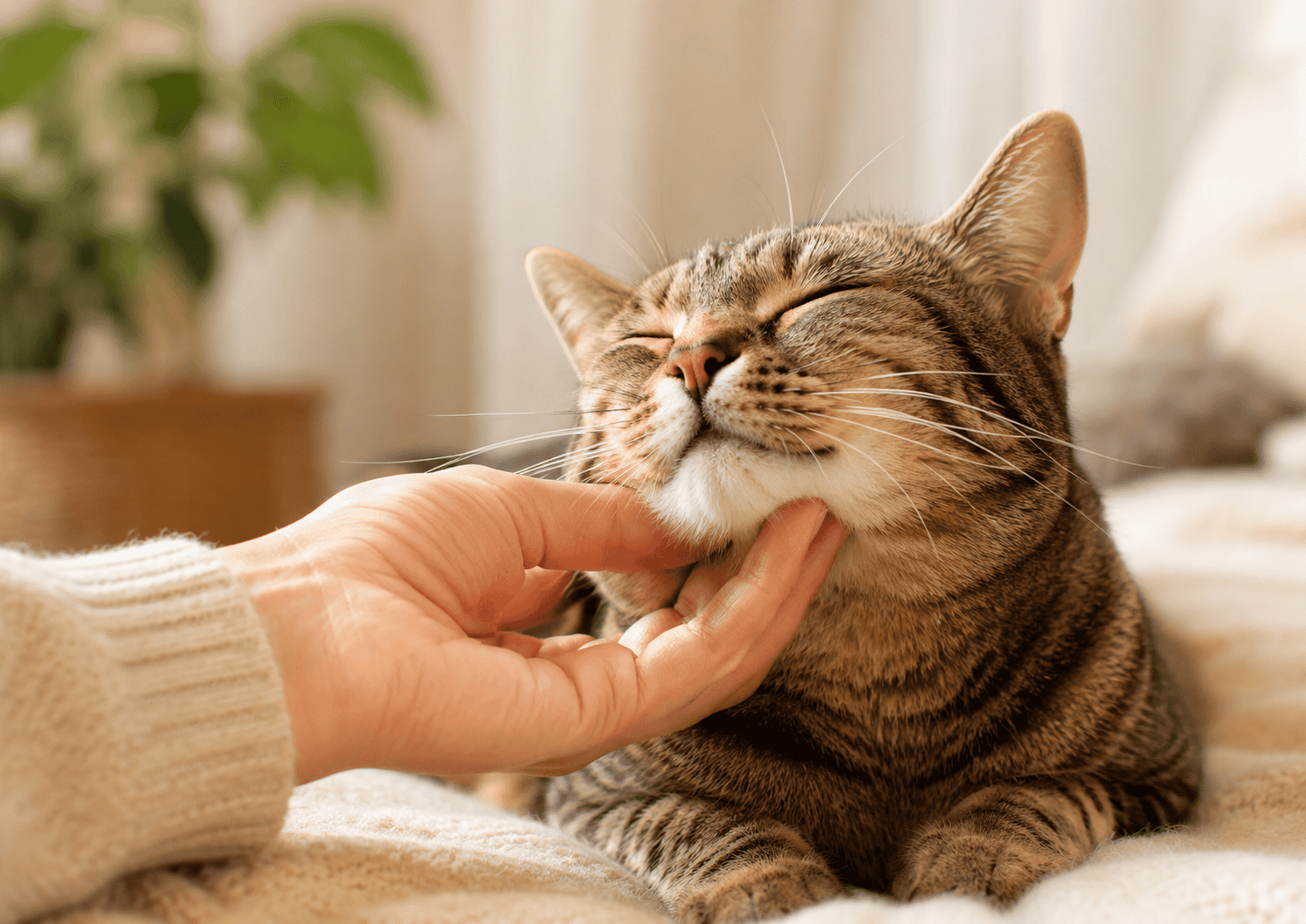
Cats purr for a surprising range of reasons — and happiness is only one of them. A cat may purr when they feel safe and loved, but also when they are hungry, anxious, overstimulated, or even unwell. The sound is consistent; what it means is not.The fastest way to decode a purr is to read the whole scene. What is your cat’s body doing? Where are they? Is this normal for them? Those answers will tell you far more than the purr alone ever could.
There is a particular moment every cat owner knows.
Your cat finds you. They circle. They settle. And then — that sound. Low, rhythmic, unmistakably theirs.
Most of us hear it and think the same thing: my cat is happy.
Sometimes that is exactly right. But purring is one of the most misread signals in cat behaviour, and understanding it properly changes how you read your cat — not just when things are good, but especially when something might be off.
A purr is not a single message. It is a quiet running commentary that shifts depending on what your cat needs in that moment. And because cats are famously reluctant to be obvious about anything, learning to read the whole scene — not just the sound — is where the real understanding starts.
Cats purr for many reasons, from deep contentment to stress, hunger, overstimulation, and even pain. The sound alone does not tell the whole story — your cat’s body, behaviour, and context complete the meaning.
What Is a Cat Purr, Exactly?
A purr is a low, rhythmic vibration that cats produce while breathing both in and out. That continuous quality — the way it rolls rather than starts and stops — is part of what makes it feel so different from a meow or a hiss.
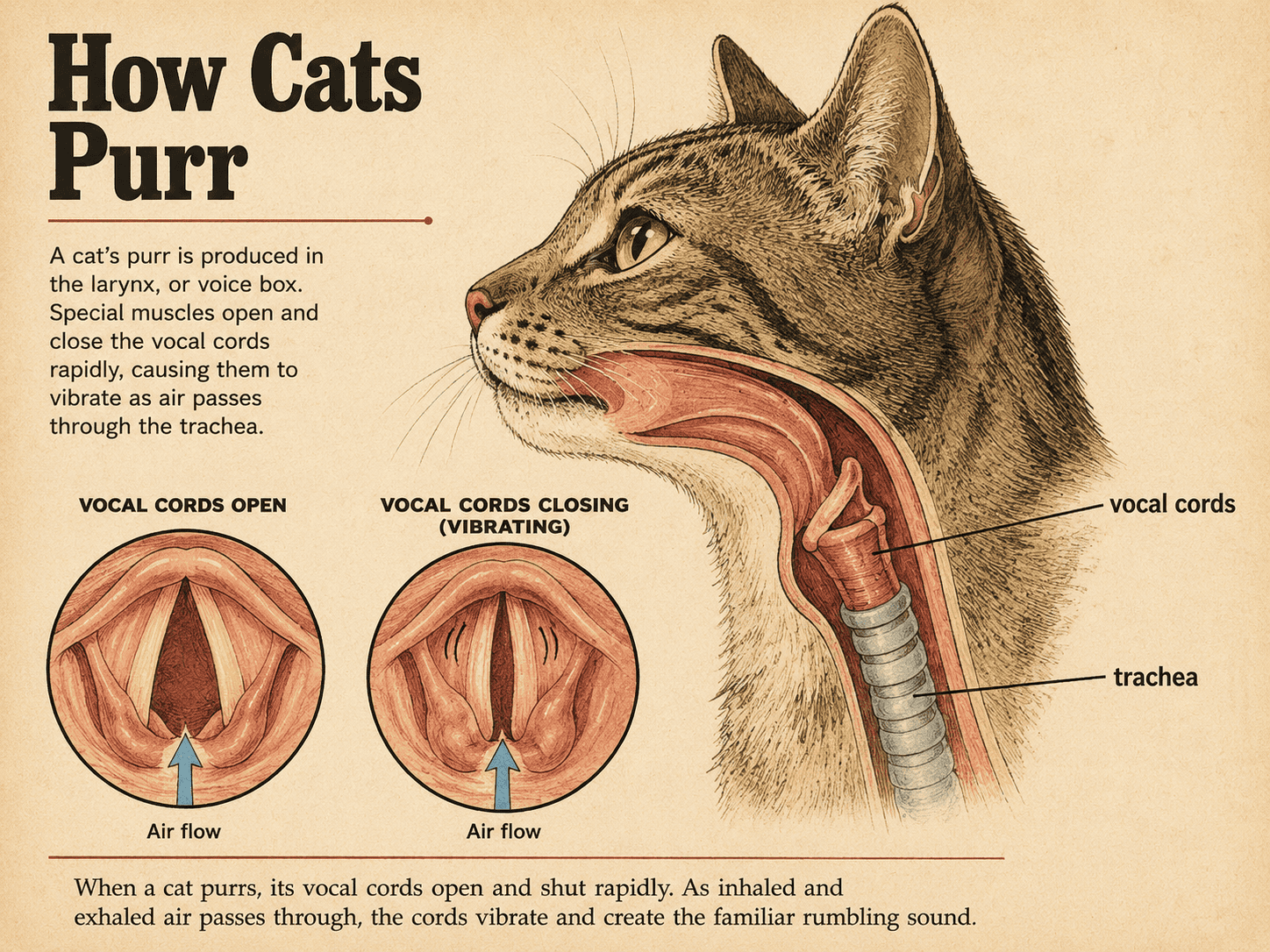
Mechanically, the purr involves the muscles around the glottis (the space between the vocal cords), which open and close rapidly as air passes through during each breath. [1] The result is that characteristic low rumble that can be so quiet you only feel it under your hand, or so loud your cat sounds like a small appliance left running.
What makes purring genuinely unusual is the frequency. A 2023 study in Current Biology found that the larynx in domestic cats can produce those unusually low-frequency sounds through specialised pads in the vocal folds — without needing repeated nerve signals to keep the sound going. [3] That adds another layer to why purring has fascinated researchers for so long.
The honest answer is that we understand more about purring than we used to — and cats are still keeping part of the mystery to themselves. Very on-brand
Does Purring Always Mean a Cat Is Happy?
No. And this is the most important thing to understand about cat purring.
A happy cat often purrs. But not every purring cat is happy.
Cats may also purr when they are anxious, overstimulated, frightened, unwell, or trying to self-soothe through pain or stress. The sound is the same. The meaning depends on everything around it.
So when someone says “my cat was purring, so they must have been fine” — that is worth slowing down. A purr is one clue in a larger picture. Your cat’s body, their habits, their energy levels, what happened earlier that day — all of that completes the sentence the purr starts.
The Happy Purr: When Your Cat Feels Safe With You
This is the purr most of us know best, and there is a reason it feels so specific.
Your cat is settled. Their paws are tucked under them. Their eyes are half-closed or doing that slow, deliberate blink. Their body feels loose rather than braced. Maybe they are kneading something with great professional focus.
That is a contented cat — and that purr is their way of saying so.
You will usually hear this when your cat is being petted in a spot they love, resting beside you in comfortable silence, greeting you after time apart, or falling asleep with the kind of ease that only cats manage.
There is something worth noticing here. Cats are selective about who they relax around. When your cat settles into that heavy, boneless comfort and the purr starts, they are not just comfortable — they are comfortable with you. Cats do not extend that to everyone. The fact that they extend it to you means something.
Also read: “How To Differentiate Between a Happy and a Stressful Purr from Your Cat”
Why Do Cats Purr When You Pet Them?
Usually: pleasure, trust, and a preference for your company.
If your cat leans into your hand, keeps their body relaxed, slow-blinks, and stays close, the purr is almost certainly a sign that they are enjoying the contact. Keep going.
But here is what catches people off-guard: some cats purr right up until the moment they are done with being touched. The transition can be fast. One minute they are leaning in. The next their tail is flickering, their skin is rippling, and the mood has shifted.
Cats Protection notes that purring during petting can be genuine enjoyment — but if your cat starts biting, scratching, or pulling away, overstimulation is likely the cause. [4]
A purr plus a relaxed body means yes. A purr plus a twitching tail and tense skin means you are probably on borrowed time. Read the full picture, not just the sound.
Why Do Cats Purr and Knead at the Same Time?
Kneading goes back to kittenhood — it is what kittens do against their mother’s belly to stimulate milk flow. Purring begins around the same time, as early as a couple of days old, as a way for kittens to communicate during feeding. [1]
When adult cats do both at once, it usually signals deep emotional comfort. They are not thinking about where they came from. They are just in a moment that feels completely safe, and their body is expressing it the way it learned to first.
Your stomach or your favourite jumper may pay a price during this. Emotionally, though, it is a compliment. A slightly pointed one, depending on claw length, but a compliment nonetheless.
The Greeting Purr: When Your Cat Acknowledges You Exist
Some cats save their most expressive purring for the moment you walk through the door.
Tail up, moving toward you, purring before they have even reached you — this is your cat re-establishing connection. It is social, warm, and occasionally tinged with a reminder that dinner is not going to serve itself.
What makes a greeting purr distinct is the body language that comes with it: tail upright, ears forward, eyes soft, body angling toward you. Everything is open and oriented at you.
It is easy to walk past this moment without really registering it. But when a cat that spent part of the day pointedly ignoring your existence meets you at the door with a purr, that is not nothing. That is your cat deciding you are worth acknowledging. Coming from a cat, that is a fairly significant compliment
The Solicitation Purr: When Cats Purr to Get Something
Not all purrs are about how your cat feels. Some are about what your cat wants.
The solicitation purr has a slightly different quality — more urgent, more insistent, sometimes with a faint cry embedded in it. Researchers at the University of Sussex found that cats embed a high-pitched cry within their purr when seeking food, making the sound harder for humans to ignore — and potentially tapping into the same instinct that makes us respond to infant cries. [5]
In practice, this is your cat discovering exactly which frequency bypasses your rational decision-making.
You will recognise it by what comes with it: sustained eye contact, positioning near the food bowl, following you around, escalating volume if you do not respond quickly enough. Your cat is not just expressing a feeling. They are making a case.
And because cats are patient and you are eventually going to walk into the kitchen anyway, they usually win.
Related article: The 7 Biggest Mistakes Owners Make When Responding to Their Cat’s Solicitation Purr
Why Does My Cat Purr So Much?
Some cats are just built that way. They purr at greetings, during petting, while resting, when you glance at them across the room. Frequent purring is often personality — some cats are simply more expressive, more social, or more tuned into using purring as their primary communication mode.
If your cat has always been a big purrer and nothing else has changed, that is almost certainly just who they are. The question that actually matters is not whether your cat purrs more than another cat — it is whether your cat is behaving normally for them.
A sudden increase in purring, especially paired with hiding, appetite changes, low energy, or unusual behaviour, is worth paying attention to. Not because purring is inherently worrying, but because change is. Cats are creatures of routine and habit. When something shifts noticeably, it tends to mean something.
Why Is My Cat Purring Loudly?
Some cats just come with bigger engines. A loud purr from a relaxed cat is usually fine — they may be deeply comfortable, excited, or simply built that way.
A loud purr can also be attention-seeking, especially the solicitation variety. When hunger is involved, volume is a feature, not a bug.
The volume itself is not the concern. What matters is whether the loud purring is new for your cat, and whether it comes with other changes — hiding, not eating, breathing differently, acting withdrawn. Loud plus normal is fine. Loud plus unusual is worth watching.
Why Is My Cat Purring Quietly?
Quiet purrs are completely normal for cats who have always communicated that way. Some cats purr so softly you only know it is happening because you can feel the vibration. That is not a problem — it is just their voice.
What you are watching for is a change. If your cat’s purr was once clearly audible and has become raspy, weak, or strained — especially alongside coughing, changes in breathing, or low energy — that shift is worth a vet conversation. Quiet is normal. Suddenly different is what you track.
Do Cats Purr When They Are Sick or in Pain?
Yes. And this is the part that matters most.
Cats may purr as a form of self-soothing when they are injured, stressed, or unwell. Some cats purr at the vet. Some purr when they are frightened. The sound feels like reassurance, but it can be the cat reassuring themselves, not signalling that everything is fine.
Cats Protection specifically notes that purring can indicate pain, particularly when a cat is purring more than usual, purring in situations that would not normally produce it, or showing behaviour changes alongside it. [4]
This does not mean you should treat every purr as a warning sign. It means you should read the whole cat, not just the soundtrack. If your cat is purring but also hiding, refusing food, moving stiffly, breathing differently, or simply not acting like themselves — trust that observation. The purr is not a “do not worry” signal. Sometimes it is the opposite.
Why Is My Cat Purring While Hiding?
A cat purring while hiding is more concerning than a cat purring on your lap. Hiding already signals that your cat is seeking distance — from noise, from stimulation, from something that felt threatening. Adding a purr to that usually means they are trying to settle themselves down.
After a stressful event — a visitor, a loud noise, a vet trip, a house move — brief hiding followed by a return to normal eating and behaviour is usually not worrying. Your cat needs to decompress, and they are doing it.
But if the hiding is sustained, food is being refused, the purr sounds unusual, or they are not coming out to behave normally, that combination of signals is worth a vet conversation. A purr does not cancel out the hiding. Both signs need to be read together.
Can Cat Purrs Help With Healing?
This one has a fascinating research backdrop — and a careful answer.
Cat purrs typically fall in the range of roughly 25 to 150 Hertz, a frequency range that some researchers have linked to possible bone density and tissue repair benefits in cats themselves. [6] The idea is that low-frequency vibration may have a mechanically stimulating effect on healing.
For cats, there may be something real here — which would make purring not just a communication tool but a physical one as well.
For humans, the evidence is emotional rather than clinical. A purring cat is grounding. The sound is warm and steady in a way few things are. Anyone who has sat in a quiet room with a purring cat during a hard week already knows this — not because a study said so, but because it is just true. That is not a medical claim. It is just one of the quieter reasons life with cats is what it is.
Why Does My Cat Purr on My Chest?
Partly warmth. Partly scent. Partly the rhythm of your breathing and the steady sound of your heartbeat — which may remind them, in some deep pre-verbal way, of the safety of their earliest days.
When a cat chooses your chest specifically, they are choosing physical closeness at a level that not every cat offers everyone. Some cats love laps. Some prefer proximity without contact. Some express affection from three feet away like emotionally careful roommates.
A cat who purrs on your chest has decided you are safe enough for that degree of closeness. That purr is not noise. It is something more specific: warmth, trust, and the kind of comfort they reserve for the people they genuinely want to be near.
You will probably stay very still for the duration. That is also part of it.
Why Does My Cat Purr and Meow at the Same Time?
A purr-meow combination usually means your cat is layering two messages: I am here and connected with you, and I also need something right now.
The purr carries warmth. The meow carries urgency. Together they form a fairly efficient request — one that often involves food, attention, a door, or a general call for you to orient yourself toward whatever your cat has decided matters at this moment.
Cats who have learned that vocalising gets results tend to use this combination strategically. If a purr-meow worked once, it gets filed under “effective techniques.” Expect it again. Probably at inconvenient times.
How to Read What Your Cat's Purr Actually Means
Start with the body, not the sound.
A purr from a relaxed, content cat usually comes with: soft or slow-blinking eyes, a loose rather than braced body, slow or absent tail movement, normal appetite, and a general willingness to stay near you.
A purr from a stressed or uncomfortable cat may come with: hiding, tense posture, flattened ears, dilated pupils, restlessness, avoiding contact, refusing food, or behaviour that does not feel like your cat’s normal.
The purr is part of the sentence. Your cat’s body and behaviour finish it. When they point in the same direction, you can trust the reading. When the purr says one thing and everything else says another, go with everything else.
| What You're Seeing | What the Purr May Mean |
|---|---|
| Curled beside you, eyes soft and slow-blinking | Contentment. Pure trust. This is the purr you live for. |
| Kneading while purring | Deep comfort — kitten-level safe. Possibly ruining your favourite blanket. |
| Walking toward you, tail up | Greeting. Bonding. A polite reminder that you've been missed. |
| Hovering near the food bowl | Hunger. Negotiation. Mild emotional manipulation. |
| Being petted, body getting tense | Enjoyment turning to overstimulation. Watch the tail. |
| At the vet | Stress, self-soothing. Not a sign they're fine. |
| Hiding away | Possible fear, stress, or discomfort. Needs context. |
| Purring with no appetite | Worth a vet call. Something may be off. |
| Louder than usual | Excitement, attention-seeking, or a change to keep an eye on. |
| Barely audible, just vibration | Perfectly normal — some cats whisper their feelings. |
Do All Cats Purr?
Domestic cats do, along with many smaller wild cat species including bobcats, servals, cougars, and cheetahs. Larger cats — lions, tigers, leopards, jaguars — are built differently; they roar rather than produce a continuous purr. [7]
For the cat currently somewhere in your home, the more useful question is not whether cats can purr. It is what your specific cat’s purr means right now, given everything else you are seeing
When Should You Actually Be Concerned About Purring?
A healthy cat purring contentedly is not a concern. Purring in that context is just your cat doing what cats do.
Call your vet if purring is accompanied by: not eating, hiding for extended periods, difficulty breathing, sudden weakness, audible distress, limping or stiffness, repeated vomiting, litter box changes, or any significant shift from your cat’s normal behaviour and energy levels.
The purr is not the problem. The purr plus a cluster of other changes is the signal.
You know your cat’s baseline better than anyone. When something feels off — even if you cannot immediately name why — that instinct is usually grounded in something real. Trust it and get a vet’s view rather than letting the purring reassure you out of investigating further.
Final Thoughts
A purr can mean happiness. It can mean hunger. It can mean “I feel safe here” or “I am trying to feel safe here” — and those two things are very different.
Learning to read your cat’s purr is really learning to read your cat. Their body, their rhythms, their version of normal, their small daily habits and how they shift. The purr is one thread in a larger pattern.
At Cats Fanatic, this is what keeps us interested in cat behaviour. Not the clean explanations that make cats feel simple, but the real ones — the ones that are honest about complexity, that respect how layered these animals actually are.
Cats are not loud with their feelings. They do not broadcast them. They offer small signals and wait for you to notice. A purr is one of those signals. Quiet enough to miss if you are not paying attention, and specific enough to mean something when you are.
Frequently Asked Questions
Why do cats purr?
Cats purr for a wide range of reasons — contentment, bonding, hunger, stress, and self-soothing among them. Some cats also purr when they are sick or in pain, which is why the sound cannot be read in isolation. Context is everything.
What does it mean when a cat purrs?
It depends entirely on the situation. A purr from a relaxed cat with soft body language usually signals comfort and trust. A purr from a cat who is hiding, tense, or not eating points somewhere different. Read the whole picture, not just the sound.
Why do cats purr when you pet them?
Often because they enjoy the contact and feel safe with you — but not always for the entire duration. Cats can purr through pleasure and into overstimulation. A relaxed, leaning-in body means keep going. A twitching tail or tense skin means you are approaching the limit. Both can involve purring.
Why does my cat purr so much?
Some cats use purring as their main mode of communication and just do it constantly. If your cat has always been a frequent purrer and everything else is normal, that is likely just their personality. A sudden increase in purring, especially with behavioural changes, is worth paying attention to.
Why is my cat purring loudly?
Loud purring is often normal, especially in cats who are deeply relaxed, excited, or actively requesting something. Volume alone is not a concern. Loud plus sudden behavioural change — hiding, not eating, acting withdrawn — is what you watch for.
Why is my cat purring quietly?
Some cats have always purred softly, and a quiet purr from a relaxed, healthy cat is completely fine. A change in the quality or volume of an established purr — especially alongside other symptoms — is more relevant than the quietness itself.
Do cats purr when they are sick?
Yes, and this is one of the most important things to know about purring. Cats may purr to self-soothe when stressed, frightened, or unwell. A purring cat is not necessarily a fine cat — the rest of their behaviour and body tells you far more.
Do cats purr when they are in pain?
They can. Purring during pain is a form of self-comfort, not a signal that everything is okay. Look at the full picture: is your cat hiding, off their food, moving differently, or behaving in a way that does not feel like their normal? A purr alongside those signs is worth a vet visit.
Why does my cat purr and knead me?
Purring and kneading together usually signal deep comfort — the kind that traces back to kittenhood, when both behaviours were part of the safety of feeding and closeness with their mother. When adult cats do both at once, they are in one of their most emotionally settled states. Your blanket (or your legs) may not survive the process unscathed, but it is a compliment.
Why does my cat purr on my chest?
Warmth, scent, your heartbeat, your breathing — all of it. Cats who choose this level of closeness are making a deliberate choice. They feel safe enough to be that close, and the purr is how they express it. Not every cat does this with everyone. The fact that they do it with you means they have decided you are trustworthy.
Can cat purrs help with healing?
For cats, there may be something to this — purring falls in a frequency range that some researchers link to bone and tissue health in felids. [6] For humans, the benefit is harder to quantify clinically, but the calming effect is real enough not to dismiss. Whether or not it heals anything physically, a quiet room and a purring cat at the end of a hard day is its own kind of restorative.
Do all cats purr?
Domestic cats do, and many smaller wild cats can purr continuously too. Larger cats — lions, tigers, leopards — roar instead; the physical structures that allow purring and roaring differ at the species level. [7] For the purposes of understanding your cat at home, the question is less “can cats purr” and more “what is my cat’s purr telling me right now.”
Sources
- Library of Congress — Why and How Do Cats Purr?
- NC State University College of Veterinary Medicine — Why Do Cats Purr?
- Current Biology — Domestic Cat Larynges Can Produce Purring Frequencies Without Neural Input
- Cats Protection — Why Does My Cat Purr?
- Current Biology — The Cry Embedded Within the Purr
- Journal of the Acoustical Society of America — The Felid Purr: A Healing Mechanism?
- Live Science — Are Cats the Only Animals That Purr?