
Happy vs Stressful Cat Purrs: How to Tell What Your Cat Is Really Feeling
Quick Answer
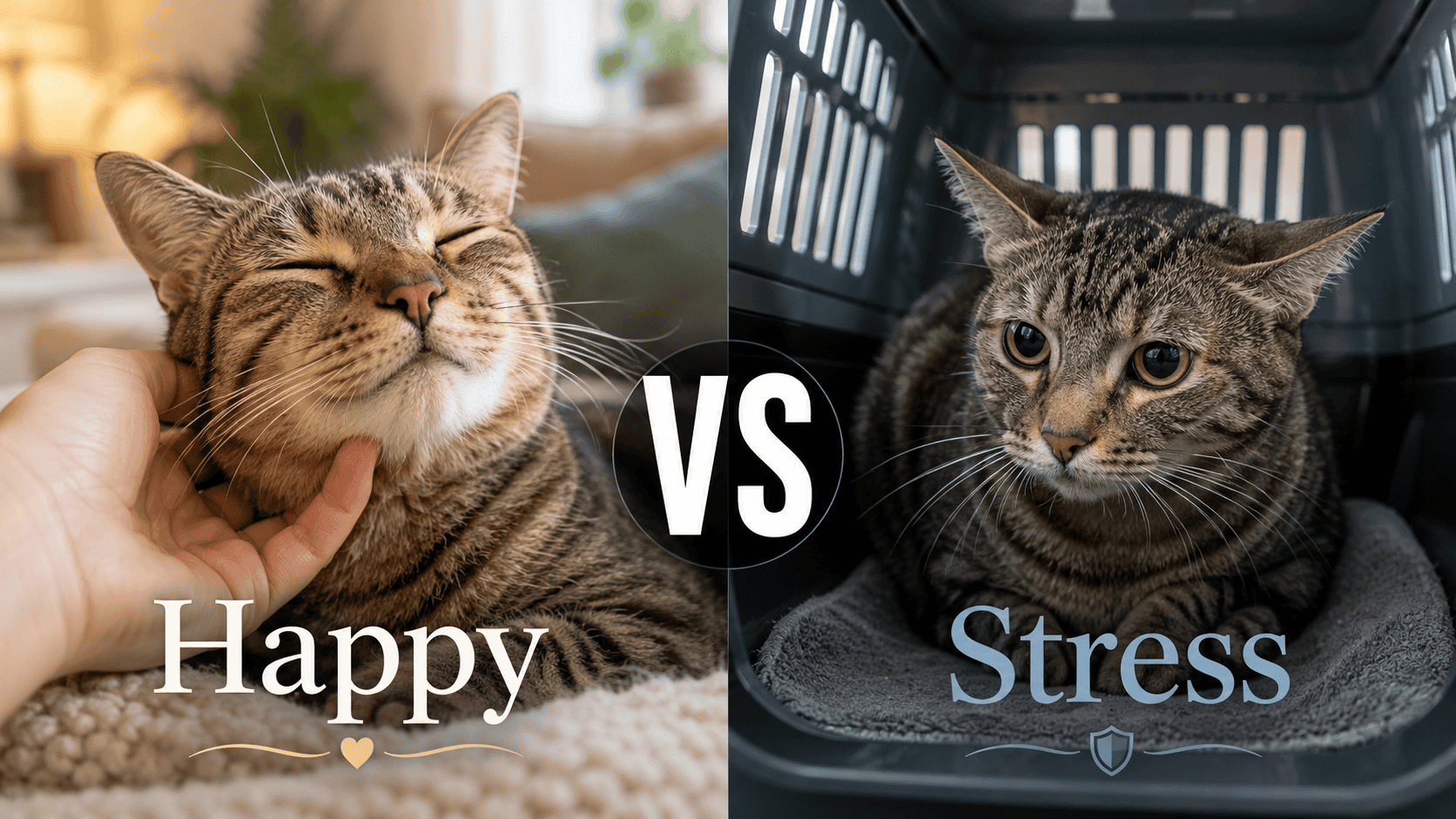
A happy cat purr usually comes with relaxed body language — soft eyes, loose muscles, calm ears, and your cat choosing to stay close. A stressful cat purr often appears with tension, hiding, wide pupils, flattened ears, a twitching tail, or a situation that feels uncomfortable, such as a vet visit, car ride, loud noise, or illness. The safest rule is simple: do not judge the purr alone. Read the whole cat.
Your cat settles beside you. The little motor starts. Their eyes go half-closed, their paws tuck in, and for a moment the whole room feels calmer.
It is easy to hear that sound and think: my cat is happy.
Usually, you are right.
But cats have never been straightforward about much, and purring is no exception. A purr can mean contentment, or it can mean stress, or it can mean your cat is trying to get through something uncomfortable and using the only tool they have. According to Cats Protection, one of the UK’s largest cat welfare charities, cats may purr when happy, stressed, self-soothing, or in pain — and figuring out which one requires looking at the whole picture, not just listening. [2] Pet health resource PetMD echoes this, noting that purring can signal contentment, stress, attention-seeking, or illness depending entirely on the situation. [1]
So the real question is not whether your cat is purring. It is what else your cat is doing at the same time
The simple rule: read the whole cat, not just the purr
The most common mistake is treating purring like a fixed signal. A purring cat looks peaceful. It feels like proof that everything is fine. But if you have lived with cats long enough, you know they can send completely mixed messages without a flicker of apology.
A cat can purr while enjoying a chin scratch. A cat can also purr inside a carrier at the vet, after a loud crash in the kitchen, or when they feel unwell. That does not mean every out-of-place purr is a crisis. It means the purr needs context.
Think of it the way you might read a person laughing. Laughter at a funny moment is one thing. Laughter during a tense silence is something else. The sound may be similar, but the situation changes what it means.
Cats work the same way. A happy purr fits the moment — your cat is warm, settled, and choosing to stay close. A stress purr often clashes with the moment — the sound is there, but the body is tight, the eyes are wide, and something about it does not quite add up.
That mismatch is usually where the answer lives.
Happy vs stressful cat purrs at a glance
| What to check | Happy purr | Stressful purr |
|---|---|---|
| Situation | Resting, cuddling, being gently petted, lying somewhere they chose | Vet visit, car ride, loud noise, hiding, unfamiliar people or pets |
| Body | Loose, soft, completely relaxed | Stiff, low, guarded, compressed |
| Eyes | Half-closed, slow blinking, soft gaze | Wide open, dilated pupils, fixed stare |
| Ears | Neutral or gently forward | Flattened, turned sideways, pinned back |
| Tail | Still, loosely curled, calm | Twitching, tucked under, low or restless |
| Behavior | Kneading, rubbing, stretching, staying close | Hiding, avoiding touch, freezing, trying to escape |
| The overall vibe | The purr matches a comfortable moment | The purr clashes with everything else going on |
Use this as a starting point, not a verdict. Cats are too individual for any chart to fully cover. One cat’s happy purr sounds like a freight train. Another cat’s stress purr barely registers. The real skill is learning what is normal for your specific cat — and noticing when the purr does not match the rest of what they are showing you.
What a happy cat purr actually looks like
A happy purr does not usually arrive alone. It comes with softness.
Your cat curls up in a warm spot, tucks their paws under their body, slow blinks at you, or leans into your hand when you scratch their chin. Their muscles look loose. Their tail is not flicking. Their ears are not flat. They are not quietly scanning for the nearest exit.
They are choosing to be there, and that choice matters more than the sound itself.
Happy purring tends to happen during moments your cat already enjoys — lying in a patch of sun, resting after a meal, kneading a soft blanket, sitting beside you on the couch. These are not situations where a cat is managing something difficult. These are situations where a cat has decided this is exactly where they want to be.
Research from Cats Protection describes the body language of a relaxed cat as ears that sit naturally or tilt gently forward, eyes that may be half-closed or fully shut, and whiskers that rest closer to the face rather than pushing forward. [3] So when someone asks how to tell if a cat purr is happy, I always come back to the same question: does your cat look like they are choosing this moment?
If yes, the purr almost certainly means what you hope it does.
What a stressful cat purr actually looks like
A stressful purr is trickier, because it can fool you.
The motor is running, so your brain files it under happy. But look at the rest of the cat. Maybe they are purring while crouched under the bed. Maybe they are in a carrier on the way to the vet. Maybe they are being held, but their paws are stiff and their eyes keep moving. Maybe they startled at a loud noise and are now purring in a low, tucked position with their ears flattened.
That is not the same as a cat melting into your lap. It is a purr with tension built around it.
International Cat Care, a veterinary-led cat welfare organization, notes that stressed cats often show altered body signals — dilated pupils, lowered or flattened ears, and shifts in whisker position. [4] Their research echoes what Cats Protection has documented: a purring cat with flat or sideways ears, wide eyes, and large pupils is most likely communicating stress rather than comfort. [2]
A stressed purr does not always mean something serious is happening. Sometimes a cat is just managing an uncomfortable moment. But the key is to trust what the body is telling you before you trust the sound.
If the purr says calm and the body says overwhelmed, believe the body. Cats are very good at holding it together. Their posture usually tells on them before the purr does.
Do cats purr when stressed?
Yes. And this is where a lot of owners get caught off guard.
Many people were told early on that purring equals happiness. It is a tidy story, and it is wrong often enough to matter. A cat may purr during stress because purring can function as a self-soothing behavior — a way of managing something uncomfortable, calming their own nervous system, or simply getting through a situation they cannot leave. [2]
You might notice cat purring when stressed during a vet exam, a car trip, a thunderstorm, a move to a new home, an introduction to another pet, or when unfamiliar guests come over. In those moments, the purr is not your cat enjoying the chaos. It is your cat coping with it.
This matters practically. If we misread the purr, we may keep doing the thing that is making the cat uncomfortable. A cat purring while being held is not necessarily asking to be held longer. If their body is loose and they are leaning into you, great. If their body is stiff, their tail is flicking, and they keep glancing toward the floor, the kinder choice is to put them down and let them decide whether to come back.
A purr is not consent. A relaxed cat stays because they want to. A stressed cat may stay because they feel stuck.
Body language tells you more than the sound
Cat purring body language is really the heart of all of this. The purr starts the question. The body usually answers it.
A relaxed cat has a particular softness to them. Their face looks calm. Their eyes may be half-closed. Their whiskers are not pushed forward tensely. Their ears sit naturally. Their body does not look compressed or braced for something.
A stressed cat often looks like they are holding themselves together. Their body may be low or stiff. Their ears flatten or swivel backward. Their pupils go wide. Their tail twitches, tucks, or pulls tight against the body. They may avoid eye contact, go still, or try to create distance when you approach.
Pet health resource PetMD points out that body language is essential for reading a cat’s emotional state, and that purring can also accompany pain or illness — which is exactly why volume alone should never be the deciding factor. [5]
Some happy cats purr like small engines. Some stressed cats purr quietly. Some cats have naturally rough-sounding purrs. Some barely purr even when they are deeply content.
Listen to the sound. But body language is usually the more reliable source.
Why context changes everything
Context is the quickest shortcut to reading a purr correctly.
A purr during a quiet cuddle on the couch usually makes sense. Your cat is safe, close, and choosing the contact. A purr during a car ride is a different situation entirely. Your cat may be purring, but the carrier, the movement, and the unfamiliar smells can make the whole experience stressful — even if you cannot hear any distress in the sound.
A purr at the vet is similar. Even the friendliest clinic is still full of strange smells, handling, other animals, and sounds your cat did not ask for. Purring there does not automatically mean your cat is enjoying the outing.
And a purr right after a sudden fright? That one especially needs a second look. If something loud crashes and your cat hides, then starts purring when you check on them, the purr is probably self-soothing rather than a sign that everything is instantly fine. [2]
In those moments, resist the urge to pull your cat out of hiding or crowd them with comfort. Give them room. Let them settle on their own terms. Let them choose contact again. Cats tend to recover faster when they feel they still have some control over their own space
What if your cat is purring but acting scared?
This is one of the clearest examples of why a purr cannot be read by itself.
If your cat is purring while crouching, backing away, freezing, or staring at you with wide eyes, that purr is probably not saying this is lovely. It may be saying I am trying to calm myself down.
A scared cat may not want direct touch right away. Even gentle contact can feel like too much if they are already at their limit. The better response is usually to lower the pressure around them. Reduce the noise. Move slowly. Keep other pets or kids at a distance. Let them access a hiding spot if they need one.
Let your cat decide when the moment is over. This is genuinely hard for people because our instinct when something is scared is to get closer. With cats, being allowed to move away first is often what actually helps them come back.
That is not rejection. It is how a lot of cats reset.
What if your cat is purring and hiding?
It depends on the cat and the context.
Some cats simply love enclosed spaces. A cat purring inside a cardboard box they claimed last Tuesday is probably just enjoying their private kingdom. If their body looks relaxed and nothing else is off, the hiding is not a problem.
But if the hiding is sudden, out of character, or paired with tension, appetite loss, weakness, or avoidance of interaction, it deserves more attention.
A cat purring under the bed during fireworks is almost certainly overwhelmed, not content. A cat hiding in a closet, purring softly, and refusing food may be unwell. A cat retreating after a conflict with another pet may be working through something and using the purr as a way to steady themselves.
Normal hiding for your cat is privacy. Unusual hiding is more often a message.
You do not need to panic every time your cat chooses a quiet corner. But you do need to notice when the pattern changes.
When purring may mean pain or illness
This one matters enough to say plainly.
Cat purring when in pain is real. That does not mean every purr points to something wrong, but it does mean a purr is not proof that everything is fine. Purring can be a sign of pain — and purring more than usual, or in situations where your cat normally would not, is worth paying attention to. [2]
Cats are impressive at hiding discomfort. A cat may still eat a little, sit near you, and look almost normal while something is quietly wrong. That is why changes in behavior are often more telling than anything else.
Watch for purring that comes alongside appetite loss, hiding, vomiting, weakness, limping, difficulty jumping, sensitivity to touch, unusual quietness, breathing changes, or a personality shift. The Merck Veterinary Manual, a leading clinical reference for veterinarians, lists pain signs as eating less, hiding or withdrawing, restlessness, changes in mood, and changes in movement or posture. [6] VCA Animal Hospitals, a veterinary hospital network, also notes that illness signs include changes in energy, sociability, appetite, litter box use, breathing, grooming, and overall appearance. [7]
You know your cat’s normal better than any chart. If the purr is happening in a strange situation, with strange body language, alongside behavior that is not usual for your cat, that is enough reason to take it seriously.
And if there are illness signs on top of that, call your vet. A purr can be very reassuring. It should not override your gut.
Can the sound itself tell you anything?
Sometimes, yes — but only if you know your cat’s personal baseline.
A happy purr is often described as softer, steadier, and more rhythmic. A stressed purr may sound more intense, rougher, or slightly different from your cat’s usual one. That can be true, but it is not a rule you can apply universally.
Some happy cats purr loudly. Some barely purr at all even when they are completely content. Some cats shift pitch when they want something. Others have naturally uneven purrs that sound effortful even on a lazy afternoon.
What to listen for is not loudness or smoothness in absolute terms. What to listen for is a change from your cat’s normal. If your cat usually purrs softly during cuddles and is now purring in a way that sounds rougher, faster, or more urgent — especially paired with tense body language — that difference is worth noticing. If your cat always purrs loudly when happy and looks completely relaxed, the volume alone means nothing.
Your cat’s normal is the baseline. Everything else is measured against that.
What to do when you genuinely cannot tell
Sometimes you will not know right away. That is completely normal. Cats are not known for submitting clear emotional reports.
When you cannot tell whether a purr is happy or stressful, the simplest move is to give your cat more control. Stop petting for a moment and see what happens. If they lean back in, rub against you, blink slowly, or stay close, they probably want the interaction to continue. If they move away, flatten their ears, twitch their tail, or disengage, let them go.
This pause test is one of the easiest ways to respect a cat’s signals without overthinking everything. It gives your cat a vote.
A lot of people keep petting because the cat is purring, then wonder why the cat suddenly swats or bites or disappears. The warning signs were usually there the whole time. The purr was never the whole answer. The whole cat was answering all along — they just had to wait until someone finally stopped and paid attention.
When to call the vet
Call your vet if purring is paired with any of the following:
- Hiding more than usual, especially if sudden
- Not eating or eating much less
- Vomiting, limping, or visible weakness
- Breathing changes or difficulty
- Sensitivity to touch in a specific area
- Unusual aggression or extreme withdrawal
- Any major shift in routine behavior
Also worth a call: if your cat starts purring much more than they normally do, purrs in situations where they never used to, or seems unsettled in a way you cannot explain. Veterinary guidance recommends seeking a vet’s opinion if a cat purrs more than usual or in different situations, or shows any behavior changes alongside the purring. [2] Similarly, sudden changes in energy, sociability, appetite, litter box use, breathing, grooming, or movement should prompt a vet visit. [7]
Not every unusual purr is urgent. But an unusual purr plus unusual behavior is not something to wait out indefinitely.
The real way to understand your cat's purr
Stop treating a purr as a single sound with one meaning.
A purr can be joy. It can be comfort. It can be a request. It can be stress. It can be a cat trying to steady themselves through something that feels like too much. The difference is almost never buried inside the purr itself. It is in the body. It is in the timing. It is in whether your cat is choosing closeness or quietly trying to disappear.
A happy purr fits a relaxed cat. A stressful purr clashes with one.
Once you start reading both, your cat’s purr stops being just a pleasant background sound and becomes something more useful: a small but honest signal about how safe, settled, or overwhelmed your cat actually feels in that moment.
That is one of the quieter privileges of living with cats. They may never explain themselves in plain language. But they are always saying something.
You just have to slow down enough to hear the whole thing.
Frequently Asked Questions
How do I tell if my cat’s purr is happy or stressed?
Look at the situation and the body language together. A happy purr typically comes with loose muscles, soft or half-closed eyes, slow blinking, kneading, or your cat choosing to stay close and engaged. A stressed purr is more likely to come with hiding, stiff posture, flattened ears, wide pupils, a twitching or tucked tail, or avoidance of touch. The purr is just one data point — the body usually tells the real story.
Do cats purr when stressed?
Yes, cats can and do purr when stressed. Purring can function as a self-soothing behavior — a way of managing an uncomfortable situation rather than a sign that the cat is fine. Common triggers include vet visits, car rides, loud noises, new environments, or introductions to unfamiliar people or pets. The purr is not proof of contentment; context determines what it means. [2]
Is a loud purr always a stressful purr?
No. Loudness alone does not indicate stress. Some cats naturally purr loudly when they are perfectly content. What matters more is whether the volume or character of the purr is unusual for your specific cat, and whether it is accompanied by tense body language, hiding, or behavior changes. Your cat’s personal baseline is the only reliable reference point.
Why is my cat purring but acting scared?
Your cat may be using purring to self-soothe. If they are purring while crouching low, backing away, freezing, or showing wide eyes and flattened ears, the purr is most likely a coping mechanism rather than contentment. In those moments, the most helpful thing you can do is reduce the pressure around them — lower the noise, move slowly, give them space — and let them approach when they are ready.
Can cats purr when they are in pain?
Yes. Cats may purr when unwell or in pain, which is one reason a purr should never be taken as proof that a cat is fine. Research from cat welfare organizations specifically notes that purring can be a sign of pain, particularly when it is more frequent than usual or occurs in situations where the cat would not normally purr. [2] If the purring is accompanied by appetite loss, hiding, vomiting, weakness, limping, or sensitivity to touch, contact your vet.
What does it mean when a cat purrs while hiding?
It depends on the cat and the context. If your cat regularly uses a particular hiding spot and looks relaxed there, purring in that space is probably just privacy and comfort. But if the hiding is sudden or out of character, and especially if it is paired with appetite loss, avoidance of interaction, or signs of fear or illness, the purring is more likely linked to stress or discomfort. Any hiding that is unusual for your cat is worth paying attention to.
Sources
[1] PetMD — Why Do Cats Purr? 5 Meanings Behind a Purring Cat
[2] Cats Protection — Why does my cat purr?
[3] Cats Protection — Spotting Signs of Cat Stress
[4] International Cat Care — Stress in cats
[5] PetMD — How To Read a Cat’s Body Language
[6] Merck Veterinary Manual — Recognizing and Assessing Pain in Animals
[7] VCA Animal Hospitals — Recognizing the Signs of Illness in Cats