
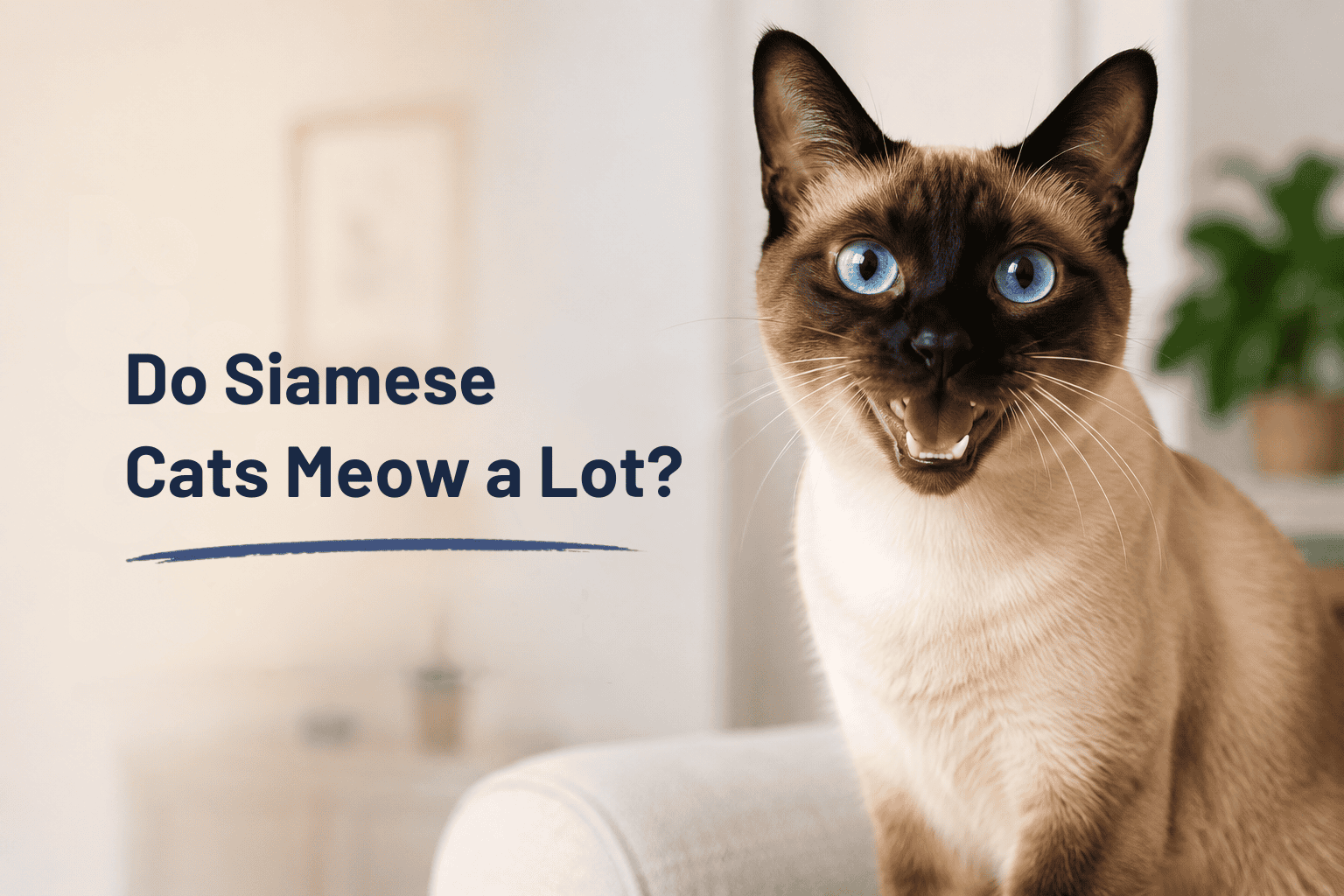
Do Siamese Cats Meow a Lot? Why They’re So Vocal and When to Worry
Quick Answer
Yes — Siamese cats are one of the most vocal breeds, and the talking is baked into the personality. They greet you, narrate their day, and remind you that dinner exists. The voice is part of the deal. But if your Siamese won’t stop meowing or the pattern has shifted, that’s worth investigating — sudden or distressed vocalization can signal a health issue, not just attitude.
If you’ve ever wondered whether Siamese cats are noisy — yes, genuinely yes. If you were hoping for a cat who blends into the furniture and lets life happen quietly around them, a Siamese is going to be an education.
This is a breed that participates. They comment on what you’re doing, announce their arrival into every room, remind you the food bowl is technically empty, and occasionally decide your phone call sounds like a group activity they should join. That’s not a personality quirk you can train out. That’s just a Siamese.
Siamese cats are recognized as one of the most vocal breeds in existence — social, expressive, and built to communicate. VCA describes them as big talkers, and the Cat Fanciers’ Association notes that Siamese are well known for making their preferences heard. [1][2]
Some owners call it talking. Some call it narrating. Some describe it as “my cat has opinions and a microphone.” None of those are wrong.
A Siamese might meow when you wake up, when you walk in the door, when you open the fridge, when you sit down in the wrong chair, and absolutely when you dare close a door between the two of you. And yet two Siamese in the same house can have completely different volumes — one broadcasts all day, the other pipes up mainly around dinner.
Personality, age, health, environment, and — importantly — how you’ve responded to the meowing over time all shape how loud your cat is. So yes, Siamese cats meow a lot. But the more useful question is: are they talking because they’re being themselves, or because something’s off? That’s where it gets interesting.
Not every Siamese sounds the same. Some are full-time broadcasters. Others save it for meals, play, or bedtime. Knowing your cat’s normal is half the job.
Why Are Siamese Cats So Vocal?
They’re not doing it to frustrate you. Even when it’s 3 a.m. and they’re performing what can only be described as a hallway concert.
Siamese cats are built for connection. They’re not cats who live in your house — they live with you. If you’re folding laundry, they inspect it. If you’re working, they supervise. If you’re on a call, they’ve decided that’s a group activity. The meowing is just how they participate. It’s their version of a paw tap, a nudge, a look — but louder.
Intelligence is the other piece. Siamese cats are fast learners, and they figure out quickly what gets a response. If meowing gets them food, they meow for food. If it opens a door, they meow at doors. If it makes you look up from your phone, they remember that too. It’s not manipulation — it’s trial and error, and with Siamese cats, the voice almost always turns out to be the most effective tool in the box.
Put those two things together — social drive plus a brain that notices what works — and you get a cat who talks. A lot. On purpose.
Common Reasons Your Siamese Cat Is Meowing So Much
Siamese meowing is easier to deal with when you stop hearing it as noise and start reading it as a message. Most of the time, your cat is trying to communicate something specific.
The ASPCA notes that cats meow to greet people, request things, seek attention, or signal that something is wrong. [3] That covers all cats — but Siamese cats make that communication considerably harder to ignore.
1. They want your attention
This is the most classically Siamese scenario. You’re reading. They meow. You look up. They meow again. You say “what?” and they take two steps closer, as if the human has finally joined the meeting they’ve been holding.
Siamese cats often want more than food and a functional litter box. They want interaction — play, conversation, proximity, eye contact. The meowing is the request. The tricky part is what happens next: if every meow earns an instant response, your cat learns that loud works. Not because they’re scheming, but because they’re paying attention and you’ve confirmed the strategy.
2. They’re bored
A bored Siamese is a loud Siamese. This is a breed that genuinely needs mental stimulation to stay settled — if the day is food bowl, sofa, window, nap, repeat, your cat will create their own entertainment, and that entertainment is usually you.
Interactive play, puzzle feeders, cat trees, window perches, toy rotation — for a smart, social cat, these aren’t extras. [7] They’re what keeps the volume at a manageable level. A tired Siamese is a more peaceful Siamese. Not silent — let’s not set unrealistic expectations — but noticeably more settled.
3. They’re hungry or anticipating food
Siamese cats often develop a very specific food voice. Not the soft trill. The urgent, dramatic “I have never eaten in my entire life” meow — delivered inches from your face or directly beside the food bowl at whatever time they’ve decided dinner should be.
A predictable feeding routine helps. Timed meals and resisting the urge to respond to every yell with a treat tend to reduce the intensity over time. One thing worth watching: if your cat suddenly seems much hungrier than usual, is losing weight, or is drinking more water, don’t chalk it up to greediness. Increased appetite alongside other changes can be an early sign of a health issue, particularly in older cats. [3]
4. They’re lonely
Siamese cats are not wired for long hours alone. Some handle it fine. Others become unsettled, clingy, and vocal — especially if they’re the only pet in the home and their person is out most of the day.
A compatible second cat can genuinely help in some cases. But don’t approach it as a mute button. Sometimes you end up with two cats who both have a lot to say.
5. They’re stressed
Cats notice disruption to their routine faster than most people expect. A shifted feeding time, houseguests, construction noise, a moved litter box, a new brand of food — any of it can produce more meowing than usual.
Stress-related meowing usually comes with other signals: pacing, hiding, appetite changes, overgrooming, or general irritability. If the meowing ramped up after something changed at home, look at the environment before assuming your cat is just being dramatic.
Siamese cats can absolutely be dramatic. They can also be genuinely unsettled. Both things are true, and they’re not mutually exclusive.
6. They’re in pain or feeling unwell
This is the one you’d never want to skip past.
A naturally talkative Siamese can actually make a health problem harder to spot, because the meowing already feels normal. But a change in pattern is the thing to watch. A Siamese who’s always been chatty after dinner is one thing. A Siamese who suddenly yowls through the night, cries in the litter box, hides, drops weight, or starts drinking noticeably more — that’s a different conversation entirely.
Excessive meowing can be connected to pain, thyroid disease, kidney problems, urinary issues, high blood pressure, cognitive changes in older cats, and other medical concerns. VCA and PetMD both flag changes in vocalization as something to investigate rather than explain away. [4][5][6]
Working rule: if the meowing is new, distressed, or paired with anything else that seems off — call the vet first. Enrichment won’t fix a thyroid problem. Ignoring won’t fix pain.
What Do Siamese Cat Sounds Actually Mean?
Siamese cats don’t have one meow. They have a vocabulary — short and sharp, long and drawn-out, quiet mid-walk comments, chirps, trills, yowls. Once you start paying attention, you’ll find the sounds are actually pretty consistent.
Here’s a practical breakdown.
| Sound | What it usually means | What to check |
|---|---|---|
| Short chirp or trill | Greeting, curiosity, or an invitation to interact — your cat is pleased about something | Tail up? Body relaxed? Approaching you? Good signs all around. |
| Loud, repeated meow | Food, attention, boredom, or a strong opinion about a closed door | Does it happen around meals or after you've responded before? Pattern is the clue. |
| Drawn-out yowl | Stress, frustration, pain, mating behavior, or — in older cats — disorientation | Is it new? Happening at night? Paired with other changes? Worth a closer look. |
| Hiss or growl | Fear, overstimulation, or a boundary being pushed | Back off first. Then figure out what triggered it. |
Normal Siamese Meowing vs. Excessive Meowing
Because Siamese cats come pre-loaded with personality, plenty of owners end up asking the same question: how much is just breed behavior, and how much is actually too much?
Normal Siamese meowing has a logic to it. They greet you at the door. They talk before meals. They chirp at whatever’s happening outside the window. They follow you from room to room and make little sounds during the ordinary business of the day. Probably while supervising your laundry. That’s usually just the breed doing its thing.
Excessive meowing feels different. It’s frantic, relentless, or unusually loud. If your Siamese won’t stop meowing regardless of what you do, that’s the signal to pay closer attention. It shows up at strange hours — repeated yowling through the night, for instance. And it tends to come with other changes: hiding, clinginess, appetite shifts, weight loss, litter box problems, poor grooming, or restlessness.
The shift is the signal. A Siamese who’s always been chatty is probably just a Siamese. A Siamese who’s become much louder or more distressed than their own normal — that’s worth investigating.
This matters more with older cats. Senior Siamese can become more vocal because of pain, hearing loss, vision changes, thyroid disease, kidney problems, high blood pressure, or cognitive decline. Cornell Feline Health Center notes that senior cats can develop health and behavior changes related to aging that need proper veterinary attention. [8]
A senior Siamese who starts wandering and yowling at night deserves a vet appointment, not just earplugs.
Why Does My Siamese Cat Meow at Night?
Night meowing is probably the most common complaint among Siamese owners — whether it’s a Siamese cat crying at night for no obvious reason or the 3 a.m. hallway performance that makes you reconsider your life decisions.
The reasons vary by age. In kittens and younger Siamese, it’s usually about adjustment and leftover energy — new environment, missing littermates, still figuring out the routine, naturally more active around dawn and dusk. In adults, it’s often habit: if meowing at night has historically resulted in food, company, or an open door, your cat has catalogued that as a working strategy. In senior cats, night yowling needs more attention — confusion, discomfort, hearing loss, vision changes, and underlying illness can all make the dark hours harder to navigate.
If you’re looking for how to stop your Siamese cat from meowing at night, a solid bedtime routine makes a bigger difference than most people expect. Real play before bed — proper play, not a half-hearted wave of a toy while you scroll — where your cat gets to chase, stalk, pounce, and finish the session. Then the last meal of the day. Clean litter box. Fresh water. A warm sleeping spot. After that, keep the night boring.
If you’ve confirmed your cat is healthy and their needs are genuinely met, resist giving in to nighttime meowing. If you make it to nine ignored meows and give in on the tenth, you’ve just taught your cat that ten is the magic number. Siamese cats are bright enough to remember that. Stay consistent. Your sleep depends on it.
How to Reduce Excessive Siamese Meowing
You’re not going to turn a Siamese into a quiet cat. That’s not the goal, and it’s not realistic. The voice is part of the deal. What you’re actually aiming for is reducing the meowing that’s driven by boredom, stress, habit, or unmet needs — while letting your cat be who they are.
Start with health. If the meowing is sudden or out of character, rule out a medical cause before you do anything else. You can’t train away pain, and ignoring won’t fix a urinary problem.
Once health is off the table, look at routine. Siamese cats do better with predictability — consistent meals, consistent play, a clean litter box, minimal surprises. Routine reduces the ambient anxiety that often drives the noise.
Invest in proper play. Not two minutes of waving a feather while you watch TV. Real sessions — ten to fifteen minutes where your cat gets to stalk, chase, pounce, and actually “catch” something. Done consistently, especially before bed, it makes a meaningful difference.
Give their brain something to do. Puzzle feeders, treat balls, snuffle mats, clicker training, cat shelves, toy rotation — a Siamese with nothing to engage with is a Siamese who’s going to find something to engage with, and that something is usually you, loudly.
Reward quiet, not noise. A lot of owners accidentally get this backwards — they ignore the cat when things are calm, then react when the meowing becomes impossible to tune out. From your cat’s point of view: loud worked. Start noticing when your cat is settled and give attention then, before the performance begins.
Skip punishment entirely. Yelling back, spraying water, or startling your cat increases stress and damages trust without teaching your cat anything useful. Redirect toward better behavior rather than reacting to the voice.
Should You Ignore a Siamese Cat Meowing?
Sometimes, yes. But not as a first response.
Before you decide to ignore the meowing, run through the basics: Is it mealtime? Is the water bowl clean? Is the litter box usable? Is your cat stuck somewhere or frightened? Is there any sign of pain or illness? If any of those boxes aren’t ticked, ignoring is the wrong move.
If all their needs are genuinely met and you’re looking at classic attention-seeking behavior, then yes — ignoring has a place. But it only works if you’re consistent. Ignore nine meows and cave on the tenth, and you haven’t reduced the behavior; you’ve just adjusted the threshold. Siamese cats will recalibrate accordingly.
The more effective approach: give attention when your cat is calm. If they sit quietly beside you, talk to them. If they bring a toy instead of yelling, play. If they pause mid-meow, reward that pause. You’re not trying to make your cat feel dismissed — you’re teaching them that quiet is just as effective as loud. Possibly more so.
Are Siamese Cats Too Loud for Apartments?
Not automatically. But this deserves an honest answer before you commit.
Plenty of Siamese cats live happily in apartments. They can genuinely thrive in smaller spaces when they get enough attention, play, vertical room to climb, mental stimulation, and a consistent routine. But they are not quiet apartment cats by default, and pretending otherwise sets everyone up for a hard time.
Thin walls, light-sleeping neighbors, a young baby in the next room, or a genuine low tolerance for noise — any of those factors make a bored, lonely Siamese a real problem. A Siamese left alone most of the day with nothing to do can get vocal enough to become a neighbor issue.
The solution isn’t a different breed — it’s honest preparation. Vertical space (cat trees, shelves, a proper window perch), a consistent play routine, and not letting boredom stack up all day are the things that make apartment life work for this breed. A well-stimulated Siamese is a very different cat from a neglected one.
A Siamese makes a genuinely excellent apartment companion for someone who actually wants an interactive, opinionated, involved cat. If you want a cat who’s mostly invisible and only shows up for meals, this is a firm no.
Do Siamese Kittens Meow More?
Yes, and in the first few days or weeks in a new home, that’s completely expected. They may be missing littermates, looking for warmth, getting used to unfamiliar sounds and smells, or simply being Siamese kittens — which is already a fairly vocal category.
That said, don’t brush kitten meowing aside entirely. Make sure they’re eating, drinking, using the litter box, staying warm, and acting normally in between the noise. If a kitten sounds weak rather than just insistent, refuses food, or seems lethargic, that’s a vet call, not a wait-and-see situation.
For normal adjustment meowing, routine and calm presence are your best tools. Safe, predictable environment. Gentle play. Regular meals. Warm bedding. Siamese kittens want company above almost everything else — a bit of reassurance goes a long way toward turning down the volume.
Do Siamese Cats Get More Vocal as They Age?
Some do, some don’t. A Siamese who’s been chatty since kittenhood may simply stay that way — that’s just their personality. But if an older Siamese becomes noticeably louder, particularly at night, that’s not something to wave away as breed behavior.
Senior cats can meow more because of hearing loss, vision changes, arthritis, discomfort, thyroid disease, kidney disease, high blood pressure, or cognitive decline. They may feel disoriented after dark, or call out for reassurance in a way they’ve never done before. [8]
This is worth resisting the easy explanation. Yes, Siamese cats are vocal. But your individual cat’s normal is the thing that matters, not the breed’s reputation. A senior Siamese who’s always been chatty at dinner is one thing. A senior Siamese who’s started wandering the house yowling at night after years of being quiet at that hour — that’s a vet conversation, not a breed characteristic to accept.
When Should You Worry About Siamese Meowing?
Worry when it’s sudden, distressed, or shows up alongside other changes.
Call your vet if your cat is meowing while trying to urinate or visiting the litter box repeatedly with little result. Call if they’re crying out, hiding, refusing food, drinking noticeably more than usual, losing weight, vomiting, acting confused, or restless at night when that isn’t their norm.
Also worth noting: if your cat’s voice itself changes — becomes hoarse, raspy, or suddenly disappears — that’s a reason to call even without other symptoms.
The aim isn’t to panic at every meow. The aim is to not wave off a genuine change because “Siamese are just like that.” A shift in vocalization is sometimes the earliest visible sign that something is wrong. Cats are skilled at hiding discomfort — right up until they can’t anymore.
Living With a Talkative Siamese Cat
Life with a Siamese isn’t quiet. It’s also, for the right person, genuinely one of the better things about cat ownership.
There’s something that’s hard to put into words about a cat who greets you like you’ve been gone for a week, follows you from room to room with opinions about your decisions, and treats the household as a shared endeavor rather than a backdrop. A Siamese makes a home feel occupied in the very best way.
They’re not low-maintenance companions. They have preferences, routines, and a voice they will absolutely use. But if you go in understanding that — not fighting it, not trying to turn them into a different kind of cat — the meowing stops feeling like a problem and starts feeling like part of how you communicate with each other.
You’re not managing a noisy cat. You’re living with a cat who talks to you. Once you learn to tell the food voice from the bored voice from the “something feels wrong” voice, it starts to feel less like noise and more like a language. A loud one. But yours.
Curious whether a Siamese fits your life beyond the noise? Here’s everything you need to know → Siamese Cat: Temperament, Size, Care, Cost, Lifespan & More
Frequently Asked Questions
Do Siamese cats meow a lot?
Yes — Siamese cats are one of the most vocal breeds, and they use meowing, trilling, chirping, and yowling to communicate throughout the day. That said, individual cats vary. Some are constant commentators; others save the volume for meals and playtime. The breed tendency is definitely toward talkative, but your cat’s own baseline is the real measure.
Why do Siamese cats meow so much?
Mostly it comes down to personality. Siamese cats are social, people-focused, and smart — they’ve figured out that their voice gets results, and they use it accordingly. Boredom, hunger, stress, loneliness, and learned behavior can all amplify the meowing. If the volume increases suddenly or the pattern shifts, health should also be on the list of things to consider.
Are Siamese cats louder than other cats?
Generally yes. Siamese tend to be more vocal than the average cat, and their voices carry. But there’s real individual variation within the breed — some are constant broadcasters, others are selective about it. Comparing your Siamese to the breed’s reputation is less useful than knowing what’s normal for your specific cat.
Why does my Siamese cat meow at night?
It depends on age. In younger cats, it’s usually leftover energy, adjustment to the home, or habit — if nighttime meowing has worked before, they’ll keep trying it. In adult cats, it’s often a learned behavior that was accidentally reinforced. In senior cats, night yowling can be a sign of discomfort, confusion, or an underlying health issue. The age and pattern matter more than a single explanation.
How do I stop my Siamese cat from meowing all night?
Start with a proper evening routine: real play before bed, a final meal, a clean litter box, fresh water. Once you’ve confirmed your cat is healthy and all their needs are covered, don’t reward nighttime attention-meowing with food, play, or a reaction. Consistency is what makes this work — caving occasionally teaches your cat that persistence is the right strategy.
Should I ignore my Siamese cat when it meows?
Only after you’ve checked that their needs are genuinely met and you’re dealing with attention-seeking rather than distress. If there’s any possibility it’s pain, a litter box issue, or hunger at a normal mealtime — check first. When you do decide to ignore attention-meowing, be consistent. Giving in intermittently makes the behavior stronger, not weaker.
Can Siamese cats be quiet?
Some individual Siamese are quieter than others, and you can reduce excessive demand-meowing through consistent routine, proper play, and rewarding calm behavior. But turning a naturally vocal Siamese into a silent cat is not a realistic goal — and honestly, it’s not what most Siamese owners actually want once they’ve gotten used to the conversation.
Are Siamese cats too noisy for apartments?
Not automatically, but it requires honest preparation. A Siamese who gets enough play, mental stimulation, and consistent company can be a solid apartment cat. A bored, lonely Siamese left alone in a small space most of the day can get loud enough to become a genuine problem. Assess your situation honestly before adopting rather than hoping for the quiet outlier.
Will getting another cat stop my Siamese from meowing?
Sometimes — if loneliness is the main driver, a compatible companion can make a real difference. But it’s not a reliable fix, and it’s not a quick one. A poorly matched pairing adds stress rather than reducing it. Sometimes the result is simply two cats with a lot to say. Whether it helps depends heavily on both cats’ personalities and how the introduction is managed.
When should I call the vet about excessive meowing?
Call your vet if the meowing is sudden, distressed, or paired with any of the following: changes in appetite, thirst, weight, energy, litter box habits, grooming, or general behavior. Also call if your cat’s voice itself changes — becomes hoarse, raspy, or disappears entirely. For senior cats especially, a shift in vocalization is often an early signal of something that needs attention, not a breed trait to shrug off.
Sources
[1] VCA Hospitals – Siamese Cat Breed Profile
[2] Cat Fanciers’ Association – Siamese Breed Profile
[3] ASPCA – Meowing and Yowling
[4] VCA Hospitals – Cat Behavior Problems: Vocalization
[5] VCA Hospitals – The Cat’s Meow: Caterwauling in Cats
[6] PetMD – Why Is My Cat Meowing So Much?
[7] PetMD – Siamese Cat Breed Health and Care
[8] Cornell Feline Health Center – The Special Needs of the Senior Cat