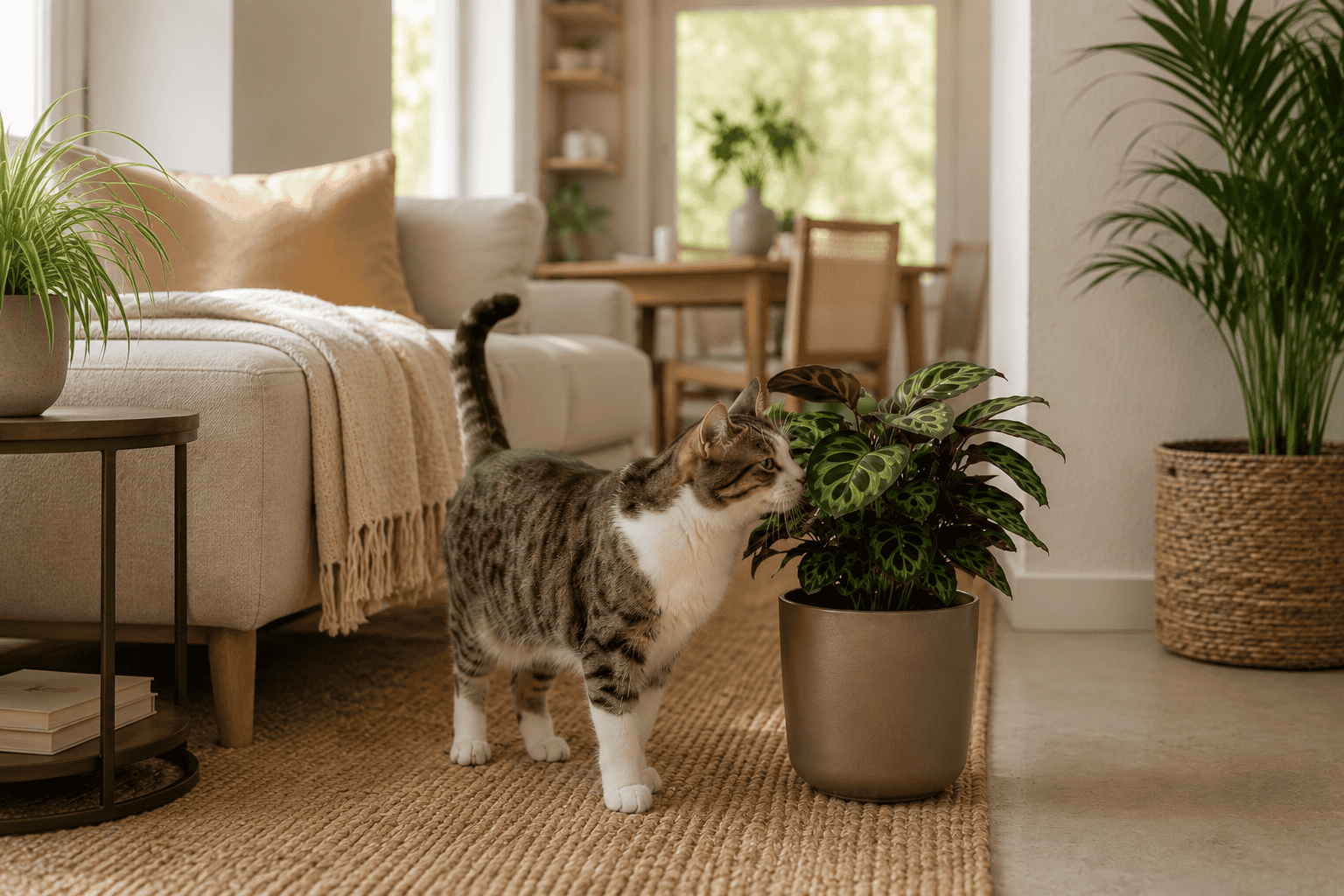
Cat-Friendly Plants: 10 Beautiful Houseplants That Are Safe for Cats
Quick Answer: What Are the Best Cat-Friendly Plants?
Best overall: Spider plant, parlor palm, peperomia — non-toxic to cats per ASPCA, easy to care for, widely available
Best for chewers: Cat grass (wheat, oat, barley, or rye) — the one plant your cat is actually allowed to eat
Best flowering option: African violet — compact, colorful, ASPCA-listed non-toxic
Best large floor plant: Areca palm or bamboo palm — tall, tropical, non-toxic
Important note: Non-toxic does not mean edible in quantity. Always verify the exact plant name before buying — common names are not reliable.
Every cat owner knows the moment.
You spot a gorgeous trailing plant at the nursery, pick it up, and spend three glorious seconds imagining it on your windowsill — all lush and photogenic. Then you remember you share your home with a creature who eats hair ties for fun and has already knocked two mugs off the counter this week.
You put the plant back. You go home. You feel sad.
It does not have to be this way.
Cat-friendly plants exist, and more than a few of them are genuinely beautiful. But the phrase gets used loosely, and that is where things go sideways for a lot of cat owners. Non-toxic to cats — as listed by the ASPCA Animal Poison Control Center — means the plant does not contain compounds known to poison cats. [1] It does not mean your cat can graze on it like a salad bar.
That is a meaningful difference. Even safer plants can cause mild stomach upset if your cat decides to eat half of one. But it does mean you are not one nibble away from an emergency vet visit.
This guide covers ten cat-friendly houseplants that are realistic for actual homes — not just pretty on a list. For each one, we cover care, the honest cat-owner caveats, and where placement matters. Because a non-toxic plant sitting within reach of a bored kitten is still asking for trouble.
What "Cat-Friendly" Really Means — And What It Does Not
When most people search for plants safe for cats, they want a yes or no. Can I bring this home without worrying?
That is fair. Cats are constitutionally incapable of leaving things alone. They sniff, paw, nibble, dig in soil, and occasionally sit directly inside the pot as though it was installed for them. So the stakes feel higher than they would with, say, a goldfish.
Here is the honest version: a cat-friendly houseplant is one that does not contain compounds known to be toxic to cats. The ASPCA Animal Poison Control Center maintains one of the most comprehensive plant safety databases available, and it is the reference used to confirm every plant in this article. [1]
But non-toxic is not the same as edible, digestible, or especially welcomed by your cat’s stomach. Plant material in large quantities can still cause vomiting or diarrhea in cats, regardless of toxicity status. And some cats will chew constantly if given access, which is a behavioral problem no plant list can fix.
So the goal here is not to build your cat a salad garden. The goal is to give you real options for greenery that are not quietly dangerous — with honest notes on which ones tend to attract the most feline attention.
One more thing: common plant names are genuinely confusing. Two different plants can share the same name, and one might be fine while the other is not. Always check the specific variety before you buy. When in doubt, the ASPCA plant list lets you search by exact botanical name. [1]
Before You Buy: One Quick Habit Worth Keeping
Before bringing any new plant home, check the exact name against the ASPCA Animal Poison Control database — not just the common name on the nursery tag, but the botanical name if it is available. [1]
Common names are not consistent. What one store calls a “bamboo palm” and another calls a “reed palm” can be the same plant, while something simply marketed as “bamboo” at a florist may be an entirely different species with a completely different safety profile. That distinction matters when you have a cat.
This article covers safer plant choices — plants confirmed as non-toxic to cats by the ASPCA. If you want the other side of that list, the plants that should never come through the door in a cat home, that is covered separately in our guide on toxic houseplants for cat owners.
Everything here has been cross-checked against the ASPCA Animal Poison Control database before going into this article. [1] That said: always use it as your final check too, not just mine.
10 Cat-Friendly Houseplants That Are Actually Safe
1. Spider Plant (Chlorophytum comosum)

Spider plants are one of those rare things: a genuinely easy houseplant that is also listed as non-toxic to cats by the ASPCA. [1] If you are looking for one of the best indoor plants safe for cats that does not require much maintenance or much worry, this is often the answer.
They have long, arching leaves and produce little dangling baby plants on long stems. The whole effect is pleasantly full and a bit wild in the best way. They grow fast, they bounce back from neglect, and they look right at home in a hanging basket, on a shelf, or cascading over the edge of a plant stand.
The catch — and there is always a catch — is that those dangling plantlets are irresistible to playful cats. They move when touched, which activates something ancient and predatory in a cat’s brain. If your cat has energy to burn, expect the spider plant to become a toy.
Spider plants do best in bright, indirect light. Let the soil dry out slightly between waterings, and make sure the pot drains properly. Overwatering is the most common mistake.
For cat homes, hanging plants are the smarter placement — not because the plant is dangerous, but because the battle between your cat and a dangling plantlet will have a clear winner, and it will not be the plant.
| Best for | beginners, hanging baskets, bright rooms |
| Care level | easy |
| Cat-owner note | safe, but a magnet for playful cats — hanging placement helps |
2. Areca Palm (Dypsis lutescens)

If you want a large houseplant safe for cats that makes a room feel warmer and more lived-in without demanding too much from you, areca palm is worth knowing. It has soft, feathery fronds that instantly shift the energy of a space, and it fills a corner the way nothing else does without looking heavy or stiff.
The ASPCA lists areca palm as non-toxic to cats. [1] That makes it one of the better large pet-safe houseplants you can actually find in most garden centres — and one of the few floor plants that earns its place in a cat home without reservation.
It prefers bright, indirect light — harsh direct sun can scorch the fronds, while deep shade will make it unhappy over time. Water when the top inch of soil feels dry, and make sure your pot has drainage. Soggy roots are areca palm’s main weakness.
For cat owners, the fronds may draw attention. Some cats like to sit beneath palms like tiny self-appointed jungle rulers. Others will swat at the leaves or, more enthusiastically, dig in the soil.
If your cat digs, cover the soil with smooth, large stones that cannot be swallowed. If your cat is a climber, keep the plant away from furniture that could serve as a launchpad. You know your cat. Plan accordingly..
| Best for | tropical style, empty corners, bright rooms |
| Care level | moderate |
| Cat-owner note | cover the soil with large stones if your cat likes to dig |
3. Boston Fern (Nephrolepis exaltata)

Boston fern is lush in a way that very few houseplants match. It has full, soft fronds that spill outward and make any room feel fresher. It is also one of the more forgiving fern choices for a cat home — the ASPCA lists it as non-toxic to cats. [1]
That said, not every plant with “fern” in the name is automatically safe. Asparagus fern, which looks similar and is often sold alongside true ferns, is listed as toxic. Common names matter less than exact botanical identification here. Boston fern’s botanical name is Nephrolepis exaltata — that is the one you want.
This plant loves humidity and bright, indirect light. A bathroom with a window, a humid kitchen corner, or any spot with consistent moisture in the air suits it well. If your home runs dry, the frond edges may brown and get crispy. A pebble tray with water underneath the pot can help.
Boston fern likes consistently moist — not wet — soil. Letting it dry out completely tends to cause dramatic shedding, which is annoying even before you factor in the cat who will absolutely investigate every fallen frond.
Hanging plants safe for cats rarely get more elegant than this one. Those fronds wave gently in any air movement, and that is genuinely fascinating to a lot of cats — which is exactly why elevation helps.
| Best for | hanging baskets, humid rooms, soft textured greenery |
| Care level | moderate |
| Cat-owner note | safer than many ferns — but those fronds will attract swatting |
4. Calathea / Prayer Plant (Calathea spp. / Maranta spp.)

Calatheas and prayer plants are for people who want leaves with actual personality. The markings are bold and geometric, the colors run from deep green to burgundy to cream, and some varieties fold their leaves upward at night like they are settling in for the evening. They do not just sit there being green. They perform.
Both calathea and prayer plant varieties are listed as non-toxic to cats by the ASPCA. [1] They are also moderately more demanding than some of the other plants on this list, which is worth knowing before you commit.
They prefer low to medium indirect light — too much sun fades the patterns and can burn the leaves. They like consistent moisture but not waterlogged roots, and some varieties are sensitive to tap water, particularly if yours is heavily chlorinated or high in fluoride. Brown leaf edges are often a sign the plant is unhappy with the water rather than the care.
For cat owners, the patterned leaves tend to attract curiosity. These plants usually stay on the smaller side, which makes them better suited to shelves or raised surfaces where a cat cannot simply sit on top of them.
Beautiful, cat-safe, and a bit particular. If you want a plant that thrives on neglect, start with spider plant. If you want something worth looking at, calathea is worth the extra attention.
| Best for | patterned leaves, medium light, decorative corners |
| Care level | moderate to fussy |
| Cat-owner note | best on a raised surface — not the right pick if you want easy-care |
5. Parlor Palm (Chamaedorea elegans)

The parlor palm is the quietly sensible choice on this list. It does not demand drama. It does not need a lot of fuss. It simply sits in its corner, looking elegant, and makes you feel like you made a good decision.
The ASPCA lists it as non-toxic to cats. [1] It is also one of the more tolerant indoor palms when it comes to lower light conditions — not dark, but it can handle rooms that do not get bright, direct sun all day. This makes it one of the better low-maintenance plants safe for cats in apartments or north-facing rooms where other palms would struggle.
It grows slowly, which means it will not take over your space. Water when the top of the soil is just beginning to dry, and make sure the pot drains well. Root rot from overwatering is the most common problem.
Cats may still bat at the fronds or try to sit beside the pot as though guarding it. Use a heavier ceramic or terracotta pot rather than a lightweight plastic one — parlor palms are compact enough that a determined cat could tip a flimsy container.
It is genuinely one of the best all-round cat-safe houseplants for beginners. Pretty, patient, and not even slightly trying to poison anyone.
| Best for | apartments, lower-light corners, beginners |
| Care level | easy to moderate |
| Cat-owner note | use a heavier pot if your cat pushes or nudges things |
6. Bamboo Palm (Chamaedorea seifrizii)

Before anything else: bamboo palm is not the same as lucky bamboo, the spirally stalked plant sold in decorative glass vases at every lifestyle store. That distinction matters because lucky bamboo has a very different safety profile. Common names are not your friend here — botanical names are.
Bamboo palm, also called reed palm, is listed as non-toxic to cats by the ASPCA. [1] It gives you height and fullness indoors without the worry that comes with many popular tropical plants, and it qualifies easily as one of the better large cat-safe houseplants for homes that need something substantial.
It does best in bright, indirect light with evenly moist, well-drained soil. It can grow several feet tall indoors, so give it room. It works well in corners, alongside windows, or as a soft backdrop beside a reading chair.
The base of the plant often becomes a favorite cat hiding spot, which is genuinely charming until the digging starts. If your cat decides the pot soil is a litter box annex, cover the surface with large smooth stones.
For homes where you want some presence — a floor plant that actually fills space — bamboo palm is a solid choice. Just triple-check the label at the nursery to make sure you are buying Chamaedorea, not something entirely different that happens to share a name.
| Best for | larger spaces, tropical feel, bright indirect light |
| Care level | moderate |
| Cat-owner note | double-check the botanical name — common names are unreliable here |
7. Baby’s Tears (Soleirolia soleirolii)

Baby’s tears takes a completely different approach from the palms and arching ferns on this list. Instead of height or drama, it gives you a dense, low carpet of tiny round leaves that looks charming in terrariums, small pots, and shaded corners.
It is listed as non-toxic to cats by the ASPCA. [1] It is also delicate in a way that most other plants on this list are not, which makes placement especially important.
The low, dense growth pattern is precisely what attracts cats — it looks like something worth pawing into. A very curious or energetic cat may dig, chew, or flatten it. Baby’s tears works best in homes with calmer cats, or in spots that are genuinely out of reach.
It prefers bright, indirect light and consistently moist soil. It does not tolerate drying out well. If your environment is particularly dry, regular misting or a pebble tray helps.
Think of it as the plant equivalent of a nice linen shirt. Beautiful, worth owning, but not made for a rough-and-tumble household. If your cat is the calm, mostly-ignores-plants variety, baby’s tears is a lovely soft-green addition. If your cat is a chaos agent, save this one for later.
| Best for | terrariums, small pots, shelves, calm-cat homes |
| Care level | moderate |
| Cat-owner note | delicate and low-growing — best kept away from very curious paws |
8. Cat Grass (Wheat, Oat, Barley, or Rye)

Cat grass earns its own section because it does something different from every other plant here: it is not just safe around cats. It is grown for them.
Cat grass is a collective name for grasses grown from wheat, oat, barley, or rye seeds — fast-growing varieties that give cats a safe, approved chewing target indoors. [2] Unlike outdoor lawn grass, which may carry pesticide or herbicide residue, indoor cat grass is grown specifically for household pets with no chemical treatment. [2]
The fiber content can help support digestion and move hairballs through the digestive tract, and it gives indoor cats a way to engage with greenery they would not otherwise have access to. [2] Whether your cat eats it for those reasons or simply because it is there is a matter only your cat knows.
It grows quickly in bright light, and you can buy it pre-sprouted or grow it from seed. Keep the soil lightly moist and replace it when it gets yellow, overly wilted, or simply chewed into oblivion.
Cat grass is one of the best tools for redirecting plant-chewing behavior. Instead of having only “no” plants in your home, you give your cat one plant that is an actual yes. That changes the dynamic.
The honest note: some cats eat so much they vomit, which cats apparently find satisfying and we do not. If vomiting becomes frequent, offer it in smaller amounts or with supervised access only, and check with your vet if over-consumption continues. [2]
| Best for | cats that chew plants, windowsills, indoor enrichment |
| Care level | easy |
| Cat-owner note | the designated "yes" plant — still offer in moderation if your cat over-indulges |
9. African Violet (Streptocarpus sect. Saintpaulia)
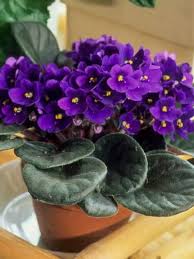
If you want something that flowers, African violet is the most straightforward safe option. It is compact, colorful, and listed as non-toxic to cats by the ASPCA. [1] If you want a flowering non-toxic indoor plant for cats that is easy enough to keep in a small space, this is the first one to consider.
It works on windowsills, shelves, and small tables. It blooms in shades of purple, pink, and white, and unlike a lot of flowering plants, it does not need to be grown in a massive pot to look good.
African violet prefers bright, indirect light. Too much direct sun scorches the leaves; too little reduces flowering. Water at the soil level and avoid getting the fuzzy leaves wet — water on the leaves causes spotting. Let it tell you when it needs water by watching the soil, not by following a fixed schedule.
For cat owners, the soft flowers may attract batting or nibbling. A calm cat may investigate and move on. A more enthusiastic cat may turn it into a regular project. Placement near the light it needs — but away from your cat’s main traffic routes — tends to be the sweet spot.
It is also worth noting that chamomile, which appears in some plant lists as a gentle option, is actually listed as toxic to cats by the ASPCA. [1] African violet does the same job as a flowering choice without that concern.
| Best for | small spaces, windowsills, adding color |
| Care level | moderate |
| Cat-owner note | a safer flowering choice — position away from high-traffic cat spots |
10. Peperomia (Peperomia spp.)

Peperomia is the plant that proves compact and low-maintenance does not have to mean boring. The genus covers over a thousand species — thick waxy leaves, rippled textures, trailing varieties, tidy rosettes — and the entire genus is considered non-toxic to cats by the ASPCA. [1] That consistency is genuinely useful: if you want to collect a few different varieties without re-checking safety every time, the whole Peperomia family has you covered.
Peperomia prefers bright, indirect light and does not like being overwatered. The thick leaves store water well, so if you tend toward over-enthusiasm with the watering can, peperomia will actually benefit from some restraint.
It works beautifully on desks, shelves, windowsills, and side tables. It stays compact, does not require high humidity, and is generally less fussy than calathea or Boston fern. For anyone looking for cat-safe plants for apartments where space and simplicity both matter, peperomia belongs near the top of the list.
For cats, the thicker leaves are less immediately interesting than trailing fronds or dangling plantlets — though a determined nibbler will still nibble. Keeping it slightly out of easy reach is enough in most cases.
Peperomia is a good final recommendation because it rewards both beginners and experienced plant owners, and it fits nearly any space. Style and sense. A rare pairing.
| Best for | shelves, desks, apartments, beginners and plant collectors alike |
| Care level | easy |
| Cat-owner note | the whole genus is ASPCA non-toxic — useful if you want multiple varieties |
Which Cat-Friendly Plant Works for Your Home?
The right plant depends on more than toxicity status. It depends on your light, your space, and — honestly — your specific cat. Here is a quick breakdown by situation.
Best Indoor Plants Safe for Cats — for Beginners
If you are just starting out, go for spider plant, parlor palm, peperomia, or cat grass. These are the most forgiving options — low-maintenance plants safe for cats that can handle inconsistent watering, lower light, and general first-time-plant-owner learning curves without giving up on you immediately. If you are still figuring out how your cat responds to greenery, start here before moving on to anything more demanding.
Cat-Safe Plants for Apartments
For smaller homes, the best cat-safe plants for apartments are the ones that do not need a lot of floor space or intense light management. Peperomia, spider plant, African violet, and cat grass work beautifully on windowsills and shelves. Parlor palm fits a corner without overwhelming the room. Hanging baskets on ceiling hooks are your friend — just map out whether your cat can reach the plant by jumping from nearby furniture before you commit to a spot.
Best for Lower-Light Rooms
Parlor palm is the strongest low-light option among non-toxic indoor plants for cats. It tolerates rooms without direct sun better than most palms. Calathea can manage medium indirect light too, though it needs more careful watering. No plant genuinely thrives in a completely dark room — if a space gets very little natural light, pick one or two lower-light tolerant options rather than forcing sun-lovers to struggle through.
Hanging Plants Safe for Cats
Spider plant and Boston fern are the obvious choices for pet-safe houseplants in hanging baskets. Both look their best when the growth can spill downward, and elevation puts them out of reach of floor-level curiosity. Before you hang anything, check whether there is a jumping route — cat tree, wardrobe, open shelving — that puts the plant back within reach. Cats are very committed when they want something.
Best for Cats That Chew Everything
This is what cat grass was made for. If you are specifically looking for safe plants for cats that chew, cat grass gives your cat something they are actively allowed to bite. That may reduce the appeal of everything else — or it may not, because cats. Beyond that: heavy pots resist tipping, covered soil discourages digging, and keeping trailing foliage out of easy eye line removes the temptation before it begins.
Cat-Safe Does Not Mean Cat-Proof
This is the part of every plant guide that tends to get skipped. A plant being non-toxic does not mean your cat will leave it alone, cannot damage it, or will not cause you to find it in three pieces on the floor on a Tuesday.
Cats may chew leaves, dig in soil, topple pots, bat at stems, or simply choose to sit directly inside a plant like it was designed as a throne. That is not a sign of the wrong plant. That is a cat.
Some practical adjustments that actually help:
- Use heavy pots — ceramic and terracotta are much harder to tip than lightweight plastic nursery containers
- Cover soil with large smooth stones to deter digging (not small decorative gravel that can be swallowed)
- Place delicate plants out of reach — then check whether your cat can actually reach it by jumping from nearby furniture
- Increase playtime if your cat fixates on plants — boredom is often the actual problem
- Offer cat grass as a designated chewing option
And if a plant becomes a genuine obsession rather than occasional curiosity, move it somewhere it cannot be accessed. Even non-toxic plants are not designed to be eaten regularly, and persistent chewing is worth discouraging regardless of what the safety database says about the plant.
What to Do If Your Cat Eats a Plant
If your cat takes a small nibble from a plant you know is non-toxic, remove access to the plant and watch your cat for the next few hours. Mild stomach upset is possible, but most cats recover quickly without intervention.
Contact your vet if your cat vomits repeatedly, drools heavily, seems lethargic, stops eating, has diarrhea, or behaves unusually after eating any plant material.
If you are not certain what your cat ate, treat it seriously. Take a photo of the plant, keep the label if you have it, and call your vet or the ASPCA Animal Poison Control Center for guidance. [1] Do not wait for symptoms to develop — particularly if lilies were anywhere in the picture.
True lilies and daylilies are among the most dangerous plants for cats. Even small exposures — including pollen, leaves, or water from a vase — can cause acute kidney injury. [3] That is why plant selection is not just an aesthetic decision.
The right plants make for a calmer home. The wrong ones make for a very expensive Tuesday.
Final Thoughts
You do not have to choose between a home with plants and a home that is safe for your cat. What you do have to do is choose more carefully than someone without cats.
The ten plants in this article give you real range — trailing, compact, flowering, structural, and everything in between. All ten are listed as non-toxic to cats by the ASPCA. [1] All ten come with honest care requirements that most people can actually manage. And each one includes a real note about what your cat is likely to think of them, because the safety list and the reality of living with a cat are two very different things.
A calm senior cat who has never shown interest in plants gives you a lot of freedom. A six-month-old kitten who treats the entire apartment as an obstacle course requires smarter placement and a bit more planning. Neither situation is insurmountable.
Start with the easier options. Watch how your cat responds. Adjust placement when needed. Keep cat grass accessible as a yes option. And always check the label before you buy — common names are unreliable, and the ASPCA database is free.
A greener home is absolutely possible. It just takes slightly more thought than it would if you lived alone.
Frequently Asked Questions
What houseplants are safe for cats?
Plants commonly listed as non-toxic to cats by the ASPCA include spider plant, areca palm, Boston fern, calathea, prayer plant, parlor palm, bamboo palm, baby’s tears, cat grass, African violet, and peperomia. [1] Always check the exact plant name before buying, since common names can refer to different species with very different safety profiles.
What is the safest indoor plant for cats?
There is no single answer because it depends on your cat’s temperament and your home setup — but spider plant, parlor palm, peperomia, and cat grass are strong starting points. All four are listed as non-toxic to cats by the ASPCA [1], all four are genuinely easy to maintain, and all four are widely available. If your cat chews plants, cat grass is the most practical answer because it is the one plant they are actually allowed to eat. If you want something decorative with minimal fuss, parlor palm or peperomia are reliable.
What plants should cat owners avoid?
Some of the most commonly encountered toxic plants for cats include lilies (especially true lilies and daylilies, which can cause acute kidney injury), pothos, philodendron, sago palm, aloe vera, and peace lily. The ASPCA maintains a full toxic plant list that is searchable by name. [1] For a deeper look at specific plants to avoid and why, see our separate guide on toxic houseplants for cat owners.
Are cat-friendly plants safe for kittens?
Generally yes — if a plant is listed as non-toxic to cats by the ASPCA, that applies to cats at any life stage. [1] But kittens warrant extra caution for two reasons. First, they chew more than adult cats, which means a higher chance of consuming enough plant material to cause stomach upset. Second, their smaller body size means any digestive reaction may be more intense. For kitten households, extra care with placement is wise — elevated shelves, hanging baskets, and heavy pots that cannot be tipped all matter more when a kitten is working through their enthusiastic phase.
Are spider plants really safe for cats?
Spider plant (Chlorophytum comosum) is listed as non-toxic to cats by the ASPCA. [1] That said, cats are often very attracted to the dangling plantlets, and some will chew them enthusiastically. Chewing large amounts of any plant can cause mild stomach upset regardless of toxicity status. Hanging placement helps reduce access without removing the plant entirely.
Are palms safe for cats?
Some palms are — areca palm, parlor palm, and bamboo palm are all listed as non-toxic to cats by the ASPCA. [1] However, sago palm is highly toxic to both cats and dogs, and even small amounts can be fatal. The name “palm” tells you very little about safety, so the specific variety matters enormously. Always verify the botanical name.
Are ferns safe for cats?
It depends entirely on the fern. Boston fern (Nephrolepis exaltata) is generally considered safe. Asparagus fern, on the other hand, is listed as toxic. The word “fern” in a plant name is not a safety indicator — always identify the exact species before bringing it home.
Is bamboo palm the same as lucky bamboo?
No. Bamboo palm (Chamaedorea seifrizii) and lucky bamboo (Dracaena sanderiana) are completely different plants. Bamboo palm is listed as non-toxic to cats by the ASPCA. [1] Always verify the botanical name when the common name contains bamboo — it is one of the most consistently confusing plant marketing terms.
Is chamomile safe for cats?
No. Chamomile — including Roman chamomile — is listed as toxic to cats by the ASPCA, despite being associated with calming herbal teas for humans. [1] It was removed from this list for that reason and replaced with African violet as a safer flowering option.
Can cats eat cat grass every day?
Some cats handle regular cat grass access well. Others eat too much and vomit, which suggests limiting or supervising access. Cat grass grown from wheat, oat, barley, or rye is considered safe [2], but how much is too much depends on the individual cat. If frequent vomiting follows cat grass access, reduce availability rather than eliminating it entirely.
Can a non-toxic plant still make my cat sick?
Yes. Non-toxic means the plant does not contain compounds expected to cause poisoning — it does not mean your cat’s digestive system will welcome large amounts of plant material. Chewing too much of almost any plant can cause stomach upset, vomiting, or diarrhea. The goal is to limit access, not to give your cat unlimited grazing rights on the grounds that the ASPCA says it is safe.
How do I stop my cat from eating houseplants?
Understanding the reason helps. Some cats chew out of boredom, some like the texture, and some have learned that chewing plants gets a very entertaining human reaction. Provide cat grass as an approved alternative. Use hanging baskets for trailing plants. Move tempting plants out of your cat’s regular routes. Increase playtime if boredom seems to be the driver. And use heavy pots — cats are much less motivated to knock something over when it does not move easily.
Sources
[1] ASPCA Animal Poison Control Center — Toxic and Non-Toxic Plant List: Cats
[2] Hill’s Pet — Cat Grass: Is It Safe for My Cat?
[3] FDA — Lovely Lilies and Curious Cats: A Dangerous Combination
Related Posts:
10 Toxic Houseplants Every Cat Owner Should Avoid
Help! My Cat Ate a Toxic Plant – What to Do Right Now?