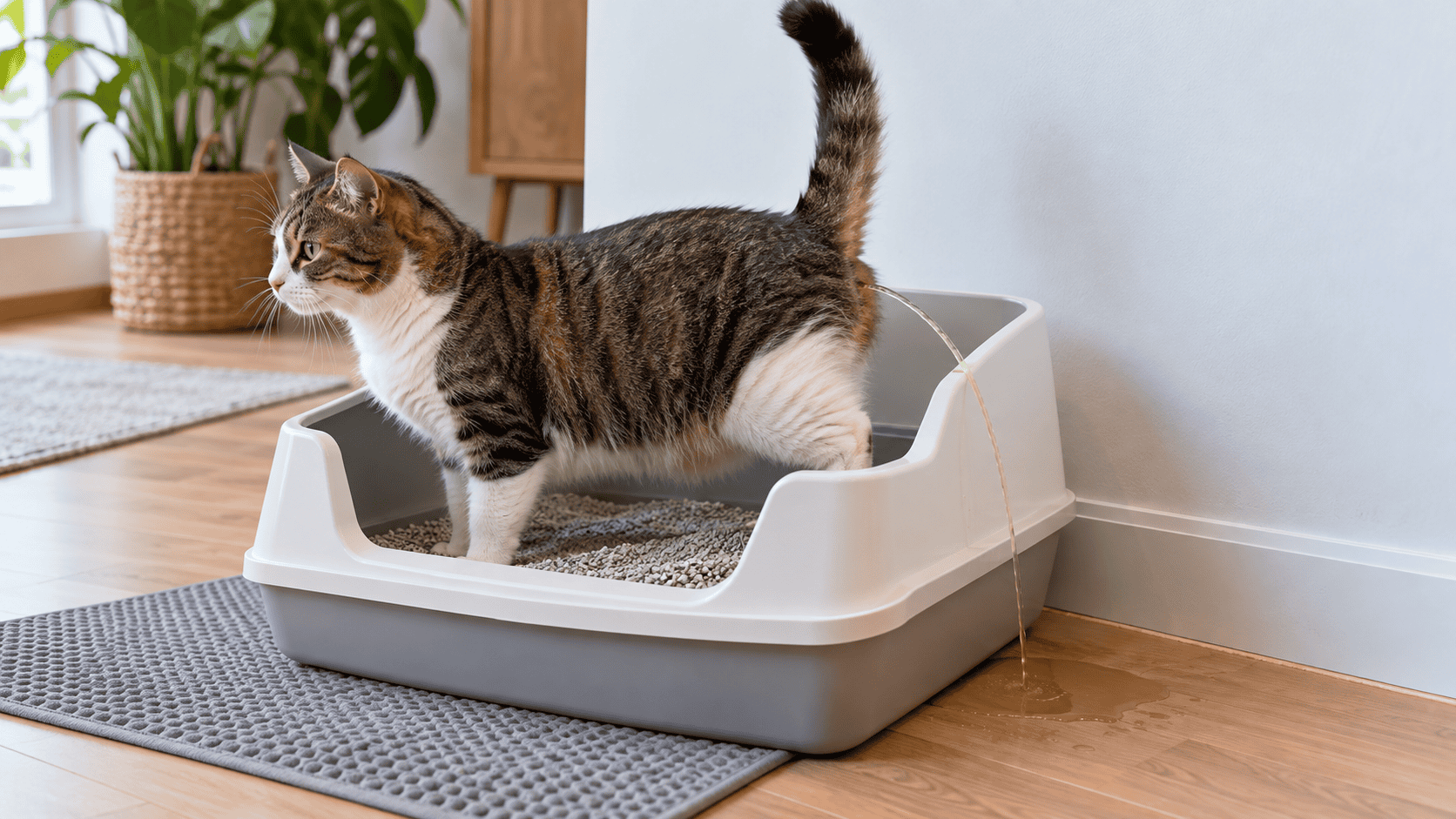
;

Cat Peeing Over the Edge of the Litter Box? Why It Happens and How to Stop It

Affiliate disclosure:This page contains affiliate links. I may earn a commission on qualifying purchases at no extra cost to you.

Cat Peeing Over the Edge of the Litter Box

Quick Answer
A cat may pee over the edge because they urinate standing up, gradually raise their rear mid-stream, don’t have enough room to position themselves, or hit a seam or entrance gap. A larger box, taller continuous walls, or a low-entry design with high sides usually solves it β€” but a sudden posture change is worth a vet visit.

Your cat climbs into the litter box, does what they’re supposed to do, and somehow you still end up wiping urine off the floor.

It’s a frustrating kind of failure, because technically, your cat is using the litter box.

If you’ve got a cat peeing over the edge of the litter box, I wouldn’t jump straight to “litter-box training problem.” The more useful question is simpler: how is the urine actually getting out?

A cat that urinates too high needs a different fix from a cat whose rear hangs over the entrance. And neither problem is quite the same as urine leaking through the seam of a covered box.

Once you identify the pattern, choosing the right fix gets a lot easier..

Table of Contents

First, Watch Exactly How the Urine Gets Out

Before buying another litter box, watch your cat use the current one if you can do it without disturbing them.

This is where I start, because “pees over the edge” can describe several very different problems.

What you see What to check first
Your cat squats but gradually raises their rear Standing/high urination; whether the posture is longstanding or new
Your cat stands and urine clears the back or side wall Effective wall height
Your cat's rear hangs over the low entrance Usable interior length and positioning
Your cat only steps partly inside before urinating Box size, entry comfort and mobility
Your cat balances on the rim with only one or two feet inside Box cleanliness, litter preference and box placement. [1]
Urine hits a covered-box wall and appears underneath The seam between the hood and base
Urine exits through an opening or vent Box design, rather than overall box height
Your cat pees normally in one box but high in another Compare the size, shape, headroom and entrance of the two boxes
An older cat has suddenly stopped squatting Pain or reduced mobility should be investigated. [2]
A small amount of urine is deposited on a vertical surface with typical marking posture Consider urine marking rather than ordinary bladder emptying. [3]

That distinction matters, because higher walls won’t help much if urine is escaping through the front entrance.

Likewise, a covered box may not solve anything if urine is finding its way through the joint between the hood and the lower tray.

The goal isn’t simply to buy a “better” litter box. It’s to find a box that solves your cat’s particular way of missing it.

I work through every one of these cases the same way: Watch, Measure, Match, Test. This section is the first step, and the rest of the guide covers the other three.

Why Does My Cat Pee Standing Up in the Litter Box?

 cat pee standing up in litter boxA cat peeing standing up in the litter box isn’t necessarily doing anything wrong.

Some cats simply eliminate from a standing position. VCA specifically notes that this can cause urine or stool to fall outside the box and recommends a backsplash or high-sided box when necessary. [4]

Other cats begin in a normal squat but slowly lift their rear as they continue peeing. To an owner, it looks like the cat’s backside is riding an invisible elevator. If you see the stream start low and end high, that points to posture and box geometry rather than a one-off aim problem.

Whether you’d describe it as a cat peeing high in the litter box or a cat that raises its butt while peeing, the practical problem is the same: the stream ends up higher than the litter-box wall.

If your cat has always urinated this way and otherwise seems healthy, the solution may simply involve changing the box setup.

If the posture is new, however, I’d pay closer attention β€” especially if your cat is suddenly not squatting to pee when they used to.

A Sudden Change in Peeing Position Deserves More Attention

There’s a big difference between:

“My cat has always peed standing up,”

and:

“My cat used to squat, but recently started standing.”

Pain can change the way a cat positions their body to urinate.

VCA lists standing while urinating instead of squatting among possible signs of pain in aging cats. It specifically explains that squatting may become painful, and that a cat standing to urinate may then hit a nearby vertical surface or the surrounding floor. [2]

That doesn’t mean every standing cat has arthritis or another painful condition.

It means a new change in posture gives you additional information worth discussing with your veterinarian.

I’d be especially cautious if the change comes with:

  • repeated trips to the litter box;
  • straining to urinate;
  • crying or obvious discomfort while urinating;
  • blood in the urine;
  • excessive licking around the genital area;
  • very small amounts of urine;
  • or little to no urine despite repeated attempts.

Cornell University College of Veterinary Medicine warns that urethral obstruction is a true medical emergency. An affected cat may repeatedly attempt to urinate while producing little or no urine, and can deteriorate rapidly if the obstruction isn’t relieved. [5]

So before redesigning the litter-box station, make sure you aren’t looking at a health problem disguised as a messy bathroom habit.

Is Your Cat's Litter Box Actually Big Enough?

“Get a bigger litter box” is common advice, but “bigger” doesn’t tell you much. The number to aim for is a rectangular box about 1.5 times your cat’s length, measured from nose to the base of the tail, according to the AAFP/ISFM house-soiling guidelines. [1]

A box can look enormous from the outside while giving the cat surprisingly little usable space inside, because of sloping walls, thick rims, curved corners, or a bulky hood.

The same guidelines add that in one study, adult cats preferred a box measuring 34 Γ— 15 inches (86 Γ— 39 cm) over a smaller one. That’s a study result rather than a hard minimum, but it’s a useful reference point when you’re comparing boxes. [1]

The guidelines also note that many commercial litter boxes are too small, and suggest large alternatives such as storage containers or concrete mixing trays when necessary. [1]

So I wouldn’t rely on labels like “large” or “XL,” especially for big or long-bodied cats, who can outgrow even those.

Measure your cat, then measure the flat usable interior of the box.

A long cat forced to turn around in a short box may end up positioning their rear much closer to an edge than you’d realize.

And that can explain why you have a cat peeing over the side of the litter box even though the box looks large enough at first glance.

The CatsFanatic 5-Point Litter Box Fit Check

Before buying another box, use this five-point check.
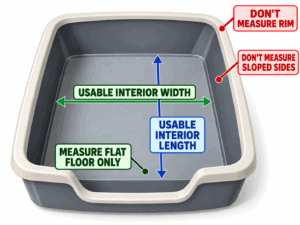
1. Usable Interior Length

Can your cat walk completely inside without their rear staying near the entrance? Can they comfortably turn around?

A cat whose body nearly fills the box has far less freedom to choose where their rear ends up.

Veterinary guidance recommends providing enough room for a cat to enter, turn, eliminate, and dig comfortably. [1][4]

This is why interior measurements matter more than the product’s outside dimensions.

2. Usable Interior Width

Length gets most of the attention, but width affects positioning too.

Your cat should have enough room to turn without squeezing against the sides or stepping awkwardly around the box.

A bulky hood or inward-sloping walls can make a supposedly large box feel much smaller.

3. Entry Height

This becomes especially important for older cats and cats with reduced mobility.

A giant high-sided box isn’t much use if your cat finds the entrance uncomfortable.

For hospitalized cats, the 2022 ISFM/AAFP Cat Friendly Veterinary Environment Guidelines recommend litter boxes that are easy to enter and exit, preferably low-sided or with high clear walls and a low entry door. [6]

The same idea works at home. The AAFP/ISFM house-soiling guidelines show a storage container with one side cut down as an easy-entry option for an older cat or one with joint disease, and VCA advises that senior cats and cats with compromised mobility need sides low enough to enter and exit comfortably. [1][4] A low front with tall back and side walls gives you containment without the climb.

4. Effective Containment Height

This is different from the total height printed on the box.

What matters is the distance from the top of the litter to the point where your cat’s urine hits the wall.

If you pile in several inches of litter, you’ve effectively shortened the wall above it. But don’t strip the litter back to gain height: the AAFP/ISFM guidelines recommend at least about 1.25 inches (3 cm), and cats vary in how much depth they prefer. [1]

And if your cat urinates almost horizontally while standing, even a box marketed as “high-sided” may not contain the stream.

5. Escape Points

Now inspect the box itself.

Look at the entrance. Look at vents. Look at the seam where a covered box clips onto its base. Look at overlapping plastic panels.

A box can have tall walls and still leak badly if your cat’s urine hits a gap halfway up them.

This is where the simple advice to “buy higher sides” starts to fall apart.
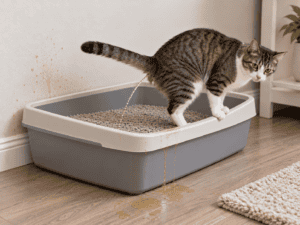
Match the Litter Box to the Way Your Cat Pees

Once you know how the urine escapes, you can choose a design that actually addresses it.

If your cat stands completely inside but pees over the back or wall of the litter box, a high sided litter box for a cat that pees standing up may be enough. Veterinary litter-box guidance specifically recognizes higher sides or a backsplash as useful for cats that eliminate while standing. [4]

If your cat’s rear stays over the entrance, adding an even taller back wall misses the real problem.

You may need a longer box that lets the cat step farther inside, or an entrance arrangement that changes how much usable space remains behind them.

If your senior cat struggles to step over a tall front wall, look for a low entrance combined with taller back and side walls. [1][4]

And if urine keeps leaking from a covered box, I’d look carefully at the box seams before replacing it with another covered model.

In other words, the best litter box for a cat that pees high isn’t necessarily the tallest one on the shelf.

It’s the one whose dimensions and construction match the way that particular cat urinates.

Why High-Sided and Covered Litter Boxes Can Still Leak

A covered litter box sounds like the obvious answer. Put a roof and taller walls around the cat, and surely the pee stays inside. Not always.

A covered litter box leaking urine can fail in several ways. The cat may aim through the entrance. Urine can reach ventilation openings. Or it may strike the upper hood and travel down toward the joint between the hood and the lower tray.

At that point, the problem isn’t simply wall height. It’s construction. That’s why I prefer thinking in terms of continuous containment where the urine actually lands, rather than assuming “covered” automatically means leak-proof. A tall wall stops urine only if the wall stays solid where the urine hits.

It also helps to know that cats are roughly split on covered versus open boxes, that small covered boxes can make it hard for larger cats to posture normally, and that the AAFP/ISFM guidelines recommend open boxes where possible because they’re easier to monitor and scoop. A cat may also avoid a covered box that holds odor, then go back to it once it’s cleaned. [1]

What If Your Cat Pees Through the Litter Box Entrance?

If your cat pees out the front of the litter box, the cat may climb in, turn around β€” or not β€” and urinate directly toward the low entrance.

The geometry is simply working against you.

Before replacing the box, watch how far your cat enters.

If their body takes up most of the usable length, they may not have enough space to position themselves farther from the opening.

A longer box may help more than taller sides.

This is another reason the AAFP/ISFM recommendation to provide a box around 1.5 times the cat’s body length is useful. [1]

You can also watch whether your cat consistently faces the same direction when entering the box. Sometimes the issue isn’t overall height β€” it’s simply that the lowest part of the box is exactly where the urine is going.

Is Your Cat Perching on the Rim? Check Cleanliness and Placement

Some cats never step fully into the box. They balance on the rim with one or two feet inside and let the rest of the body hang over, which is how urine ends up on the edge, the floor, or the wall behind the box.

The AAFP/ISFM guidelines say that balancing on the edge with only one or two feet inside may point to an aversion to the litter or to a soiled box, and a soiled box can cause aversion by itself. [1] Before you change the box, check the basics:

  • how often waste is scooped (at least once a day, and no litter or deodorizer replaces regular cleaning);
  • how often the box is washed with soap and hot water, every one to four weeks, avoiding ammonia-based products;
  • whether the litter is fine, unscented and clumping, since many cats find aromatic litters and deodorizers offensive;
  • whether the box sits in a quiet, accessible spot, away from food and water;
  • and, in a multi-cat home, whether there are enough boxes (the traditional rule is one more than the number of cats). [1]

If the perching started after a change, such as a new litter, a moved box or a new pet, undo that one change and watch what happens. That’s the Test step again: your cat is giving you information about the box.

And if you’re finding urine on the wall behind the box, work out whether your cat is peeing high from a standing position, which the containment sections above cover, or backing up to the wall with a raised, quivering tail, which points to marking and is covered in the spraying section below.

Can You Use a Storage Tote as a Litter Box?

Yes, and this isn’t merely an internet hack.

The AAFP/ISFM house-soiling guidelines specifically recommend considering alternatives such as sweater boxes, under-bed storage containers, and other large containers when commercial litter boxes aren’t large enough. [1]

A large tote can be useful because it may provide:

  • generous floor space;
  • tall continuous walls;
  • fewer openings;
  • and no hood-to-base seam.

But don’t just grab the tallest container you can find.

A very high entrance may create a new problem, especially for a senior cat.

The AAFP/ISFM owner guidance notes that older cats may need a lower entry, and illustrates modifying a storage container accordingly. [1]

If you cut an entrance into plastic, make sure the resulting edge is smooth and safe. The finished box also needs to stay stable and large enough for your cat to turn comfortably.

Think of a storage tote as another litter-box design β€” not a guaranteed cure.

What If a Senior Cat Starts Peeing Over the Edge?

A senior cat peeing over the litter box deserves a slightly different approach.

Older cats can develop pain or reduced mobility that changes the way they squat, climb into a box, or turn inside it.

VCA specifically notes that painful aging cats may begin standing to urinate instead of squatting. [2]

At the same time, simply giving the cat a box with tall walls everywhere can make entry harder.

That creates an apparent contradiction: you need tall walls to catch the urine, but your cat needs a low entrance to get inside comfortably.

Fortunately, those two things can coexist.
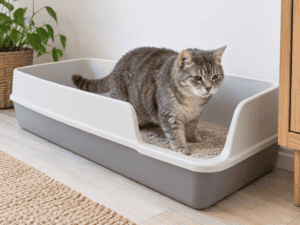
litter box with low entry side for senior catsA long box with a low front entry and higher back and side walls can give an older cat easier access while still providing greater containment.

The ISFM/AAFP Cat Friendly Veterinary Environment Guidelines describe the same design for hospitalized cats, and the AAFP/ISFM house-soiling guidelines show a cut-down storage container as an easy-entry option for older cats and cats with joint disease. [1][6]

I’d also place the box somewhere your senior cat can reach without unnecessary stairs or slippery flooring. The AAFP/ISFM guidelines make a similar point: cats with arthritis, weakness or impaired vision can struggle to reach boxes in basements or far from their core territory, so move or add boxes closer. [1]

The goal isn’t simply to stop the mess. It’s to make toileting physically easier.

Is Your Cat Peeing Standing Up or Spraying?

Standing while urinating does not automatically mean spraying.

This distinction matters, because the solutions are different.

VCA’s veterinary behavior guidance describes typical urine spraying as the deposition of a relatively small amount of urine onto a vertical surface. A spraying cat commonly backs toward the surface, remains largely upright, and may quiver the tail. [3]

A cat emptying their bladder inside the litter box while standing may simply have an unusual urination posture.

So if your cat pees against the litter box wall, look at the whole behavior rather than posture alone.

Ask:

  • Is the cat entering the litter box specifically to urinate?
  • Is there a normal bladder-sized amount of urine?
  • Or are you finding small amounts of urine on multiple vertical surfaces elsewhere in the home?
  • Does the cat back toward the target with the tail raised and quivering?

If marking seems possible β€” particularly if it’s a new behavior β€” talk with your veterinarian rather than assuming the litter box itself is the only issue

What If Your Cat Only Pees High in One Litter Box?

This is one of my favorite troubleshooting clues, because it lets your cat do some of the detective work for you.

Suppose your cat squats normally in one open box but stands to urinate in a covered or automatic box.

That comparison tells you to inspect the box, not just the cat.

Compare:

  • usable floor space;
  • entrance height;
  • entrance position;
  • headroom;
  • wall angles;
  • floor curvature;
  • litter depth;
  • and room to turn.

If changing the box changes the posture, that’s useful information.

It doesn’t prove there’s no medical issue, but it suggests box geometry may be influencing how your cat positions themselves.

This is also why changing one thing at a time can teach you much more than replacing the entire litter setup in one afternoon.

If your cat uses two boxes differently, treat that contrast as evidence: note which box changes the posture, then compare the dimensions, entry, headroom and usable floor space.

Protect the Floor While You Fix the Problem

You don’t have to sacrifice your floor while experimenting.

Use a large waterproof litter mat that extends beyond the side where urine actually escapes.

A tiny litter mat directly in front of the entrance won’t protect much if your cat urinates over the back wall.

If urine reaches a wall or baseboard, protect that area too.

If you use a storage tote, the AAFP/ISFM guidelines suggest standing its lid upright behind the box to shield the wall. [1]

And clean previous urine thoroughly, so you aren’t left with lingering odor even after the litter-box problem has been solved.

A pet-urine enzymatic cleaner may be useful on compatible surfaces.

The temporary protection doesn’t have to be pretty. It just needs to buy you time while you work out which box configuration keeps the urine where it belongs.

Change One Thing at a Time

This is where many litter-box experiments become confusing.

You buy a new box. Change the litter. Move the box. Add a mat.

And then your cat behaves differently β€” but you have no idea which change mattered.

This is the Test step, and the rule is simple: change one variable at a time.

Where practical, keep the familiar litter and location while testing the new box.

Watch which box your cat chooses. Watch whether their posture changes. Watch exactly where the urine lands.

Veterinary litter-box guidelines also support offering alternative setups to assess a cat’s preferences, rather than assuming every cat will prefer the same arrangement. [1]

If the new box solves the problem, you’ve learned something useful about what your cat needs.

If it doesn’t, you’ve still narrowed the possibilities.

Troubleshooting gets a lot easier once you stop changing five variables at once.

That’s the whole method, and it’s the same four steps every time: watch first, measure second, match the setup to the behavior, and test one change at a time.

When Should You Call Your Veterinarian?

A messy litter box can look like a simple equipment problem, but changes in urination deserve attention.

Contact your veterinarian if your cat suddenly starts urinating differently or shows signs such as:

  • straining;
  • frequent attempts to urinate;
  • crying or obvious pain;
  • blood in the urine;
  • excessive genital licking;
  • or other new urinary accidents. [5]

And if your cat repeatedly tries to urinate but produces little or no urine, seek emergency veterinary care.

Cornell University College of Veterinary Medicine describes urethral obstruction as a true medical emergency that requires immediate veterinary attention. [5]

For an older cat, don’t dismiss a new standing posture as laziness or bad aim.

It may simply be time to make the litter box easier to use β€” but it’s worth finding out why the posture changed.

Quick Fix Cheat Sheet: Match What You See to What to Do

That’s a lot of detail, so here it is in one place. Find what you’re seeing, try the matching fix, and change only one thing at a time

What you see What to do
Your cat squats, then gradually raises their rear Use a box with taller continuous walls or a backsplash, with enough length to move around. If the posture is new, see your vet first. [2][4]
Your cat stands and urine clears the back or side wall Switch to a high-sided box or add a backsplash. Keep the front low if your cat is older. [4]
Your cat's rear hangs over the entrance, or urine comes out the front Get a longer box, about 1.5 times your cat's nose-to-tail-base length, so they can step farther in. [1]
Your cat perches on the rim with only one or two feet inside Scoop daily, wash the box every one to four weeks with soap and hot water, and switch to unscented clumping litter. Undo any recent change. [1]
Urine leaks at the seam or vents of a covered box Move to an open box or a large storage tote with continuous walls and no seam. [1]
Your senior cat struggles to climb in Choose a low front entry with tall back and side walls. [1][6]
Your cat pees high in one box but normally in another Compare size, entrance, headroom and wall angles. Copy what works, changing one thing at a time.
Urine lands on the wall or floor behind the box Add a waterproof surface that extends past the escape side, and stand a tote lid upright behind the box. [1]
A small amount of urine on vertical surfaces, with a raised, quivering tail This is likely marking, not a box problem. Talk to your vet. [3]
Sudden new standing, straining, crying or blood in the urine Call your vet. [2][5]
Repeated attempts to urinate but little or no urine Emergency. Go to a vet immediately. [5]

The Bottom Line

If your cat pees over the edge of the litter box, don’t immediately buy the tallest box you can find.

First figure out how the urine is escaping.

Is your cat standing? Does their rear gradually rise? Are they hanging over the entrance? Does urine hit a seam? Do they only pee high in one particular box?

Once you know that, you can match the solution to the problem.

For many cats, that means a roomier box with higher continuous walls. For an older cat, it may mean a low entrance with high back and side walls. For others, a large storage container may work better than a conventional covered box. [1][4]

The important part is that the litter box should fit both your cat’s body and the way your cat actually uses it.

Frequently Asked Questions

Why does my cat raise their butt while peeing?

Some cats start in a squat and gradually raise their rear as they urinate. If this has always been your cat’s normal posture and they otherwise appear well, a higher-sided setup may be enough to contain the urine. If your cat has suddenly changed from squatting to standing, especially if they’re older, have them checked for pain or other medical problems. [2]

Why does my cat pee standing up in the litter box?

Some cats naturally eliminate from a standing position. [4] Others may stand because squatting has become uncomfortable. [2] The important clues are whether this is a longstanding habit or a new behavior, whether your cat appears comfortable, and whether there are additional urinary symptoms. A longstanding habit in an otherwise healthy cat is usually a box-setup problem, while a new change is worth a vet check before you buy anything.

Is peeing standing up the same as spraying?

No. Standing posture alone doesn’t prove that a cat is spraying. Typical spraying involves a relatively small amount of urine deposited for marking, commonly on a vertical surface while the cat is standing with the tail raised and often quivering. [3] A cat that stands in the box and empties a normal-sized bladder is more likely a high-peeing cat, though a new marking pattern is worth raising with your vet.

Why does my cat pee against the wall of the litter box?

Your cat may simply prefer a higher urination posture or position their rear close to the wall. If the urine stays inside, it may not be a problem. If it escapes, a taller continuous wall or different box design may help. Check, too, that the box isn’t pushed so close to the wall that your cat has little room to position themselves. A sudden change in posture deserves veterinary attention. [2]

Why does my cat pee on the edge of the litter box?

A cat that balances on the rim with only one or two feet inside may be avoiding the litter or a soiled box, according to the AAFP/ISFM guidelines. [1] Scooping at least once a day and washing the box every one to four weeks with soap and hot water are the first fixes. If the habit is new or comes with straining or other urinary changes, check with your vet rather than assuming it’s the box. [5]

Why does my cat pee through the front of the litter box?

Your cat may be positioning their rear toward the entrance, or may not have enough interior space to move farther inside. Check the usable internal dimensions before assuming you simply need higher walls. Veterinary guidance recommends a box approximately 1.5 times the cat’s nose-to-tail-base length. [1] If the box is already roomy, watch whether your cat always faces the same way when entering, because the low spot may simply be where the urine is going.

Why does urine leak out of my covered litter box?

Urine may escape through the entrance or other openings, or it may hit the upper section and travel toward joints between pieces. Watch exactly where the urine lands before assuming the solution is another covered box. Small hoods can also make it hard for larger cats to posture normally, so a roomier open box with high sides is sometimes the better fix. [1]

Will a high-sided litter box stop my cat from peeing over the edge?

It can help if urine is simply clearing a wall that’s too low. VCA specifically recommends higher sides or a backsplash for cats that eliminate while standing. [4] It may not help if the urine is leaving through the entrance or another opening, and very tall sides can make entry harder for kittens, seniors and cats with sore joints, so pair them with a low front or cut-down entry where needed.

Why does my cat poop over the edge of the litter box?

Standing to defecate can send stool over the edge the same way standing to urinate sends urine over it, and VCA recommends a backsplash or high-sided box for cats that eliminate standing up. [4] A cat that has newly started standing to defecate may be in pain, though, so mention it to your vet if the change is recent. [2] If stool is landing in front of the box rather than over the back, check the box’s length and entry height first.

How big should a litter box be?

Aim for a rectangular box about 1.5 times your cat’s length, measured from nose to the base of the tail. [1] In one study, adult cats preferred a 34 Γ— 15 inch (86 Γ— 39 cm) box over a smaller one, though that’s a study result rather than a minimum. Measure the usable interior, not the number on the packaging, because sloping walls and hoods can shrink it.

Can I use a storage tote as a litter box?

Yes. AAFP/ISFM guidelines specifically identify large storage containers as possible alternatives when ordinary commercial litter boxes are too small. [1] Older cats may need a lower entry (the guidelines show a tote with one side cut down), and any modified edges should be smooth and safe. Stand the lid upright behind the box to protect the wall, and check that your cat can still turn comfortably inside.

Does litter depth affect whether urine escapes the box?

Yes, and it’s an easy detail to miss. Effective wall height is measured from the top of the litter, not the floor of the box, so extra inches of litter quietly shorten the wall your cat’s urine has to clear. Don’t strip the litter back too far to compensate: the AAFP/ISFM guidelines recommend at least about 1.25 inches (3 cm), and cats vary in how much depth they prefer. [1]

How I Researched This Guide

This guide uses feline house-soiling, pain, accessibility and urinary-disease guidance from the AAFP/ISFM, VCA Animal Hospitals and Cornell Feline Health Center as the basis for its medical and safety information, and I checked each cited claim against its source page.

I then apply that guidance to a practical troubleshooting question: where is the urine actually escaping, and what box dimensions or design features match the way your cat uses the litter box? This guide is educational and is not a substitute for veterinary diagnosis or treatment.

Sources

[1] American Association of Feline Practitioners & International Society of Feline Medicine. “AAFP and ISFM Guidelines for Diagnosing and Solving House-Soiling Behavior in Cats.”

[2] VCA Animal Hospitals. “How to Recognize Pain in Aging Cats.”

[3] VCA Animal Hospitals. “Cat Behavior Problems: Marking and Spraying Behavior.”

[4] VCA Animal Hospitals. “House Training for Kittens and Cats.”

[5] Cornell Feline Health Center, Cornell University College of Veterinary Medicine. “Feline Lower Urinary Tract Disease.”

[6] International Society of Feline Medicine & American Association of Feline Practitioners. “2022 ISFM/AAFP Cat Friendly Veterinary Environment Guidelines.”