
The 10 Cat Breeds With Blue Eyes: Full Profiles
Origin: Thailand | Coat: Short, colorpoint | Blue-eye gene: Colourpoint (cs)
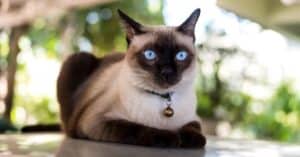 The Siamese is the blueprint. Nearly every other blue-eyed breed on this list either descends from the Siamese or was developed using Siamese genetics as a foundation — which tells you everything about how central this breed is to the story of blue eyes in cats.
Originating in Thailand — formerly known as Siam — the Siamese was prized by royal families and temple priests for centuries before reaching Europe in the late 1800s. It remains one of the most recognised and oldest cat breeds in the world.
Physically, the modern Siamese is defined by a lean, wedge-shaped head, large ears, and deep sapphire almond-shaped eyes. The CFA breed standard specifies ‘deep vivid blue’ eye colour and lists eyes other than blue as a disqualifying fault [1]. The coat is short, fine, and low-maintenance, with the classic colourpoint pattern in seal, chocolate, blue, or lilac.
The Siamese is not a quiet cat. This breed is one of the most vocal in existence — opinionated, persistent, and capable of sustained conversation. They are deeply social, form intense bonds with their people, and do not handle long solitary hours well. If you want an engaged, devoted companion who will follow you from room to room, few cats compare.
Health note: Purebred Siamese can be prone to amyloidosis and certain heart conditions. Their blue eyes are produced by the colourpoint gene — not the dominant white gene — so the elevated deafness risk associated with white cats does not apply [4].
Origin: California, USA | Coat: Semi-long, colorpoint | Blue-eye gene: Colourpoint (cs)
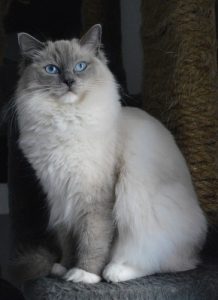 The Ragdoll is the gentle giant of the cat world, and its blue eyes are among the most striking of any domestic breed — large, luminous, and deeply coloured.
Developed in the 1960s by California breeder Ann Baker, the Ragdoll was intentionally bred for temperament as much as appearance. The lineage draws from Persians, Birmans, and Burmese — all chosen for calm, affectionate natures. The result is a large, plush cat that fully earns its name: when picked up, a Ragdoll goes limp and relaxed in your arms.
Ragdolls are one of the largest domestic cat breeds, with males regularly reaching 20 pounds. Their semi-long coat is silky rather than dense, requiring regular but not excessive grooming. The CFA breed standard specifies blue eye colour across every colour and pattern combination and lists eyes other than blue as a disqualifying fault [2].
These are profoundly social cats. They are playful without being hyperactive, and affectionate without feeling overwhelming. They follow their owners from room to room, greet visitors at the door, and get along well with children and other pets.
Health note: Ragdolls can be predisposed to hypertrophic cardiomyopathy (HCM). Responsible breeders screen for this. All Ragdolls have blue eyes — it is a fixed breed trait [2].
Origin: Burma (Myanmar) | Coat: Silky, colorpoint with white gloves | Blue-eye gene: Colourpoint (cs)
 The Birman — also known as the Sacred Cat of Burma — has one of the more evocative origin stories in the cat world. Legend holds that these cats were temple companions to Burmese priests, and that their distinctive white-tipped paws were granted as a mark of holiness. How the breed reached France in the early 20th century is less certain, but the reputation for grace has persisted.
What sets the Birman apart from other colourpoint breeds is those white-gloved paws — all four feet have pure white tips contrasting cleanly against the darker point colouring. The CFA breed standard describes the eyes as ‘blue, almost round’ and notes they are ‘set well apart, giving a sweet expression to the face’ [3].
Birmans are social and affectionate without the vocal intensity of the Siamese. They adapt well to homes with children or other pets and tend to be genuinely easy-going companions.
Health note: Generally a healthy breed, though some lines carry a risk of kidney disease. Their silky coat benefits from regular, gentle grooming.
Origin: USA (Siamese × Persian cross) | Coat: Long, colorpoint | Blue-eye gene: Colourpoint (cs)
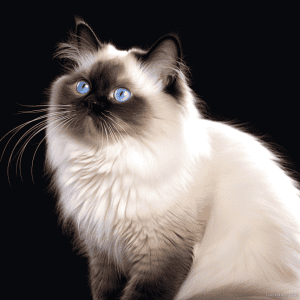 The Himalayan is what happens when you cross the colourpoint pattern and blue eyes of the Siamese with the luxurious coat and structure of the Persian. Formally developed in the United States in the 1950s, it delivers on both counts.
These cats have the flat-faced (brachycephalic) structure of the Persian — round head, short nose, compact heavy-boned body — and a long, thick, dense coat that is genuinely high-maintenance. Their eyes are a vivid, clear blue, consistent with the colourpoint gene shared across all pointed breeds, as confirmed in CFA breed standards [4].
From the Persian, Himalayans inherit a sweet, docile, and quietly affectionate nature. From the Siamese, a streak of playfulness that prevents them from being purely sedentary. Gentle with children, relaxed at home, and not particularly vocal.
Health note: The flat facial structure predisposes Himalayans to respiratory issues, eye discharge, and dental crowding — common in brachycephalic breeds. Their long coat requires daily grooming to prevent mats.
Origin: USA (longhaired Siamese mutation) | Coat: Long, silky, colorpoint | Blue-eye gene: Colourpoint (cs)
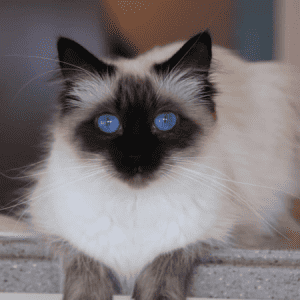 The Balinese is the Siamese in a longer coat — not a separate ancient breed, but a natural genetic mutation that appeared in Siamese litters and was subsequently standardised in the United States in the mid-20th century.
Despite the longer coat, the Balinese retains the lean Siamese body type, the same colourpoint pattern, and the same vivid blue eyes — produced by the identical colourpoint gene found across all pointed breeds [4]. The coat is fine and silky — a single layer that lies close to the body and flows rather than puffs — making it considerably easier to maintain than most longhaired breeds.
Personality is fully Siamese: highly intelligent, vocal, intensely social, and prone to mischief if under-stimulated. Known for being acrobatic and playful, the Balinese forms strong, demonstrative bonds with its people.
Health note: Like the Siamese, the Balinese can be prone to progressive retinal atrophy and certain heart conditions. Reputable breeders test for these.
Origin: North America (Siamese × Balinese cross) | Coat: Medium-long, silky, colorpoint | Blue-eye gene: Colourpoint (cs)
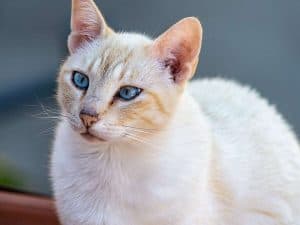 The Javanese was developed in North America as a cross between the Siamese and Balinese, named after the island of Java — near Bali — reflecting its lineage. The purpose was to expand the range of recognised colourpoint colours beyond the four traditional Siamese shades, adding lynx points, tortie points, and others.
Physically, the Javanese closely resembles the Balinese: slender, fine-boned, and elegant, with a medium-length silky coat and vivid blue eyes from the same colourpoint gene pathway [4]. In temperament it carries the full Siamese family character: vocal, deeply loyal, and mentally sharp.
Classification note: TICA now classifies the Javanese as a colour division within the Balinese breed standard rather than a separate breed. CFA still recognises it distinctly.
Origin: USA (Siamese × American Shorthair cross) | Coat: Short, colorpoint (extended colours) | Blue-eye gene: Colourpoint (cs)
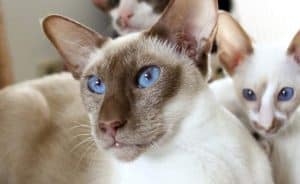 The Colorpoint Shorthair was developed to expand the Siamese colour range. Where the Siamese is recognised in four classic point colours, the Colorpoint Shorthair comes in more than sixteen colourpoint variations — including red, cream, lynx, and tortie points.
Physically near-identical to the Siamese: same lean body, same short low-maintenance coat, same deep blue almond-shaped eyes from the colourpoint gene [4]. The personality is equally Siamese — demanding of attention, highly vocal, and deeply social.
Classification note: CFA and the World Cat Federation recognise the Colorpoint Shorthair as a distinct breed. TICA considers it part of the Siamese breed group. Regardless of classification, the blue eyes are consistent and expected.
Origin: Thailand | Coat: Short, colorpoint | Blue-eye gene: Colourpoint (cs)
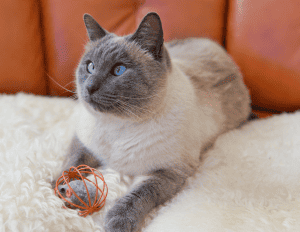 The Thai cat — also called the Traditional Siamese or Old-Style Siamese — represents what the Siamese looked like before decades of selective breeding pushed the breed toward its current extreme physique. Where the modern Siamese has an elongated wedge-shaped head and angular body, the Thai retains a rounder face and more moderate build.
TICA recognises the Thai cat as a distinct breed, preserving the original type. Their blue eyes and colourpoint pattern are produced by the identical genetic mechanism as the modern Siamese [4] — the difference between the breeds is structural, not chromatic. Most owners describe Thai cats as social and vocal, but slightly less intense than the modern Siamese.
Interesting fact: The Thai cat is sometimes described as a living record of what Siamese cats looked like when they first reached the West in the 1800s — before show standards began reshaping the breed’s silhouette.
Origin: New Mexico, USA | Coat: Short to medium, any colour | Blue-eye gene: Dominant blue eye (DBE / PAX3 mutation)
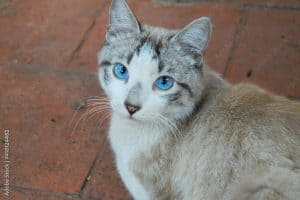 The Ojos Azules is no longer an active recognised breed. TICA removed it from breed status in 2014, and no known breeding programmes continue. It is included here because its genetics are genuinely significant — and because it remains a fascinating chapter in the history of blue-eyed cats.
First discovered in a feral cat colony in New Mexico in 1984, the Ojos Azules carried a dominant blue-eye mutation that decoupled eye colour from coat colour entirely. Most blue-eyed cats are blue-eyed because of the colourpoint gene or the dominant white gene, both of which also affect coat pigmentation. The Ojos Azules could produce deep blue eyes in cats of any coat colour or pattern — including dark and tabby coats — making it genetically unique.
Research by Abitbol et al. (2024) classified this as a PAX3 gene mutation — now designated as part of the Dominant Blue Eye (DBE) group [7]. The breeding programme was halted because the gene is lethal when homozygous: two copies cause cranial deformities and stillbirth. The breed could only be produced by pairing carriers with non-carriers, making sustainable population growth genetically precarious.
Legacy: Though the breed is extinct, the PAX3-based DBE gene pathway it represented continues to be researched. Newer breeds such as the Altai and Celestial carry related variants currently under study [7].
Origin: United Kingdom | Coat: Short, all-white | Blue-eye gene: Dominant white (W)
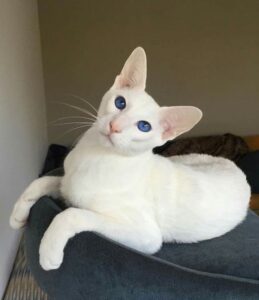 The Foreign White is a Siamese cat in a white coat. Developed in the United Kingdom in the 1960s, the goal was to create a cat with the Siamese body type, personality, and blue eyes — but in a pure white coat rather than the colourpoint pattern. Siamese were crossed with white domestic cats to achieve this.
The result is striking: a sleek, long-bodied cat with fine bone structure, vivid blue eyes, and a short, smooth, brilliant white coat. The Foreign White carries all the personality of the Siamese — vocal, sociable, intelligent, and deeply affectionate — in a visually distinctive package.
Important health note: Unlike the Siamese, whose blue eyes come from the colourpoint gene, the Foreign White’s white coat and blue eyes are produced by the dominant white gene. This gene causes cochleo-saccular degeneration, the primary mechanism of congenital deafness in white blue-eyed cats [5]. A peer-reviewed study of client-owned purebred kittens in the UK found congenital sensorineural deafness in 50% of white kittens with two blue irises [6]. Responsible breeders BAER-test their cats as standard. Always confirm this before acquiring a Foreign White.