
Sphynx Cat: Personality, Care, Cost, Lifespan, Health & What to Know Before Getting One
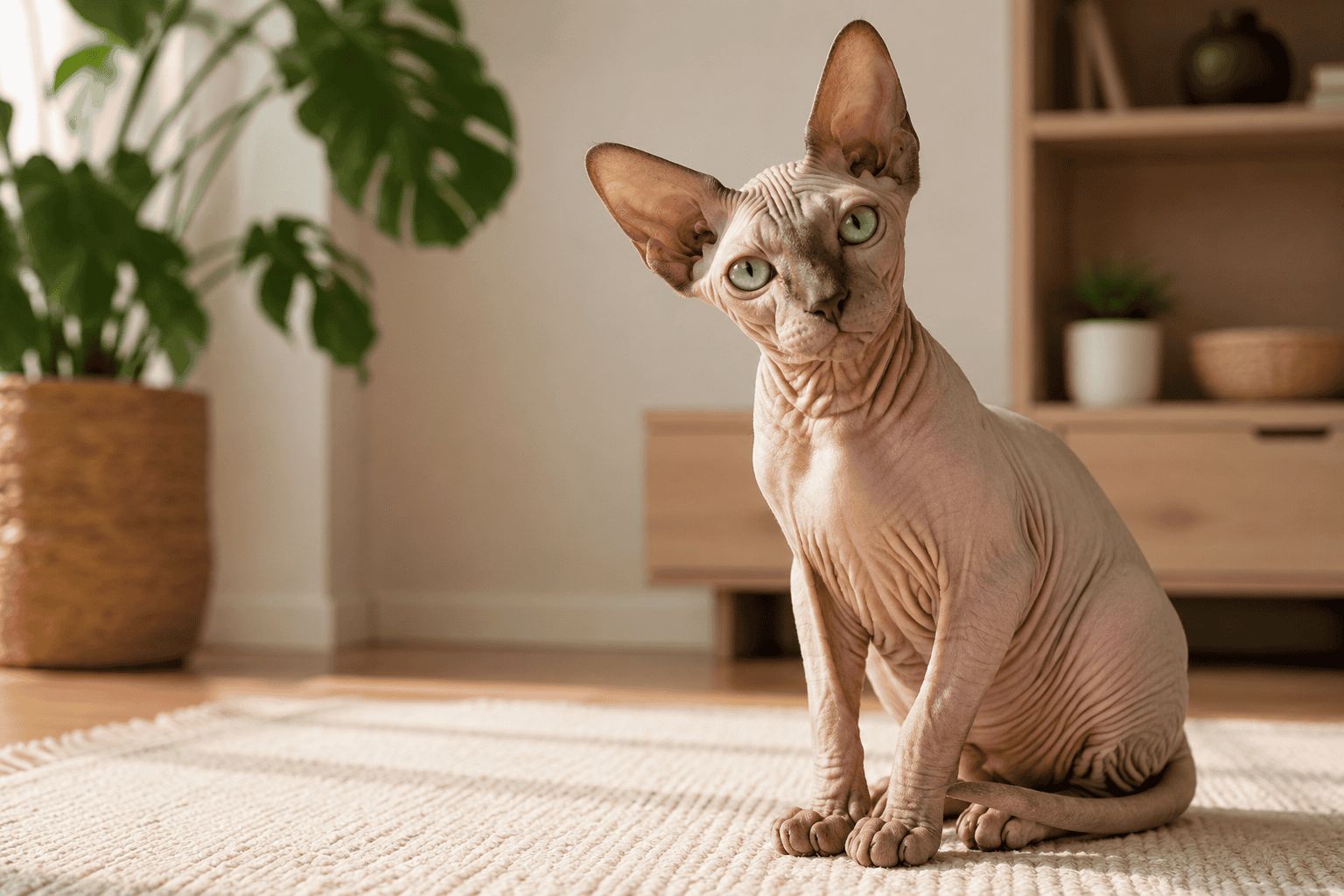
Quick Facts: Sphynx Cat
The Sphynx is a medium-sized, muscular, nearly hairless cat with an enormous personality. Bred from a natural genetic mutation first recorded in Toronto, Canada in 1966, it is widely considered one of the most affectionate and interactive cat breeds in existence — social, vocal, dog-like in its loyalty, and deeply averse to being left alone.
Its skin requires regular bathing in place of brushing, its elevated risk for a genetic heart condition (HCM) makes annual cardiac screening strongly advisable, and its need for warmth means it is strictly an indoor cat. The Sphynx asks a lot. It gives back at least as much.
The first time you see a Sphynx cat in person, you do a double-take. No fur, enormous bat ears, wrinkled brow, pot belly, and those wide lemon-shaped eyes staring straight back at you with unmistakable intelligence. The sphynx cat breed divides people. Some find them extraordinary. Others find them unsettling. Almost no one is indifferent.
The thing is, the Sphynx doesn’t care about your first impression. It is far too busy climbing onto your shoulder, following you to the bathroom, or shamelessly stealing your warm spot on the couch. This is a cat whose personality is bigger than any room it walks into — funny, vocal, affectionate, and completely uninterested in being ignored.
If you are looking for a thorough sphynx cat breed guide before you commit, this is it. You will find the real sphynx cat personality, what the weekly care routine looks like, the health concerns worth taking seriously, what a sphynx cat costs upfront and long-term, how sphynx cat adoption works, and how to find a breeder who takes the breed’s health as seriously as you should.
The Sphynx is one of the most affectionate, demanding, and entertaining cat breeds in existence. It is not a low-maintenance choice — but for the right owner, it is an extraordinary one
Sphynx Cat Breed Profile
| Trait | Details |
|---|---|
| Breed name | Sphynx, also known as the Canadian Hairless |
| Origin | Toronto, Canada |
| Registry recognition | TICA Championship; CFA Championship since 2002, miscellaneous class in 1998; also recognized by FIFe and ACFA |
| Weight range | 6–12 lbs |
| Lifespan | 9–15 years, with breed-specific health notes to consider |
| Coat type | Hairless; fine peach-fuzz down may be present on the nose, ears, paws, and tail |
| Colors & patterns | All colors and patterns, expressed through skin pigmentation, including solid, tabby, tortie, point, van, and more |
| Eye color | Vivid blue, green, gold, copper, or hazel; varies widely |
| Energy level | High |
| Vocality | Medium to high |
| Hypoallergenic? | No. Sphynx cats still produce Fel d 1 allergen in saliva and skin oils |
| Key health concern | Hypertrophic cardiomyopathy, often shortened to HCM |
History of Sphynx Cat
The Sphynx cat breed is not ancient, and it has nothing to do with Egypt. The name comes from the breed’s resemblance to the Egyptian Sphinx monument — a label that stuck because the look fit — but the breed itself is very much a product of twentieth-century North America, born from a spontaneous genetic mutation rather than any deliberate design.
The story starts in 1966 in Ontario, Canada, when a domestic cat gave birth to a hairless kitten. That kitten, named Prune for its wrinkled skin, was bred in an attempt to develop a hairless line. Because hairlessness is a recessive gene, some litters had hair and some did not. These early cats were called Canadian Hairless Cats — or sometimes Moonstones — before the name Sphynx took hold, coined by a CFA judge who thought the resemblance to the ancient Egyptian figure was too apt to ignore. [1][2]
By the mid-1970s, additional natural mutations appeared independently in Minnesota — two hairless females named Epidermis and Dermis, born in 1975 and 1976. These cats were incorporated into the growing breeding program and crossed with Devon Rex cats, which carry a naturally sparse coat, to build genetic diversity. Modern Sphynx trace their ancestry to these Minnesota cats and a second Canadian bloodline, not to Prune herself — the original male was neutered before producing any offspring. [1][2]
The road to recognition was not smooth. Early attempts at CFA status were revoked in 1971 over concerns about fertility and breed viability. It took decades of careful outcrossing and health improvement before the major registries came on board. TICA granted championship recognition, and the CFA followed in 2002. [1][2]
Today the breed is firmly established worldwide. The CFA now allows only Sphynx-to-Sphynx pairings for cats born after December 31, 2023, while TICA still permits outcrossing to American Shorthair and Devon Rex to maintain genetic health. [10]
Sphynx Cat Personality and Temperament
The sphynx cat personality is genuinely unlike most other breeds. These are not cats that tolerate your presence — they actively seek it. They will follow you from room to room, greet you at the front door, and insert themselves into whatever you are doing with cheerful, unapologetic confidence. [3]
Sphynx cats are frequently described as dog-like, and the comparison holds. They are social with strangers, highly interactive in play, and deeply attached to the people they live with. Left alone for long stretches, they become genuinely distressed. This is a breed that thrives on companionship — from humans or from other animals. [2]
Are sphynx cats friendly? Reliably and enthusiastically so. Are sphynx cats affectionate? To a degree that surprises most new owners. A 2012 study in the Journal of Veterinary Behavior found that purebred Sphynx cats were rated by their owners as friendlier than purebred European cats — consistent with what breeders and owners have observed for decades. [6]
They are also entertainers. The Sphynx will perform, clown, and find creative ways to get your attention when it feels overlooked. The CFA notes that the breed will communicate its needs — usually revolving around attention or food — very clearly, keeping up a steady chatter as it follows you from room to room. Not necessarily loud, but persistent. [2]
With Children
Are sphynx cats good with kids? Generally, yes. The Sphynx’s affectionate, playful nature makes it a natural fit for an active household. The caveat is worth saying plainly: Sphynx skin is delicate. Rough play can irritate or injure it in ways that a thick-coated breed would simply brush off. Best suited to families with children old enough to understand that this cat needs gentler handling than most. [2]
With Other Cats and Dogs
The Sphynx does not do well solo. If you work long hours and live alone, seriously consider getting two — the CFA recommends it. [2] The breed is equally comfortable with other cats and with dogs, provided introductions are handled with patience. The Sphynx tends to be the one initiating contact rather than retreating from it.
Appearance and Sphynx Cat Size
The Sphynx cat is immediately recognizable: medium-sized with a muscular, substantial body, heavy bone structure, and a distinctly rounded belly that looks like the cat just finished a very satisfying meal — even when it hasn’t. This is normal for the breed, not a weight concern. [2]
Sphynx cat size is medium. Sphynx cat weight typically falls between 6 and 12 pounds, with males tending toward the upper end. The head is a modified wedge with prominent cheekbones, a short muzzle, and striking lemon-shaped eyes. The ears are large and bat-like — one of the breed’s most defining features. The legs are long and fine-boned, with thick, rounded paw pads and long, finger-like toes. [3]
Coat, Skin, and Sphynx Cat Colors
Are Sphynx cats really hairless? Almost, but not entirely. The skin has a fine, soft down that gives it a suede or chamois-leather texture. Per TICA breed standards, some hair on the nose is required; hair on the ears, paws, and tail may or may not be present. Seasonal and hormonal changes can also affect how much down is present at any given time. [11]
Sphynx cat colors cover the full spectrum, because there is no fur to express them through — all colors and patterns show directly on the skin. Solid, tabby, tortoiseshell, point, van, bicolor — every standard pattern can appear, and is often more vividly visible than it would be on a coated cat. [10]
What do Sphynx cats feel like? The standard description is warm suede. Because they lack insulating fur, these cats lose body heat more readily than coated breeds — which is why they feel warmer to the touch and why they seek out warm spots with such determination. [3]
Do Sphynx cats have whiskers? Sometimes. Whiskers and eyebrows may be present — whole, broken, or completely absent — and all are acceptable within the breed standard. [11]
Distinctive Traits
- The belly. That prominent, rounded abdomen is characteristic of the breed — not weight-related, not a health concern. It is simply a Sphynx belly.
- The wrinkles. Skin around the head, neck, and shoulders is typically wrinkled, giving the cat an expression that reads as wise, worried, or deeply judgmental depending on your perspective.
- The heat-seeking. Lacking insulating fur, a Sphynx feels warmer to the touch and actively seeks warmth — pressing against you, sleeping under covers, finding the sun patch before anyone else in the room.
- The skin oil. Without fur to distribute and absorb the skin’s natural sebum, a visible film of oil builds up on the skin. Regular bathing is not optional — it is simply part of what Sphynx ownership involves.
- The dog personality. The breed’s social behavior — greeting strangers, following owners, initiating play — is consistent enough to be a defining trait, not an occasional quirk.
Sphynx Cat Care
Sphynx cat care is not complicated, but it is consistent. The absence of fur does not mean low maintenance — it means different maintenance, and quite a bit of it.
Diet and Calorie Needs
Sphynx cat diet requires more attention than most people expect. Because these cats lack insulating fur, they use more calories maintaining body temperature than a coated breed would. Their metabolism runs higher, which means they eat more, digest faster, and need higher-quality food to sustain them. [3]
Feed a high-protein, animal-based diet — real meat or fish as the primary ingredient, low in carbohydrates, with adequate fat for energy and skin health. Many owners feed a mix of premium wet food and high-quality dry kibble. Some choose a raw diet; if you go that route, work with a vet to ensure it is properly balanced. A diet low in quality protein and essential fatty acids can show up quickly on a Sphynx: oily skin, digestive issues, and a dull, tacky coat are common signs that food quality is not meeting their needs. [3]
Calorie needs vary by individual cat, age, and activity level. Your vet is the best source for specific portion guidance. Sphynx cat kittens in particular need careful nutritional support during their first year of rapid growth.
Exercise and Mental Stimulation
Sphynx cats are high-energy and genuinely curious. They will climb, explore, and investigate everything with cheerful enthusiasm. Wand toys, puzzle feeders, and vertical cat trees are good investments. Interactive play daily is not optional for this breed — a Sphynx with nowhere to direct its energy will find somewhere to direct it, and the results are not always convenient.
Because they hate being alone, a second cat — ideally another Sphynx or a similarly social breed — is often the single most effective enrichment you can provide. [2]
Home Environment
Indoor only, full stop. Without insulating fur, a Sphynx cannot regulate body temperature the way a coated cat can; cold, wind, and direct sun all pose genuine risks. [3] Outdoors, their skin is as vulnerable to sunburn as human skin. If your Sphynx sits near a sunny window, filtered light or a pet-safe sunscreen your vet has approved will protect the skin.
Indoors, make sure warm spots are available — heated cat beds, fleece blankets, and cozy spots near gentle heat sources. Many Sphynx cats sleep under covers with their owners. This is not unusual behavior; it is thermally rational and entirely typical for the breed. [3]
Cat clothing — sweaters, soft onesies — is not purely aesthetic for this breed. In cooler weather or air-conditioned homes, a well-fitting sweater makes a real difference to comfort. Choose soft, breathable fabrics and wash them regularly; oil transfers from the skin to fabric quickly.
Sphynx Cat Grooming
Sphynx cat grooming is the part of ownership that catches most new owners off guard. No fur does not mean no grooming. It means bathing instead of brushing — and the bathing is non-negotiable.
Sphynx cat skin care starts with understanding what happens without it: the skin’s natural oils (sebum), with no fur to absorb or distribute them, build up into a visible, sometimes sticky film. Unmanaged, this oil leaves greasy residue on furniture and bedding, and creates ideal conditions for skin acne, bacterial infections, and yeast infections in the skin folds. [3]
How often should you bathe a Sphynx cat? Most need sphynx cat bathing every one to two weeks using a gentle, fragrance-free cat shampoo and lukewarm water. The exact frequency depends on the individual cat — some produce more oil than others. Rinse thoroughly; residue left in folds or behind the ears can cause irritation. Dry fully afterward, as moisture sitting in skin folds is an invitation for yeast. [3]
Between baths, unscented pet wipes or a soft damp cloth keep oil from building up in the skin folds, underarms, and around the chin. Stainless steel or ceramic food bowls reduce chin acne caused by friction against plastic.
Ear cleaning weekly is non-negotiable. The Sphynx’s large ears have minimal hair to filter debris, so wax and dirt accumulate faster than in most breeds. Use a vet-approved ear cleaner and a cotton ball — never a swab inside the ear canal. [3]
Nail trimming every two to three weeks rounds out the routine. The Sphynx’s long, finger-like toes collect dark residue in the nail beds; a quick wipe with a damp cloth keeps this under control between trims.
Sphynx Cat Health Problems
Sphynx cat health problems worth knowing before you commit include one major genetic concern and several breed-specific issues connected to their physiology.
Hypertrophic Cardiomyopathy (HCM)
Hypertrophic cardiomyopathy is the most significant health concern in the Sphynx. HCM causes abnormal thickening of the heart’s walls, reducing the volume of blood the heart can pump and increasing the risk of heart failure, blood clots, and sudden death. It is the most common feline cardiac disease across all breeds, and the Sphynx is among those at elevated risk. [5][8]
A specific genetic mutation (ALMS1) has been identified in association with HCM in Sphynx cats, and is present in an estimated 60% of affected individuals. The mutation has incomplete penetrance — not every cat carrying it will develop detectable disease — and onset can range from as early as 2–3 years to as late as 8–10 years. [6]
A 2012 retrospective study in the Journal of Feline Medicine and Surgery confirmed a heritable etiology for HCM in Sphynx cats, consistent with what has been established in Maine Coons and Ragdolls. [7] Cornell University’s College of Veterinary Medicine recommends regular cardiac monitoring for cats at elevated breed risk. [5]
It is strongly advisable — though practices vary between breeders — to require documentation of annual echocardiograms by board-certified cardiologists on both parent cats when buying a Sphynx kitten. A negative genetic test result does not rule out HCM, as other mutations may be involved; ongoing screening throughout the cat’s life is the most reliable approach to early detection.
One further note on lifespan: while many breed profiles give a broad 9–15 year range, a 2024 UK VetCompass life-table study found a much shorter average life expectancy for Sphynx cats among the breeds it analyzed. That does not mean every Sphynx will have a short life, but it does make cardiac screening, careful breeder selection, and ongoing veterinary care especially important. [13][5][6]
Sphynx Cat Skin Conditions
The same oil that requires regular bathing can, when unmanaged, lead to yeast infections, bacterial skin infections, and acne — particularly in the skin folds around the neck, chin, and underarms. Consistent sphynx cat skin care keeps these conditions manageable; they are preventable rather than inevitable. [3]
Hereditary Myopathy
A heritable condition affecting muscle function has been noted in the breed. The CFA includes hereditary myopathy among breed-specific health concerns to discuss with your veterinarian. [2]
Dental Disease
Sphynx cats are prone to periodontal disease. Daily brushing with cat-safe toothpaste is the gold standard; regular dental check-ups will help catch tartar buildup before it progresses. [3]
Gastrointestinal Sensitivity
Some Sphynx cats have sensitive digestive systems. Loose stools are often linked to diet quality or changes made too quickly. Transition to new foods gradually over 7–10 days, and if GI issues persist, talk to your vet about elimination diets or probiotic supplementation.
Male vs. Female Sphynx Cat
| Male | Female | |
|---|---|---|
| Weight | 8–12 lbs typically | 6–9 lbs typically |
| Build | Larger, more muscular | Smaller, more delicate frame |
| Temperament | Often more relaxed and openly affectionate | Often more active and independent |
| Vocality | Moderate | Moderate to high |
| HCM risk | Higher prevalence reported in males | All Sphynx should be screened regardless of sex |
| Neutered/spayed | Recommended for pet cats | Recommended for pet cats |
Sphynx Cat Cost
The sphynx cat price is one of the higher starting points in the cat world — a direct reflection of what ethical breeding actually costs.
Purchase Price
From a reputable breeder, a pet-quality Sphynx kitten typically costs between $1,500 and $5,000 in the United States. Show-quality or champion-line cats can cost significantly more. [9][10] The price reflects real costs: annual cardiac echocardiograms for breeding cats run $300–$600 per cat, genetic testing adds further expense, and smaller litters mean fewer kittens to spread those costs across.
A Sphynx kitten priced well under $1,500 from an unverified source is a warning sign, not a bargain. Health testing alone makes that price point difficult to square with responsible breeding. [9]
Sphynx Cat Adoption
Sphynx cat adoption from a rescue is a meaningful alternative. Adoption fees for rare purebred rescue cats can run around $300–$600 and often include spay/neuter, vaccinations, microchipping, and other basic care. [12] Sphynx-specific rescues exist but are limited; breed-specific rescue networks and platforms like Petfinder are the best starting points. Adult Sphynx in rescues are often already litter-trained and socialized — and they need homes just as much as kittens do.
Annual Cost of Ownership
| Expense | Estimated Annual Cost |
|---|---|
| High-quality food (wet + dry combination) | $480–$900 |
| Routine veterinary care (2 visits/year) | $300–$600 |
| Cardiac echocardiogram (annual, recommended) | $300–$600 |
| Grooming supplies (shampoo, wipes, ear cleaner) | $120–$240 |
| Pet insurance | $300–$600 |
| Heated beds, cat clothing, enrichment toys | $150–$300 |
| Dental care | $200–$500 |
| Estimated Annual Total | $1,850–$3,740 |
Finding a Sphynx Cat Breeder
Finding a reputable sphynx cat breeder takes longer than most people expect, and that is the point. Good breeders are selective about who they sell to — they are evaluating you as carefully as you are evaluating them.
What to Look For
- TICA or CFA registration. Require documentation — registered breeders have signed codes of ethics and are accountable to their organizations.
- Annual cardiac screening on both parent cats. Echocardiograms by board-certified cardiologists, with dated records available for review. This is the baseline for serious breeding.
- Willingness to answer questions. A breeder who can speak in depth about their lines, their HCM testing history, and their health guarantee is a good sign.
- In-home raising. Sphynx kittens raised underfoot with regular human contact from birth are better socialized than those kept separately.
- A waiting list. Quality breeders typically have one. If kittens are always immediately available across multiple ages, look more closely.
Red Flags
- No written health-test documentation for parent cats
- Kittens released before 12 weeks of age
- Always has kittens available — a pattern consistent with volume breeding rather than careful, health-tested litters
- Avoids or deflects questions about parent health history
- Price significantly below market without a clear explanation
Adoption Resources
The TICA breeder directory at tica.org/breed/sphynx lists registered breeders who have signed the TICA Code of Ethics. The CFA’s Sphynx page at cfa.org/breed/sphynx is another verified starting point. [1][2]
Sphynx vs. Similar Breeds
| Trait | Sphynx | Devon Rex | Cornish Rex | Peterbald |
|---|---|---|---|---|
| Origin | Canada | England | England | Russia |
| Coat | Hairless (fine down) | Very short, wavy | Short, wavy | Hairless to coated variants |
| Size | Medium, muscular | Medium, fine-boned | Medium, slender | Medium, fine-boned |
| Energy level | Very high | High | High | High |
| Affection | Extremely high | High | High | High |
| Grooming | High (regular bathing) | Low to moderate | Low | Moderate (skin care) |
| HCM risk | Elevated | Moderate | Lower | Unknown/lower |
| Vocality | Medium-high | Medium | Medium | Medium-high |
| Registry | CFA, TICA, FIFe | CFA, TICA | CFA, TICA | TICA only |
Sphynx Cat Pros and Cons
| ✓ Pros | ✗ Cons |
|---|---|
| Dog-like social behavior: greets guests, follows owners, initiates play | Elevated HCM risk; annual cardiac screening is strongly advisable |
| No shedding on furniture, clothes, or bedding | Cannot tolerate cold or prolonged sun exposure; strictly indoor cat |
| Excellent with children, dogs, and other cats when introduced properly | High purchase price ($1,500–$5,000+) from reputable breeders |
| Highly intelligent and reliably entertaining | Does not do well alone; benefits significantly from a feline companion |
| Visually distinctive — a genuine conversation starter | Ongoing annual costs are higher than average for most cat owners |
| Deeply loyal; forms strong bonds with all family members | Sensitive skin prone to acne and yeast infections if grooming lapses |
Is the Sphynx Cat Right for You?
The Sphynx is an extraordinary cat. It is also a cat with specific, consistent needs that will not simplify over time. Before committing, be honest about a few things.
If you travel frequently and live alone, the Sphynx is a poor fit. This is a breed that suffers when under-stimulated and under-companioned. A second cat helps significantly, but it does not replace human interaction.
If the idea of weekly bathing, ear cleaning, and consistent skin-fold maintenance feels like too much, that is useful self-knowledge. The sphynx cat grooming routine is real and non-negotiable — skipping it leads to skin problems that are harder to manage than they are to prevent.
If your budget is tight, factor in the annual cardiac screening. Responsible Sphynx ownership includes regular cardiac monitoring, based on your veterinarian’s advice — not every year will surface a problem, but the ones where it does can enable early treatment that meaningfully extends your cat’s life.
On the other hand: if you want a cat that is genuinely interested in you, interactive, warm in every sense, and entertaining enough that you will never look at your phone when it’s in the room — the Sphynx is one of the best breeds in existence for that. It asks a lot. It gives back at least as much.
Living With a Sphynx: The Honest Take
The Sphynx is one of those breeds where the description on paper — hairless, high-maintenance, expensive, heat-seeking, demanding — sounds like a lot. Then you spend twenty minutes with one and understand entirely why people wait months on a breeder’s list for them.
This is a cat that is actively glad you exist. It will greet you, follow you, sit on your keyboard, climb your shoulder, and press its warm, suede-soft body against yours with a persistence that has nothing performative about it. The Sphynx is not aloof. It is not indifferent. It is entirely, unambiguously present with you in a way that many cat lovers find — once they’ve experienced it — very hard to give up.
The care requirements are real and should not be minimized. Regular bathing, cardiac monitoring, the need for warmth and companionship — these things take time, money, and consistency. The Sphynx is not the right cat for someone who wants minimal involvement.
But for someone who wants a deeply companionable cat, who is comfortable with a consistent grooming routine, and who takes the health screening seriously — the Sphynx delivers something genuinely unusual: a cat that, day after day, makes it clear that your presence is one of its favourite things.
That is not a small thing.
Frequently Asked Questions
Are Sphynx cats good pets?
Yes — for the right owner. The Sphynx is one of the most affectionate and social cat breeds in existence. They form deep bonds with their families, get along with children and other pets, and provide the kind of interactive companionship more associated with dogs than cats. The caveat is commitment: they require regular bathing, indoor-only living, cardiac monitoring, and consistent attention. They are not a low-involvement pet.
Are Sphynx cats hypoallergenic?
No. Sphynx cat allergies are a common misconception. Cat allergies are primarily triggered by the Fel d 1 protein, which is produced in saliva and skin oils — not fur. Because the Sphynx has oily skin with no fur to trap allergens, they can be more directly present in the environment. The CFA notes that regular bathing does reduce the allergen load somewhat, and some people with mild allergies report tolerating the breed better — but this varies considerably by individual, and there is no guarantee. If sphynx cat allergies are a concern, spending time with the breed before committing is the only reliable test. [2]
Do Sphynx cats need baths?
Yes, consistently. Without fur to absorb the skin’s natural oils, those oils sit on the surface and build up. Most Sphynx cats need sphynx cat bathing every one to two weeks with a gentle, cat-appropriate shampoo. Skipping baths leads to oily skin, residue on furniture, and increased risk of skin infection. The exact frequency depends on your individual cat. [3]
Do Sphynx cats get cold easily?
Yes. Without insulating fur, Sphynx cats lose body heat more readily than coated breeds. They seek warmth constantly — sunny spots, blankets, your body heat. In cooler environments, cat sweaters and heated beds are genuinely useful rather than just decorative. [3]
Can Sphynx cats go outside?
Not safely without supervision, and ideally not at all. Sphynx cats face outdoor risks that furred cats can better tolerate: sunburn from UV exposure, inability to thermoregulate in cold weather, and skin more vulnerable to injury than a coated breed’s. A supervised, enclosed catio is the safest compromise if outdoor access matters to you. [3]
How long do Sphynx cats live?
The Sphynx cat lifespan is often given as 9–15 years in breed profiles. However, a 2024 UK VetCompass life-table study found that Sphynx cats had the shortest life expectancy among the breeds it analyzed, so the breed’s health-screening conversation matters. Well-cared-for individuals who receive regular cardiac monitoring and high-quality nutrition may still live much longer than population averages, but HCM screening should not be treated as optional. [13][5][6]
Are Sphynx cats high maintenance?
Higher maintenance than average, yes. The grooming routine alone — regular bathing, ear cleaning, skin-fold maintenance — is more involved than brushing a shorthaired cat once a week. Add in their strong need for companionship and the recommended cardiac monitoring, and the Sphynx requires a more engaged owner than many breeds. Whether that feels like ‘high maintenance’ or simply ‘a different kind of routine’ tends to come down to how much you enjoy being genuinely involved with your cat.
Do Sphynx cats smell?
A well-groomed Sphynx does not smell. The skin oil, left to build up between infrequent baths, can develop a musky, faintly yeasty odor. The same applies to unwashed bedding that absorbs the oil. A consistent bathing schedule and regular washing of cat bedding keeps this completely manageable — it is a maintenance issue, not a breed characteristic.
Do Sphynx cats like to cuddle?
Very much. The Sphynx is one of the most physically affectionate cat breeds. They cuddle in part because warmth is genuinely useful to them without fur — your body heat matters to a hairless cat — but also because affection is simply in their nature. Expect a cat that sleeps pressed against you, under covers when possible, and on top of you whenever the opportunity presents itself.
Why are Sphynx cats so expensive?
Ethical Sphynx breeding is expensive. Annual cardiac echocardiograms, genetic testing, veterinary care during pregnancy, smaller litter sizes, and registration fees all add up. A breeder producing kittens responsibly — with health testing, proper socialization, and genetic transparency — cannot do so for a few hundred dollars. The price reflects what responsible sphynx cat kittens actually cost to produce. [9][10]
What health problems do Sphynx cats have?
The primary concern is hypertrophic cardiomyopathy (HCM) — an inherited heart condition present at elevated rates in the breed. Secondary concerns include skin conditions (acne, yeast infections from oil buildup if grooming lapses), periodontal disease, hereditary myopathy, and gastrointestinal sensitivity. Regular veterinary care, consistent sphynx cat skin care, and cardiac screening based on your veterinarian’s advice are the most effective tools for managing these risks. [2][5][6][8]
Is the Sphynx a good breed for first-time cat owners?
It can be — with the right expectations going in. The Sphynx’s affectionate, interactive personality makes it genuinely enjoyable to own, and new cat owners often love the relationship the breed creates. The challenge is the care routine: bathing, skin maintenance, and the recommendation for cardiac monitoring are more involved than most first-time owners anticipate. If you go in knowing what the Sphynx requires, and you have the time and budget for it, the breed can be a wonderful first cat.
Sources
[1] Sphynx Breed Profile — The International Cat Association (TICA). Accessed 2026.
[2] Sphynx Breed Profile — Cat Fanciers’ Association (CFA). Accessed 2026.
[3] Sphynx Cat Breed Profile — VCA Animal Hospitals. Accessed 2026.
[4] Do cats from established breeds behave differently toward humans than outbred cats? — Asselineau B, Abitbol M, Deputte BL. Journal of Veterinary Behavior, 2012; 7(6). DOI: 10.1016/j.jveb.2012.09.006.
[5] Hypertrophic Cardiomyopathy — Cornell University College of Veterinary Medicine, Feline Health Center. Accessed 2026.
[6] Sphynx Hypertrophic Cardiomyopathy (HCM) — North Carolina State University College of Veterinary Medicine. Accessed 2026.
[7] Hypertrophic cardiomyopathy in the Sphynx cat: a retrospective evaluation of clinical presentation and heritable etiology — Silverman SJ, Stern JA, Meurs KM. Journal of Feline Medicine and Surgery, 2012.
[8] Hypertrophic Cardiomyopathy — Animal Health Topics, UC Davis School of Veterinary Medicine. Accessed 2026.
[9] What’s the Price of a Sphynx Cat? — Spot Pet Insurance. Accessed 2026.
[10] Sphynx Prices: Purchase Cost, Vet Bills and Other Costs — A-Z Animals. Accessed 2026.
[11] Adoption Fees — Specialty Purebred Cat Rescue. Accessed 2026.
[12] Sphynx Breed Standard PDF — The International Cat Association (TICA). Accessed 2026.
[13] Life tables of annual life expectancy and risk factors for mortality in cats in the United Kingdom — Teng KT, Brodbelt DC, Church DB, et al. Journal of Feline Medicine and Surgery, 2024.