
Why Do Cats Chirp and Chatter? The Meaning Behind This Strange Cat Sound
Quick Answer: Why Do Cats Chirp and Chatter?
Cats usually chirp and chatter because their prey drive has switched on. The sound often happens when they see birds, bugs, squirrels, or toys they want to stalk but cannot reach. It is usually normal during window-watching or play, especially when your cat is alert, focused, and settles afterward. What matters is context: if the jaw movement happens without a prey trigger, or comes with drooling, bad breath, appetite changes, pawing at the mouth, or trouble chewing, it is worth checking with your vet.
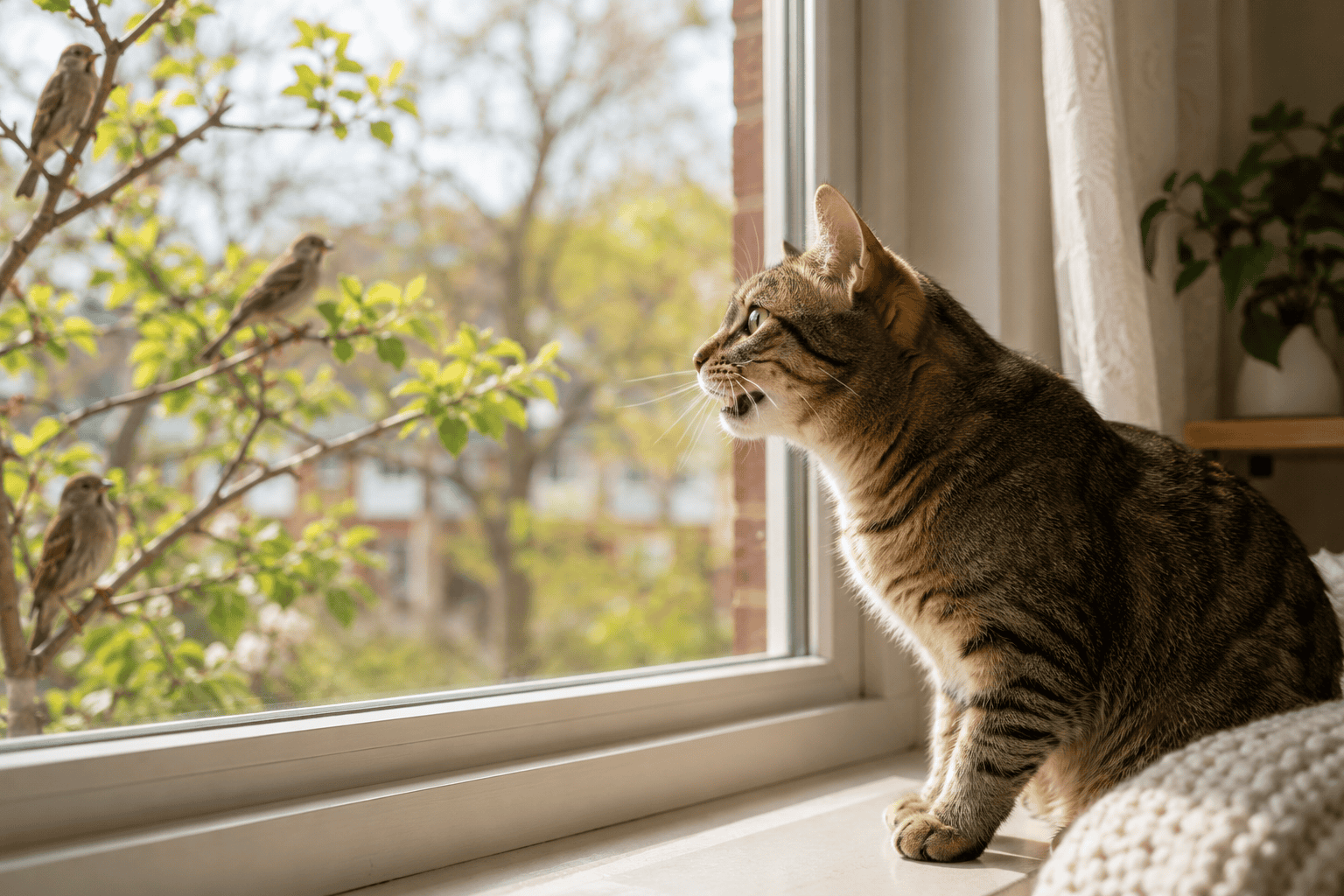
There’s a particular cat moment that stops me every single time. My cat is sitting by the window, completely motionless, staring at a bird with the kind of focus that suggests the fate of the household genuinely depends on it. Then the mouth starts moving. The jaw trembles. The teeth click. Out comes that tiny ‘ek-ek-ek’ — and I drop whatever I’m doing to watch.
That moment is why people search for why do cats chirp and chatter. It sounds too deliberate to be random, too intense to be a normal meow, and just bizarre enough to make you wonder if your cat has secretly been a bird all along.
The short answer: chirping and chattering are almost always tied to prey-watching. Your cat spots something small, fast, and out of reach. Their body locks in. Eyes widen. Whiskers push forward. Tail flicks. And then that little mouth show begins.
But the honest answer is more interesting — and more uncertain — than “cats are hunters.” There are several possible layers here: predatory focus, excitement, frustration, jaw movement linked to hunting patterns, and maybe even a kind of mimicry. The mistake a lot of articles make is treating these as facts. They’re not all settled. Researchers can describe when chirping happens and what it seems connected to. The exact ‘why’ is still being debated. [1][2][5]
Chirping vs Chattering vs Clicking: Are They the Same Thing?
Cat owners use different words for the same general window-side performance. One person says their cat chirps. Another says chatter. Someone else says clicking. And then there’s the very technical internet term: ekekek.
They’re related, but not always identical. A chirp is usually short and high, almost bird-like. A chatter tends to involve the jaw and teeth moving quickly — that jaw trembling at birds you might notice when your cat is locked onto something outside. A clicking sound often comes from the teeth clacking together. Some cats combine all of it into one strange package: chirp, squeak, click, jaw-tremble, repeat. Some owners type it as ek-ek-ek sounds; others call it chattering or clicking. Same behavior, different words for the same window-side performance.
A phonetic pilot study of domestic cats specifically recorded and categorized sounds made while watching birds through a window, separating them into chatter, chirp, tweet, and tweedle. That matters, because it means cat chirping and chattering are real, recognizable behaviors — not just owner imagination — distinct enough that researchers tried to classify them. [2]
So if you’re searching why do cats make clicking noises at birds, you’re probably describing the same prey-watching behavior other owners call chattering or chirping. The label differs. The scene is always the same: cat, window, something fascinating outside, intense focus from within.
Why Do Cats Chirp and Chatter?
The most likely answer: your cat’s hunting system has switched on. Cats are built to notice fast, unpredictable movement. Birds flutter. Bugs zip. Squirrels twitch. A feather wand darts across the floor. That kind of movement doesn’t politely ask for your cat’s attention. It grabs them.
When your cat chirps or chatters, they’re probably expressing a mix of excitement, desire, and frustration. They can see the target. They’re locked on. But there’s a window in the way, or a screen, or they’re on a leash, or the fly is on the ceiling. The hunt can’t go anywhere. So the little mouth show begins instead.
Behaviour veterinarian Katrina Ward put it plainly in an ABC interview: chattering is most often seen when a cat watches prey they can’t reach — birds through glass being the classic example — and frustration, desire, and excitement are all plausible explanations. She also made the important point that we don’t know the exact reason with certainty. [5]
That honesty matters. Your cat isn’t broken or being dramatic. Their brain has spotted something that looks huntable. Their body is responding. The inconvenient indoor-cat detail — glass, walls, gravity — catches up later.
Why Do Cats Chirp at Birds Through the Window?
Birds are the classic trigger because they move in a way cats find almost impossible to dismiss. They hop, flutter, dart, disappear, reappear, and make tiny sounds. To your cat, a bird at the window isn’t ambient scenery. It’s a live hunting problem with one maddening detail: no access.
That’s why cat chirping at birds looks so deliberate. Your cat may crouch low, lean into the glass, freeze their body, twitch their tail tip, push their whiskers forward. The sound is only one part of the scene. The body is telling the fuller story: total focus, full hunting mode, zero chill.
So when someone asks why do cats chatter at birds, the clearest answer is this: your cat sees something their instincts label as prey, and the sound is part of that highly focused, excited, sometimes frustrated state. The bird is outside. Your cat is in. But inside your cat’s head, the hunt is very much underway
Is Cat Chattering a Sign of Frustration?
Often, yes — but not in the distressing way people worry about. This is where a lot of cat owners get tangled up. They watch their cat staring out the window and think: Am I tormenting them? Is a bird feeder cruel? Should I close the curtains?
Not necessarily. Frustration can absolutely be part of the picture, because the cat can see the prey but can’t reach it. But that doesn’t mean the whole experience is miserable. Cats are naturally wired to watch, stalk, wait, and calculate. In real hunting, they don’t catch everything they spot. A lot of the process is observation and timing.
The better question isn’t “should my cat ever watch birds?” The better question is: what does my cat look like afterward? If they watch, chatter for a bit, then go curl up somewhere, that’s probably enrichment doing its job. If they become frantic, pace for a long time, redirect tension onto another pet, or can’t calm down, that’s worth paying attention to.
This is a gap a lot of articles miss. They explain the sound and stop. But what owners actually need is guidance on what to do with that information. For most cats, window-watching is genuinely good for them. For cats who wind up tight and stay there, the fix is a short hunting-style play session afterward — somewhere for all that energy to land.
Is Your Cat Trying to Mimic Birds?
This is the fun theory, and I completely understand why people love it. The sound can be so bird-like that it genuinely feels like your cat is attempting a terrible impression from the windowsill.
There’s some basis for discussing mimicry, but it needs careful framing. A well-documented field observation reported a margay — a small wild cat — producing calls similar to the sounds of pied tamarin infants while hunting. That supports the broader idea that at least some wild felids may use vocal imitation in predatory contexts. [6]
But that doesn’t prove your house cat is consciously trying to trick the robin on the fence. The safer, more honest framing: mimicry is one possible theory, the sound may sometimes resemble prey calls, but we don’t have enough evidence to say every chattering domestic cat is deliberately faking it.
That distinction matters. It keeps the article interesting without dressing up a theory as a settled fact. Your cat may be imitating prey. They may simply be making a sound that appears during high prey focus. Either way, the bird has completely taken over the room
What About the “Kill Bite” Theory?
Another popular explanation: cat chattering teeth at birds is practice for the quick bite cats use to dispatch prey. You’ll see this all over pet content — the jaw trembling is a rehearsal for the kill.
It’s an interesting theory, but I wouldn’t present it as settled fact. The movement does look like a rapid jaw action. The connection to predatory behavior makes instinctive sense. But making sense isn’t the same as being proven.
A stronger answer: the jaw movement may be linked to hunting motor patterns, but we can’t say with certainty that every chattering cat is “practicing the kill bite.” What we can say is that chattering almost always appears when a cat is intensely focused on prey-like movement and physically can’t act on it. [2][5]
Cat owners deserve that level of honesty. They know when something sounds too tidy. Give them the useful idea — then tell them where the evidence actually stops.
Do Cats Only Chatter at Birds?
Not even close. Birds are the famous trigger, but the real pattern is much broader. Cats may chirp or chatter at squirrels, lizards, flies, moths, cockroaches, crickets, feather toys, wand toys, and sometimes laser dots. The common thread isn’t the species — it’s movement that activates the hunting brain.
That’s why an indoor cat will stare up at a ceiling fly with exactly the same seriousness they bring to a bird feeder outside. The fly is small. It moves unpredictably. It’s difficult to reach. Congratulations — the fly has become premium cat television.
Some cats also chatter during play, especially when a toy moves like prey but stays just out of reach. A feather toy darting behind a chair can trigger the same anticipation as a bird disappearing behind a branch. Your cat is watching, calculating, waiting for the gap.
This section matters for search too — a lot of owners don’t search “bird chattering.” They search based on what they’re actually watching: why does my cat chirp at squirrels, why does my cat chatter at bugs, why does my cat make clicking noises at toys, or why does my cat make ek-ek-ek sounds at the window. The answer is the same in each case — the article just needs to meet them where they are.
Is Window Bird-Watching Good Enrichment or Just Frustrating?
For most indoor cats, a safe window perch is one of the best low-effort enrichment tools you can offer. Movement, changing scenery, something to use their eyes and brain on — it costs you nothing and keeps them engaged. The AAFP and ISFM feline environmental guidelines recommend opportunities for play and predatory behavior, and specifically note that indoor resting areas benefit from visibility outdoors. [3]
That said, not every window setup is the right intensity for every cat. A bird feeder pressed right against the glass may be too much for a highly reactive cat. A territorial outdoor cat walking past the same spot every day may stress an indoor cat who can’t do anything about it. A bird feeder six feet back from the window is a very different experience than one mounted to the glass.
The practical read is simple: let bird-watching be enrichment, but read your cat. Focused and interested, then settles down? You’re good. Frantic, slamming at the glass, or redirecting aggression onto another pet? Dial it back. Move the perch, close the curtain during peak activity, or follow the session with play.
And please don’t scold the chatter. Your cat is not misbehaving. They’re doing cat math: small moving thing plus no access equals strong feelings about the situation.
What Should You Do When Your Cat Chirps and Chatters?
Most of the time, nothing. I’d treat it as useful information: your cat is alert, interested, and mentally engaged. The better move is giving that energy a healthy place to go.
After a window-watching session, try a short play routine that follows the natural hunting sequence. Move a wand toy like prey. Let your cat stalk. Let them chase. Most importantly, let them catch it. Then offer a small treat or a meal. You’re giving them a more complete version of what their instincts were already trying to do.
The AAFP/ISFM guidelines specifically recommend play and feeding activities that let cats express predatory behavior — wand toys that mimic moving prey, letting the cat actually catch the toy, and rewarding after play. [3]
That’s a much more useful answer than “they’re frustrated, poor thing.” Fine — but then what? Give your cat a way to finish the story. Watch, stalk, chase, catch, eat, groom, nap. That cycle is usually more satisfying than letting the excitement build with no exit.
Normal Chattering vs When to Call the Vet
Here’s where we get practical. Is cat chattering normal? Yes, most of the time — but not every jaw movement is automatically behavioral, and context matters a lot.
If your cat chatters while watching birds, bugs, squirrels, or toys — eats normally, acts normally, and settles afterward — there’s no reason to worry. If the chattering appears away from prey triggers, or shows up suddenly in a cat who’s never done it, or comes alongside anything mouth-related, it deserves a closer look.
Cornell Feline Health Center notes that dental disease signs in cats include reluctance to eat, turning the head while chewing, stopping mid-meal, drooling, bad breath, and a preference for soft food. Tooth resorption in particular can be painful, causing cats to drop food, drool, or become irritable. [4]
| What you see | Usually normal | Worth a vet check |
|---|---|---|
| Trigger | Birds, bugs, squirrels, toys, laser-like movement | No clear trigger — happens while resting, eating, or wandering |
| Sound | Short chirps, chatters, clicks, or ek-ek-ek during focus | New jaw clicking, repeated mouth movements, or signs of pain |
| Body language | Alert, focused, whiskers forward, tail twitching, then settles | Restless, distressed, hiding, growling, pawing at the mouth |
| Eating | Normal appetite and chewing | Dropping food, refusing food, chewing oddly, or preferring only soft food |
| Mouth signs | No drooling or bad breath | Drooling, bad breath, bleeding, visible mouth discomfort |
This isn’t about turning every chirp into an emergency. Chattering at birds is usually behavioral. Chattering linked to dental pain looks different — and usually comes with other warning signs. It’s about knowing the difference between “cat watching birds” and “cat in pain.” When in doubt, record a short video and show your vet. A video is worth far more than trying to describe a sound that’s essentially “tiny teeth percussion at the window.”
Why Some Cats Never Chirp or Chatter
Not every cat is a commentator. Some watch birds in total silence, like tiny judges sitting behind glass. Others chirp once and never again. Some go full window-side opera at every sparrow, as if filing a formal complaint with the sky.
All of it is normal. Cats differ in personality, confidence, prey drive, vocal habits, and how easily movement excites them. A quiet cat isn’t less interested. A noisy cat isn’t necessarily more stressed. They’re just expressing the moment differently.
This is also why comparing cats in the same house can be misleading. One may chatter at every ceiling bug. Another blinks slowly and goes back to sleep. Both are perfectly fine cats — one just has stronger opinions about window entertainment
The Best Way to Read the Sound
The sound alone doesn’t tell the whole story. To really understand what your cat’s doing, read the full scene.
- What is your cat looking at? Birds, bugs, toys, squirrels — or nothing obvious?
- What does their body look like? Focused and alert, or tense and distressed?
- How long does it last? A few seconds, a few minutes, or constantly?
- Can your cat settle afterward? Or do they pace, yowl, or redirect tension?
- Are there any mouth symptoms — drooling, bad breath, dropping food, trouble chewing?
That’s the real answer behind why do cats chirp and chatter. It’s not one clean explanation. It’s a behavior that almost always appears in a very specific context: prey-like movement, high focus, and limited access. Once you understand the context, the sound stops being mysterious. It’s still ridiculous. It’s still completely adorable. But it’s no longer random.
Conclusion: Your Cat Is Not Weird. Your Cat Is Watching Prey.
So — why do cats chirp and chatter? Most of the time, it’s your cat’s prey drive spilling out through a tiny, strange, extremely serious sound. They’ve spotted something they want to stalk. Their body is locked in. Their jaw is moving. And they might sound, just slightly, like a malfunctioning bird trapped inside a cat.
The important thing is not to spiral every time you hear it. If it happens during bird-watching, bug-hunting, or a feather toy session, it’s almost certainly a normal part of being a cat. Enjoy it. It’s one of those small, ridiculous house-cat moments that remind you there’s still a hunter sitting on your windowsill — even if that hunter’s most recent prey was a moth at 11pm.
But stay sensible too. If the chattering appears without a prey trigger, if your cat seems distressed, or if there’s anything mouth-related going on, it’s worth a vet visit. Normal cat weirdness is one thing. Pain is another.
Most of the time, though, that little chatter just means something fascinating landed outside the glass. The bird will never know the drama it caused. Your cat, meanwhile, is completely certain it nearly had it.
Frequently Asked Questions
Is it normal for cats to chirp and chatter?
Yes — when it happens during bird-watching, bug-hunting, or play, it’s usually a normal instinctive response. It becomes worth a second look if it appears without a prey trigger, or if it comes alongside drooling, bad breath, appetite changes, or difficulty eating.
Why do cats chirp at birds?
Their prey drive is activated. Birds move quickly and unpredictably in a way that grabs a cat’s full attention, triggering the kind of intense focus that often comes out through chirping, chattering, or jaw movement.
Why do cats chatter their teeth at birds?
The teeth-chattering is likely part of the same prey-watching response — sometimes described as the teeth actually clacking together, sometimes mixed with chirps or squeaks. The exact purpose isn’t fully settled, but frustration and excitement are the most supported explanations. [5]
Are cats frustrated when they chatter at birds?
Possibly, yes. Watching prey through glass can put a cat in a state of excitement and frustration at the same time. The key question is what happens next: if your cat settles down afterward, it’s probably fine. If they stay wound up, redirect, or seem distressed, that’s worth managing with play.
Do cats chatter because they’re mimicking birds?
Mimicry is a real theory — wild felids have been observed producing prey-like sounds while hunting — but it’s not proven that every domestic cat is consciously impersonating birds. It’s one of several plausible explanations, not a confirmed answer.
Should I stop my cat from chattering at birds?
Usually, no. Scolding your cat for chattering accomplishes nothing useful — they’re responding to instinct, not being naughty. If they seem happily engaged, let them watch. If they get overstimulated, redirect with play or adjust the intensity of the window setup.
Can cat chattering mean dental pain?
It can, depending on context. Chattering at birds or bugs is almost always behavioral. Jaw movement that appears without a prey trigger — especially if it comes with drooling, bad breath, appetite changes, or pawing at the mouth — should be assessed by a vet. [4]
Why does my cat chirp at bugs too?
Bugs trigger the exact same hunting response as birds. They’re small, fast, unpredictable, and often just out of reach. As far as your cat’s brain is concerned, that ceiling fly qualifies as priority wildlife.
Why does my cat chirp at toys?
A toy moving like prey — especially one that darts out of reach at the last second — can absolutely trigger chirping or chattering. Your cat is fully in hunting mode, watching for the right moment to commit.
Why doesn’t my cat chatter at birds?
Some cats simply express it differently. A quiet bird-watcher may be just as interested as a noisy one. Not chattering is completely normal — there’s no one-size-fits-all way to watch a bird.
Sources
[1] Feline vocal communication — PMC
[2] A phonetic pilot study of chirp, chatter, tweet and tweedle in three domestic cats — Lund University PDF
[3] AAFP and ISFM Feline Environmental Needs Guidelines — PMC
[4] Feline Dental Disease — Cornell Feline Health Center
[5] Does your cat ‘chirp’ at birds? Behaviour vet Katrina Ward explains why — ABC
[6] Hunting Strategy of the Margay (Leopardus wiedii) to Attract the Wild Pied Tamarin (Saguinus bicolor) — BioOne
[7] Why do cats chatter and chirp at birds? — Cats Protection
If you are interested to learn more about weird cat behaviors, check out this post on “Weird Cat Behaviors Explained-Why Cats Do the Strangest Things?”
Related Articles:
Why Do Cats Headbutt? – Decoding the Irresistible Charm
Why is my cat licking the floor? Bizarre or Normal?
Cat Zoomies Explained: Why Do Cats Suddenly Turn Into Cheetahs?
Why Do Cats Knock Things Over? – The Truth Behind This Mischievous Act