
Understanding Cat Sleep: A Complete Guide to Your Cat's Sleep Patterns and Habits
Quick Facts
- Adult cats sleep 12–16 hours a day on average; up to 20 hours can still be within normal range.
- Kittens can sleep up to 20 hours; senior cats commonly sleep 16–20 hours.
- Cats are crepuscular — most active at dawn and dusk, resting in between.
- They nap in multiple short cycles, averaging around 78 minutes each, instead of one long stretch.
- About 75% of a cat’s sleep is light sleep; around 25% is deep sleep, including REM.
- Cats almost certainly dream during REM sleep.
- The most important signal is not exactly how much your cat sleeps — it is whether that amount has changed.
You glance over at your cat. It’s 2pm on a Tuesday, and she’s been asleep since approximately 10am. Before that, she was asleep from 7am to 9am. She woke up, ate half a bowl of food, stared at you with mild contempt, and went back to sleep.
And now you’re searching “is my cat sleeping too much” — because somehow, even though cats have always been like this, today it feels like a lot.
Here’s the reassurance you came for: it almost certainly isn’t. But understanding why your cat sleeps so much, what normal actually looks like at different life stages, and — most importantly — how to spot the difference between healthy sleep and something worth a vet call, is genuinely useful. Not just for today’s worry, but for every future 2pm Tuesday.
Most cats sleep between 12 and 16 hours a day. Cats are crepuscular — naturally most active at dawn and dusk — and sleep the rest of the time to conserve energy. The number of hours matters less than whether that pattern has changed. A shift in sleep alongside changes in appetite, grooming, or behavior when awake is when you pay attention.
Table of Contents
Why Do Cats Sleep So Much?
The honest answer: they’re built for it, and sleeping this much is not a character flaw.
In the wild, feline predators operate on a burst model — short, explosive periods of intense effort (stalking, sprinting, pouncing) followed by long periods of rest. Hunting is metabolically expensive. A cat chasing prey burns enormous energy in a very short time, and genuine recovery demands genuine rest. Your indoor cat hasn’t hunted a day in its life, but millions of years of biology don’t care. The operating system is the same, and it calls for a lot of downtime between sprints.
Cats are also crepuscular — their natural activity peaks fall at dawn and dusk. [1] That’s when many prey animals are more active, and it helps explain why your cat appears to sleep all day and then materializes at 5am ready for chaos. That’s not random. That’s the schedule.
What makes it feel more dramatic in domestic cats is that they’ve largely removed the work without removing the sleep. There’s no hunt. There’s just waiting for the food bowl to appear — and a lot of napping in between.
How Much Is Normal? Sleep by Age
Sleep needs vary meaningfully across a cat’s life, and knowing the right range for your cat’s stage saves a lot of unnecessary worry.
Kittens: Sleep Is the Work
Kittens sleep between 16 and 20 hours a day, and this is not excessive — it’s essential. [2] The first months of a cat’s life involve rapid physical growth, neurological development, and the formation of immune function. Sleep is when most of that development actually happens. You’ll see the pattern clearly: intense bursts of energy, a mad dash across the room, then complete collapse for two hours. That’s the cycle working exactly as it should.
Kittens also twitch and move more during sleep than adult cats. This is normal REM activity — their developing brains processing and consolidating an enormous amount of new information every single day.
Adult Cats: The Rhythm Sets In
Adult cats settle into roughly 12–16 hours of sleep per day. [2] Patterns become more predictable and often sync with your household schedule — sleeping while you’re at work, stirring around your return, especially near feeding time.
This is the stage where individual variation shows most clearly. Some cats are naturally more active and sleep closer to 12 hours; others are constitutionally committed nappers and lean toward 16. Neither is wrong. What matters is consistency for that specific cat.
Senior Cats: More Sleep, Worth Watching
Senior cats commonly sleep 16–20 hours a day. [2] Slower metabolism, reduced stamina, and the physical changes of aging all contribute to more rest, and within reason this is normal.
The important caveat: “they’re just old” is not a complete explanation for a significant increase in sleep, and it shouldn’t wave away changes that deserve attention. Cornell University’s Feline Health Center is clear on this point: “Never assume that changes you see in your older cat are simply due to old age, and are therefore untreatable.” [3]
Degenerative joint disease affects around 90% of cats over 12. [4] A senior cat sleeping more because movement has become painful is in a different situation from one simply aging peacefully — and pain management can genuinely improve quality of life. Senior cats can also develop feline cognitive dysfunction syndrome (CDS), the feline equivalent of dementia, which causes excessive sleeping, disrupted sleep-wake cycles, disorientation, and often loud unprompted vocalization at night. [5] If your older cat has started crying or yowling in the small hours, this is worth raising with your vet rather than simply tolerating.
Related read: Why Senior Cats Sleep More: Understanding Changes in Aging Felines
Is My Cat Sleeping Too Much?
Let’s address this directly, because it’s what most people really want to know.
The number of hours your cat sleeps matters far less than whether that number has changed from their normal. A cat that has always slept 18 hours and is bright, engaged, and hungry when awake is fine. A cat that normally sleeps 13 hours and has been sleeping 19 for the past week, seems dull when awake, and has lost interest in food — that cat is telling you something.
Veterinarians draw a clear distinction between a tired cat and a lethargic one. A tired cat sleeps, wakes up, and is normal. A lethargic cat sleeps more than usual and isn’t right when awake: low energy, unresponsive, disengaged from food and interaction. [6] Lethargy is the body conserving energy to fight illness or manage pain — and because cats are hardwired to hide vulnerability, it often appears before any obvious physical symptoms. [7]
When to Call the Vet
Increased sleep on its own is usually not an emergency. Increased sleep plus any of the following is a reason to make that call:
- Not eating or drinking for more than 24 hours
- Hiding in unusual places, especially dark enclosed spots
- Unkempt coat — a cat that has stopped grooming is often a cat in pain
- Changes in litter box habits: straining, going outside the box, less urine than usual
- Increased thirst or urination
- Any difficulty breathing
- Pale or yellow-tinted gums
- Vomiting alongside low energy
- Becoming increasingly withdrawn when normally sociable
If lethargy is sudden and severe, or comes with collapse, suspected toxin exposure, or seizure activity, that is an emergency. Don’t wait.
Related read: How to Tell If Your Cat Is Sleeping Too Much: When to Worry
The Cat Sleep Cycle: What's Happening While They Nap
Cats nap in multiple short cycles throughout the day and night rather than one long block, averaging around 78 minutes per cycle with individual naps ranging from 50 to 113 minutes. [2] Each cycle moves through distinct sleep stages.
Light Sleep (NREM)
Around 75% of a cat’s sleep is spent in light sleep. [2] In this phase the body rests, but the alert system stays on. This is why your cat can appear deeply asleep while their ears rotate independently toward a sound across the room. Eyes may be partially open, whiskers may twitch gently, and they can be fully functional within seconds of waking. This is the nap you’ve interrupted a hundred times without consequence — they were barely under.
Deep Sleep and REM: Where Dreams Happen
Roughly 25% of sleep is spent in deeper stages including REM — where real physical recovery happens, and where dreaming occurs. [2]
The evidence that cats dream is substantial. Much of the foundational research on REM sleep was actually conducted on cats. In the 1960s, neurologist Michel Jouvet’s experiments showed cats physically acting out behaviors — stalking, pouncing, defensive posturing — when the normal sleep paralysis mechanism was disrupted during REM. [8] During this stage a cat’s brain activity closely mirrors the waking state. The body stays still because a separate mechanism inhibits the muscles, but the brain is very much active.
What cats dream about isn’t knowable with certainty. Given that their waking lives revolve around hunting, eating, and monitoring their territory, the subject matter probably isn’t much of a mystery.
Related read: Do Cats Dream and What Do They Dream About?
That Twitching: Dreams, Not Seizures
Paw paddling, whisker flickering, soft chirping, rapid eye movement under closed lids — all of this is normal REM behavior. Your cat is dreaming. [8]
The question owners frequently ask is whether it could be a seizure. The difference is significant: sleep twitching is mild, rhythmic, and limited to specific areas like paws, whiskers, and face. Seizures are different — full-body rigidity or violent uncontrolled movement, loss of consciousness, drooling, and disorientation or vomiting on waking. If you’re genuinely uncertain, film it and show your vet. But the gentle paw-paddling mid-nap is almost never a cause for concern.
Why Does My Cat Sleep With Eyes Half Open?
The laundry basket full of clean clothes. The cardboard box you meant to recycle. The bathroom sink. The precise center of your laptop keyboard.
There’s logic to all of it — it just operates on cat priorities rather than yours. Warmth, safety, and familiar scent are major reasons cats choose certain sleeping spots. [10] High shelves add a vantage point that’s hard to be ambushed from. Small enclosed spaces feel defensible. Your keyboard is warm, smells like you, and is positioned exactly where you are, which qualifies it on multiple counts.
Cats also rotate sleeping spots regularly — spreading their scent, keeping options fresh. A cat moving from the sofa to the armchair is making a preference call. What’s different is a cat that suddenly retreats to a dark, hidden, isolated spot they’ve never used before. That kind of withdrawal often signals discomfort or illness, especially when it comes alongside other changes.
Why Does My Cat Sleep in Such Weird Places?
The laundry basket full of clean clothes. The cardboard box you meant to recycle. The bathroom sink. The precise centre of your laptop keyboard.
There’s logic to all of it — it just operates on cat priorities rather than yours. Cats select sleeping spots based on warmth, safety, scent, height, and enclosure. [11] The laundry basket is warm and saturated with your scent, which is genuinely comforting to them. High shelves provide a vantage point that’s hard to be ambushed from. Small enclosed spaces feel defensible. Your keyboard is warm (electronics generate heat) and positioned exactly where you are, which qualifies it on multiple counts.
Cats also rotate sleeping spots regularly — spreading their scent, keeping options fresh. A cat moving from the sofa to the armchair is making a preference call. What’s different is a cat that suddenly retreats to a dark, hidden, isolated spot they’ve never used before. That kind of withdrawal often signals discomfort or illness, especially when it comes alongside other changes.
Why Does My Cat Wake Me Up at 3am, 4am, 5am?
Welcome to crepuscular ownership. That pre-dawn activity peak is biologically driven and can’t be entirely trained away — but it can be managed.
Hunger and learned behavior. If your cat has ever woken you and been rewarded with food — even once — it has filed that result. Cats are excellent at training their owners. An automatic feeder set for a specific early-morning time is one of the most effective interventions, because it removes you from the equation entirely. The feeder dispenses; you stay asleep; the cat has no reason to escalate.
The crepuscular window. Dawn activity is biological. A solid play session in the evening before bed, followed by a small meal (mimicking a hunt-eat-sleep sequence), can shift that window later. Tire the cat out before you wind down.
Boredom. An understimulated indoor cat displaces daytime energy into nighttime activity. Puzzle feeders, window perches, and consistent interactive play during the day reduce the surplus that shows up as 4am zoomies.
Senior cat cognitive dysfunction. If your older cat has recently started vocalizing loudly at night and seems confused or disoriented, that’s not just bad manners — it’s a recognized clinical sign of CDS that warrants a vet conversation. [5]
Why Does My Cat Sleep With Me?
Because they chose to. And if you know cats, you know that isn’t a small thing.
Sleep is when cats are most vulnerable — when they can’t easily defend themselves. Where they choose to sleep says something real about where they feel safe. When a cat chooses your bed, your chest, or the spot pressed against your legs, it’s usually because you are warm, familiar-smelling, safe, and trusted. [10]
There are also practical reasons. Your body runs warmer than a room, and cats seek heat instinctively. You’re a warm, familiar-smelling, predictable presence. Research on sleeping with pets also suggests that sharing sleep space can provide comfort and emotional benefits for many people, though it can disrupt sleep for others. [11]
If your cat stops sleeping with you after a long pattern of doing so, it’s worth a moment of attention. Sometimes it’s simply a new preferred spot. But withdrawal from contact alongside other behavioral changes can reflect pain, anxiety, or illness. A changed dynamic in a multi-cat household is also a common driver.
Cat Sleeping Positions: What They Tell You
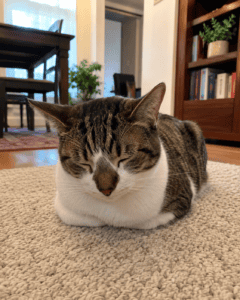 Loaf
Loaf
Paws tucked under the body, sitting upright and compact. Light sleep — resting but ready. Your cat feels reasonably safe but isn’t fully letting their guard down. Common in watchful cats and in environments where something is slightly off.
 Curled tight
The classic ball. Conserves body heat and protects the abdomen — a cat’s most vulnerable area. Common in cooler spots or in cats that feel comfortable but not completely relaxed.
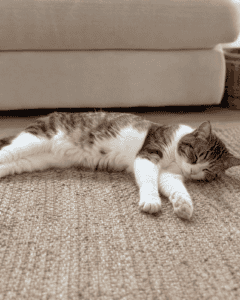 Side-stretched
Legs out, belly accessible. Deep relaxation. A cat sleeping on its side is a cat that feels fully safe — exposed abdomen, no defensive posture. If your cat sleeps like this regularly, that’s a compliment to the home you’ve created.
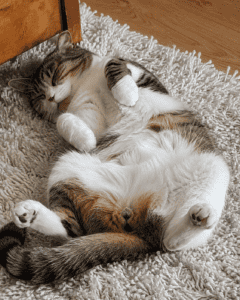 Belly up
Maximum vulnerability. The highest expression of comfort and trust. It doesn’t mean they want a belly rub (they usually don’t), but it does mean they feel completely at ease.
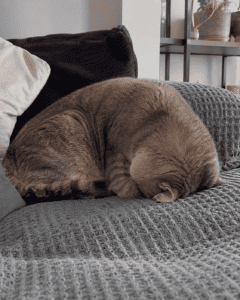 Face plant
Head buried in paws, blanket, or the couch cushion. Blocking out light and stimulation — this cat wants deep, undisturbed sleep.
 Contorted
Cat sleeps twisted into an odd-looking shape, such as half on their back, legs stretched in different directions, or their head hanging off an edge. It usually means your cat feels relaxed, safe, and comfortable enough to fully let go.
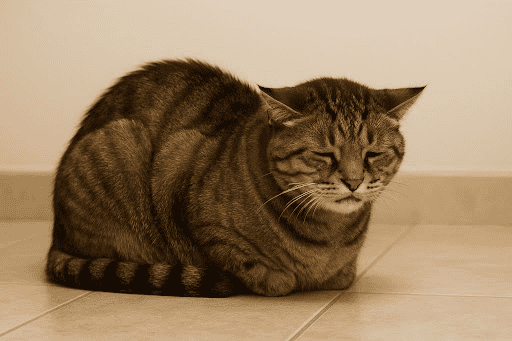 Hunched, restless, or shifting repeatedly.
This one is different from all the others. A cat that can’t seem to get comfortable, keeps adjusting, and seems tense rather than relaxed is often a cat in pain or discomfort. Consistent restlessness during sleep is worth watching and mentioning to your vet.
Cat Snoring and Other Sleep Sounds
Some cats snore. Most of the time, it’s harmless.
Snoring happens when airflow through the nose or throat is partially obstructed during sleep. It’s more common in flat-faced breeds like Persians and Exotic Shorthairs because their anatomy makes full airway clearance harder. Position matters too — a cat sleeping face-down in a cushion is more likely to snore than one stretched out.
Occasional mild snoring in an otherwise healthy cat is not a cause for concern. What warrants a vet call: snoring that appears suddenly in a cat that didn’t snore before; snoring alongside labored breathing or visible effort; any respiratory noise combined with coughing, sneezing, or discharge. These can indicate upper respiratory infection, polyps, or obesity-related airway restriction.
Other normal sleep sounds include soft meowing, chirping, and quiet chattering — all signs of REM and dreaming. Teeth grinding is less common and can indicate dental pain or stress; if you notice it consistently, it’s worth mentioning at your next vet visit.
Supporting Better Sleep: What Actually Helps
Give them real choice. Cats sleep better with multiple locations at different heights and temperatures. A cat competing for the one good sleeping spot is a stressed cat. Perches near windows, a quiet corner bed, access to warmth — variety matters.
Match feeding to their natural rhythm. Cats are built for a hunt-eat-sleep cycle. Feeding after an evening play session mimics that sequence and encourages longer overnight sleep. An automatic feeder for the early-morning meal removes you from the equation entirely.
Tire them out before bed. Ten to fifteen minutes of genuine interactive play in the evening — wand toys, anything that mimics prey movement — burns the energy that otherwise surfaces at 3am.
Keep their core sleeping spots consistent. Familiar spots carry their scent and signal safety. Constantly washing their bedding, rearranging furniture, or disrupting preferred locations increases low-level stress.
For senior cats specifically: Orthopedic or memory foam beds reduce the joint pressure that disrupts sleep. Keeping sleeping areas warm, at floor level with easy access, and away from household foot traffic all help a cat who finds movement increasingly uncomfortable.
Final Thoughts
A sleeping cat is, the overwhelming majority of the time, a healthy cat doing exactly what it evolved to do.
The single most useful habit you can build isn’t memorizing a number of hours or a list of positions. It’s knowing your own cat’s baseline — how much they typically sleep, where they typically sleep, and how they behave in the minutes after waking. That specific pattern is your reference point for everything.
When that pattern changes — especially alongside a shift in appetite, grooming, or how present they seem when awake — that’s the signal worth acting on. Not the absolute number, not a lazy afternoon, not the fact that it’s cold and they’ve claimed the warmest corner of the house for the foreseeable future.
A cat who sleeps all afternoon, comes alive at 5pm, demolishes their dinner, stares at you with quiet judgment, and goes back to sleep — that cat is fine. More than fine. That cat is operating exactly as intended.
Frequently Asked Questions
How Many Hours a Day Do Cats Sleep?
Most healthy adult cats sleep 12–16 hours per day. Kittens can sleep up to 20 hours; senior cats often sleep 16–20 hours. Cats nap in multiple short cycles averaging around 78 minutes rather than sleeping in one long stretch. [2]
Is My Cat Sleeping Too Much?
This depends entirely on what’s normal for your specific cat. The concern is a change from their baseline — a cat who used to sleep 12 hours now sleeping 18, especially if energy and engagement when awake have also dropped. That shift, combined with appetite or behavior changes, is the signal worth acting on. [6]
Why Does My Cat Sleep All Day But Go Crazy at Night?
Because cats are crepuscular — their natural activity peaks are at dawn and dusk. [1] Sleeping during the day and becoming active in the evening is not insomnia; it’s the biological schedule they’re built on. Many domestic cats shift their peak activity around their owner’s routines over time, but the underlying pattern is always there.
Why Does My Cat Twitch in Its Sleep — Is It a Seizure?
Almost certainly not. Twitching paws, flickering whiskers, and soft vocalizations during sleep are normal signs of REM — your cat is dreaming. [8] Seizures look distinctly different: full-body rigidity or violent uncontrolled movement, loss of consciousness, drooling, and disorientation or vomiting immediately on waking. Gentle sleep twitching is almost never cause for alarm, but if you’re unsure, film it and show your vet.
Why Does My Cat Sleep With Its Eyes Half Open?
The third eyelid (nictitating membrane) becomes visible when facial muscles relax during sleep, giving the appearance of half-open eyes. [9] This is normal, particularly during light NREM sleep and in very relaxed cats. It becomes worth checking if the third eyelid is consistently visible when your cat is fully awake, or if there’s accompanying redness, discharge, or cloudiness.
My Cat Is Sleeping More But Still Eating Normally. Should I Worry?
Eating normally is reassuring but doesn’t rule out illness entirely. Monitor closely over 48 hours. If the increased sleep resolves and everything else stays normal, it was likely just a quieter period. If it persists, or if other subtle changes appear — slight coat changes, mild shifts in litter box habits, a little less engagement — a vet check is the right call. Cats can maintain appetite for a while into an illness.
My Cat Used to Sleep With Me Every Night and Has Stopped. Did I Do Something Wrong?
Probably not. Cats shift sleeping spots regularly for reasons of scent, temperature, and personal preference. If your cat is otherwise normal — eating well, engaging with you during waking hours, no other behavioral changes — it’s most likely just a new preferred spot. A withdrawal that comes alongside other changes is worth monitoring. In multi-cat homes, shifts in social dynamics are often the driver.
Why Does My Cat Sleep in Weird Places?
Warmth, safety, and familiar scent are some of the real criteria. [10] The laundry basket is warm and smells like you. The cardboard box is enclosed and defensible. The high shelf offers security. Spot rotation is also normal territorial behavior. The version worth noting: a sudden shift to isolated, dark, hidden spots the cat has never used before. That pattern, especially alongside other changes, can signal discomfort or illness.
Do Cats Dream?
The evidence strongly suggests yes. Cats experience REM sleep with brain activity that closely mirrors the waking state — the same stage associated with dreaming in humans. [8] Jouvet’s 1960s research showed cats enacting recognizable hunting and defensive behaviors during REM when the muscle-inhibition mechanism was experimentally disrupted. What they dream about can’t be known, but the neurological mechanism for dreaming is clearly there.
My Older Cat Has Started Crying Loudly at Night. Is This Related to Sleep?
It can be, and it’s worth taking seriously. Loud, unprompted nighttime vocalization in senior cats is one of the key behavioral signs of feline cognitive dysfunction syndrome. Cornell University’s Feline Health Center lists it alongside excessive sleeping, disorientation, and altered sleep-wake cycles as primary signs of CDS. [5] It can also reflect pain, hyperthyroidism, or other age-related conditions. A vet visit is the right next step rather than assuming it’s simply the cat getting older.
Is It Okay to Let My Cat Sleep in My Bed?
For most people with healthy cats, yes. The practical considerations are sleep disruption if your cat is active at night, and allergens for anyone with sensitivities. Many owners also find sleeping near a pet comforting, though the effect on sleep quality varies from person to person. [11] If your cat wants to be there and you’re happy with the arrangement, it’s a mutual relationship that works for both of you.
Sources
[1] PetMD — Are Cats Nocturnal?
[2] Sleep Foundation — How Many Hours Do Cats Sleep?
[3] Cornell University College of Veterinary Medicine — The Special Needs of the Senior Cat
[4] VCA Animal Hospitals — Degenerative Joint Disease in Cats
[5] Cornell University College of Veterinary Medicine — Cognitive Dysfunction
[6] PetMD — Lethargic Cats: Causes, Symptoms, and What to Do
[7] VCA Animal Hospitals — Recognizing the Signs of Illness in Cats
[8] Fear Free Happy Homes — Catnap Connoisseurs: How Cats Sleep
[9] Vetster — Why Is My Cat’s Third Eyelid Showing?
[10] PetMD — Why Does My Cat Sleep on My Head?
[11] Sleep Foundation — Sleeping with Pets: Benefits and Risks