
 Play aggression is a natural and instinctive behavior, especially common in kittens and young cats.
It’s a way for cats to practice their hunting skills, which are hardwired into their DNA.
This type of aggression is generally harmless, though it might be startling if you’re on the receiving end.
Common Behaviors
Play aggression typically involves pouncing, chasing, light biting, and swatting.
You might notice your cat crouching low to the ground before springing at a moving object—whether that’s a toy or your unsuspecting foot.
These behaviors are usually accompanied by a playful posture: ears forward, pupils dilated, and a tail either up or swishing in excitement.
Typical Triggers
Cats are naturally attracted to movement, so anything that moves—like your hand under a blanket or a toy mouse—can trigger play aggression.
Boredom is another common trigger. If your cat isn’t getting enough mental and physical stimulation, it may turn to play aggression to burn off excess energy.
 True aggression, on the other hand, is a more serious behavioral issue.
It can stem from fear, anxiety, or other underlying problems and is not something to be taken lightly.
Unlike play aggression, true aggression can harm both the cat and the people or animals around it.
Common Behaviors
True aggression manifests in more intense behaviors compared to play aggression.
These include hissing, growling, intense biting, and scratching.
The body language associated with true aggression is also more severe: a tense posture, ears flattened against the head, tail flicking or puffed up, and pupils narrowed to slits.
Vocalizations like hissing or growling are common and serve as a clear warning sign that your cat is not in a playful mood.
Typical Triggers
The triggers for true aggression can vary widely but often include perceived threats, pain, territorial disputes, and fear.
For example, a cat might become truly aggressive if it feels cornered or is suddenly approached by a stranger or another animal.
Medical issues like pain or discomfort can also cause a cat to lash out aggressively.
Understanding the key differences between play and true aggression is essential for any cat owner.
While both behaviors may involve biting, swatting, or pouncing, the context, intensity, and physical signs will help you tell them apart.
Behavioral Cues
- Play Aggression:
The behavioral cues of play aggression are generally more relaxed and spontaneous.
Your cat might initiate play out of boredom or a desire to interact with you. There’s usually minimal vocalization, and the body language remains loose and playful.
A cat engaged in play aggression often stops the behavior when it loses interest or when the object of its play (such as a toy) is no longer moving. - True Aggression:
In contrast, true aggression is deliberate and intense. It’s not about having fun—it’s a serious reaction to something the cat perceives as a threat.
Vocalizations like hissing, growling, or spitting often accompany the behavior.
The cat’s body language will be tense, with ears flattened, tail puffed up, and eyes narrowed, signaling they are ready to defend themselves if necessary.
Intensity and Context
- Play Aggression:
Play aggression is generally low-intensity and doesn’t escalate to the point of causing harm.
The biting is usually light, and the swatting lacks force.
Playful behavior occurs when the cat feels safe and secure, like during a game with their favorite toy. - True Aggression:
True aggression is high-intensity and can escalate quickly.
If a cat feels threatened or is in pain, their aggression can lead to serious injury.
This type of aggression is context-dependent and occurs when the cat feels cornered, threatened, or uncomfortable.
Physical Signs
- Play Aggression:
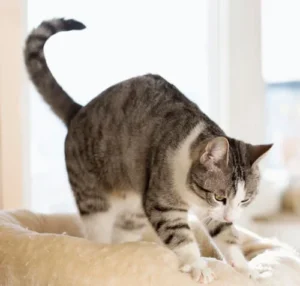
During play aggression, the cat’s body will remain relaxed. The ears are often forward, and the tail, while active, isn’t puffed up.
The cat might exhibit playful swatting or gentle biting, but these actions are usually controlled and not intended to cause harm. - True Aggression:

When a cat is truly aggressive, its body language changes dramatically.
The body becomes stiff, the ears flatten against the head, and the eyes narrow, giving it a menacing appearance.
The tail may flick aggressively or puff up as a sign of agitation. Biting and scratching during true aggression is forceful and meant to defend, not play.
Additional Considerations
Transition Behaviors
It’s important to note that play aggression can sometimes escalate into true aggression if not properly managed. This transition often occurs when play becomes too intense, or the cat overstimulates.
Recognizing the signs of this transition is crucial for preventing potential injury.
Intensity Spectrum
Aggression in cats isn’t always black and white. There can be a spectrum of behaviors between obvious play and clear aggression.
Some cats may display behaviors that fall somewhere in the middle, making distinguishing between play and true aggression challenging.
Owner Response
How an owner reacts to play aggression versus true aggression can significantly impact the cat’s future behavior.
Responding appropriately to play aggression (redirecting to toys, not using hands as play objects) can prevent it from escalating.
In contrast, true aggression often requires a calm, non-confrontational approach and may necessitate professional intervention.
Recovery Time
Another way to distinguish between play and true aggression is by observing how quickly a cat returns to normal behavior after an aggressive episode.
Cats engaged in play aggression typically calm down quickly and may even seek further interaction.
In contrast, a cat exhibiting true aggression may remain agitated for longer.
Consistency of Behavior
The consistency of aggressive behaviors over time can indicate whether they are play or true aggression.
Play aggression tends to be more sporadic and situation-dependent, while true aggression may occur more regularly in response to specific triggers or stimuli.