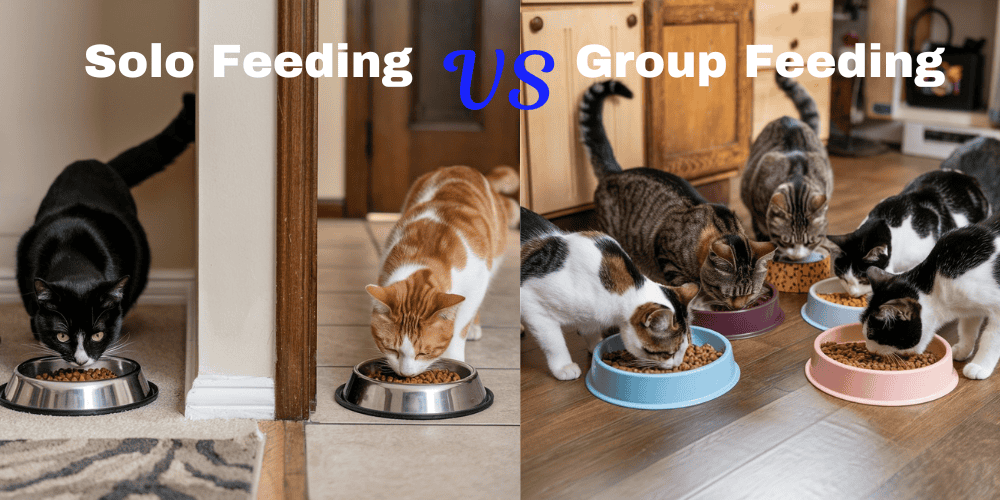
Solo Feeding vs. Group Feeding:
Which Is Better In Preventing Cat Food Aggression
Food aggression in cats is a serious behavioral issue characterized by hostile or defensive actions during eating or when their food is approached. This behavior can lead to conflicts between cats in multi-cat households and even pose risks to human caretakers.
If you’ve been dealing with food aggression among your cats, you might wonder whether feeding them separately (Solo feeding) or together (Group feeding) is the better approach.
The answer is clear: solo feeding is the most effective method to reduce food aggression in cats.
Why Solo Feeding is Better for Preventing Cat Food Aggression
1. Eliminates Competition
One of the main triggers for food aggression in cats is the competition that arises when they eat together.
When cats share a feeding space, they often feel the need to guard their food, leading to aggressive behaviors like growling, hissing, or even swatting.
By feeding each cat separately, you remove the direct competition, making it less likely for them to feel threatened or defensive during mealtimes.
2. Reduces Stress and Anxiety
Cats are sensitive creatures, and the stress of having to compete for food can heighten their anxiety, leading to food aggression.
According to research conducted by Dr. Leticia M. S. Dantas, DVM, PhD, DACVB, a Clinical Assistant Professor in Behavioral Medicine at the University of Georgia:
“Cats fed inside homes should also be treated as solitary feeders, and resources should be ample and spaced out sufficiently to prevent competition or stress when eating” (National Center for Biotechnology Information, 2020).
This highlights the importance of solo feeding in reducing the stress that often leads to aggressive behaviors.
Additionally, the research emphasizes:
“When cats are required to share a feeding bowl or station, a cat may be forced to eat while feeling stress or anxiety rather than forgo a meal” (National Center for Biotechnology Information, 2020).
This anxiety can manifest as food aggression, making solo feeding a crucial strategy in multi-cat households.
Solo feeding creates a calm and controlled environment where each cat can eat at its own pace without the pressure of another cat nearby. This significantly reduces the stress associated with mealtime, helping to keep aggressive behaviors at bay.
3. Prevents Resource Guarding
Resource guarding is a natural instinct in many animals, including cats.
In a group feeding scenario, some cats may develop a tendency to guard their food, seeing other cats as a threat to their meal. This behavior can quickly escalate into aggression.
As the research points out:
“Aggression between cats can be influenced by conflict over availability of resources including food.”
National Center for Biotechnology Information, 2020
Solo feeding eliminates this dynamic entirely, as each cat has its own designated area to eat, reducing the likelihood of resource guarding and the aggression that can come with it.
Situations Where Solo Feeding May Not Be Practical
While solo feeding is highly effective in preventing food aggression, it isn’t always practical for every household.
Here are some scenarios where solo feeding might be challenging:
Space Limitations

In homes with limited space, it may be difficult to set up separate feeding areas for each cat. This can make solo feeding challenging to implement.
However, even in smaller spaces, creative solutions like using vertical space or partitions can help create individual feeding zones.
Time Constraints
Managing multiple feeding stations can be time-consuming, especially if you have a busy schedule.
In such cases, it may not be feasible to feed each cat separately every day.
Social Cats
Some cats are more social and prefer eating in the company of other cats.
If your cats are used to eating together and have established a stable dynamic without signs of aggression, group feeding might still work, but it requires careful monitoring.
Managing Group Feeding to Prevent Food Aggression
If solo feeding isn’t an option for you, there are ways to minimize the risk of food aggression in a group feeding environment:
Multiple Feeding Stations
Setting up multiple feeding stations within the same room or in different areas of the house can help reduce competition. When cats have the option to choose their own space, they are less likely to feel threatened or crowded, which can lower the chances of aggressive behavior.
Resource guarding, a common trigger for food aggression, often arises when one cat feels the need to protect its food.
“Resource guarding can be triggered by a concern for the availability of food… Sometimes the sweetest cat can turn into a tiger when it comes to preventing feline companions from coming close to the food.”
Pam Johnson-Bennett, Cat Behavior Associates, 2020
Use of Slow Feeders
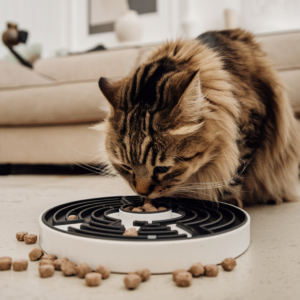
Using food puzzles is an effective way to slow down your cat’s eating and provide mental and physical enrichment by tapping into their natural hunting instincts.
According to a study:
“Food puzzles provide cognitive, physical, and behavioral benefits, mimicking a cat’s natural instinct to work for their food. They can help reduce problem behaviors like aggression and obesity by providing much-needed mental stimulation.”
Dantas, et al., 2016, Journal of Feline Medicine and Surgery
Introducing food puzzles can be particularly beneficial in multi-cat households, reducing competition and stress by keeping each cat engaged with its own puzzle.
Supervised Feeding
If you notice that food aggression is an issue, supervising your cats during feeding times can be helpful.
This allows you to intervene if any aggressive behavior arises, ensuring that all cats have a chance to eat peacefully. Over time, supervised feeding can help reinforce positive behaviors and reduce aggression.
Separate the Dominant Cats
If one or more of your cats tends to be more dominant and prone to aggression during meals, try separating them from the rest of the group.
Feeding these cats in a different room or at a different time can help minimize conflict and create a more harmonious feeding routine for everyone.
Final Thoughts
When it comes to preventing food aggression, solo feeding is the superior method. It eliminates competition, reduces stress and anxiety, and prevents resource guarding, all of which contribute to a more peaceful mealtime for your cats.
A study published by NCBI further supports this by demonstrating that cats in less stressful feeding environments exhibit fewer aggressive behaviors.
However, if solo feeding isn’t practical in your household, implementing strategies like multiple feeding stations, slow feeders, supervised feeding, and separating dominant cats can help manage group feeding and minimize the risk of aggression.
For a broader understanding of the different types of cat aggression and how to manage them, check out our comprehensive guide Understanding and Managing Cat Aggression
Please share this article if you feel it deserves
Related Posts:
How to Avoid Triggering Fear Based Aggression in Your Cat
Signs of Cat Aggression
Understanding Cat Petting Aggression: Causes and Solutions
Cat socialization techniques
Play Aggression Vs. True Aggression: Understanding the Differences
Secrets to Helping Cats Overcome Non-Recognition Aggression
How To Avoid Territorial Aggression in Multi-Cat Households
The 7 Biggest Misconceptions About Redirected Aggression in Cats
References
National Center for Biotechnology Information (NCBI). (2020). The Influence of Feeding and Housing Conditions on the Behavior of Domestic Cats (Felis catus). Retrieved from https://www.ncbi.nlm.nih.gov/pmc/articles/PMC7415653/
Dantas, L. M. S., Delgado, M. M., Johnson, I., & Buffington, C. A. (2016). Food puzzles for cats: Feeding for physical and emotional wellbeing. Journal of Feline Medicine and Surgery, 18(9), 723-732. Retrieved from https://journals.sagepub.com/doi/full/10.1177/1098612X16643753
Johnson-Bennett, P. (n.d.). Resource Guarding Behavior in Cats. Retrieved June 27, 2020, from cat behavior associates: https://catbehaviorassociates.com/resource-guarding-behavior-in-cats/ea
Frequently Asked Questions
- Q: How long does it typically take to transition from group feeding to solo feeding?
A: The transition time can vary depending on the cats involved, but it often takes 2-4 weeks for cats to adjust to a new feeding routine. It’s important to be patient and consistent during this period. - Q: Are there any specific types of food that are more likely to cause food aggression in cats?
A: While food type isn’t typically the primary cause of food aggression, high-value foods like fresh meat or fish might increase competition. Stick to a consistent, balanced diet to minimize potential conflicts. - Q: Can food aggression in cats be a sign of an underlying health issue?
A: Yes, sometimes food aggression can be linked to health problems such as hyperthyroidism, dental pain, or gastrointestinal issues. If food aggression suddenly appears or worsens, consult with a veterinarian. - Q: Is it possible for food aggression to develop between cats that have lived together peacefully for years?
A: Yes, it’s possible. Changes in the household, aging, or health issues can trigger food aggression even in long-established cat relationships. Always monitor for changes in behavior. - Q: How can I tell if my cats are exhibiting food aggression or just playing around their food bowls?
A: Food aggression typically involves growling, hissing, swatting, or physically blocking access to food. Playful behavior is usually more relaxed and doesn’t involve these aggressive signals. - Q: Are certain cat breeds more prone to food aggression than others?
A: While any cat can develop food aggression, some more territorial or dominant breeds might be more predisposed. However, individual personality and environment play a bigger role than breed. - Q: Can food aggression in cats extend to water bowls as well?
A: Yes, some cats may guard water resources similarly to food. Providing multiple water sources throughout the home can help mitigate this issue. - Q: Is it okay to feed cats at different times of the day if I can’t manage simultaneous solo feeding?
A: Yes, feeding cats at different times can be an effective strategy if simultaneous solo feeding isn’t possible. Just ensure each cat gets their full daily nutritional requirements. - Q: How can I prevent my non-aggressive cats from being intimidated during group feeding?
A: Provide elevated feeding stations or use baby gates to create safe spaces for less assertive cats. This allows them to eat without feeling threatened by more dominant cats. - Q: Can food aggression in cats be completely cured, or is it something that needs ongoing management?
A: While food aggression can often be significantly reduced or managed, it may require ongoing attention. Consistent feeding routines and environment management are key to long-term success.