
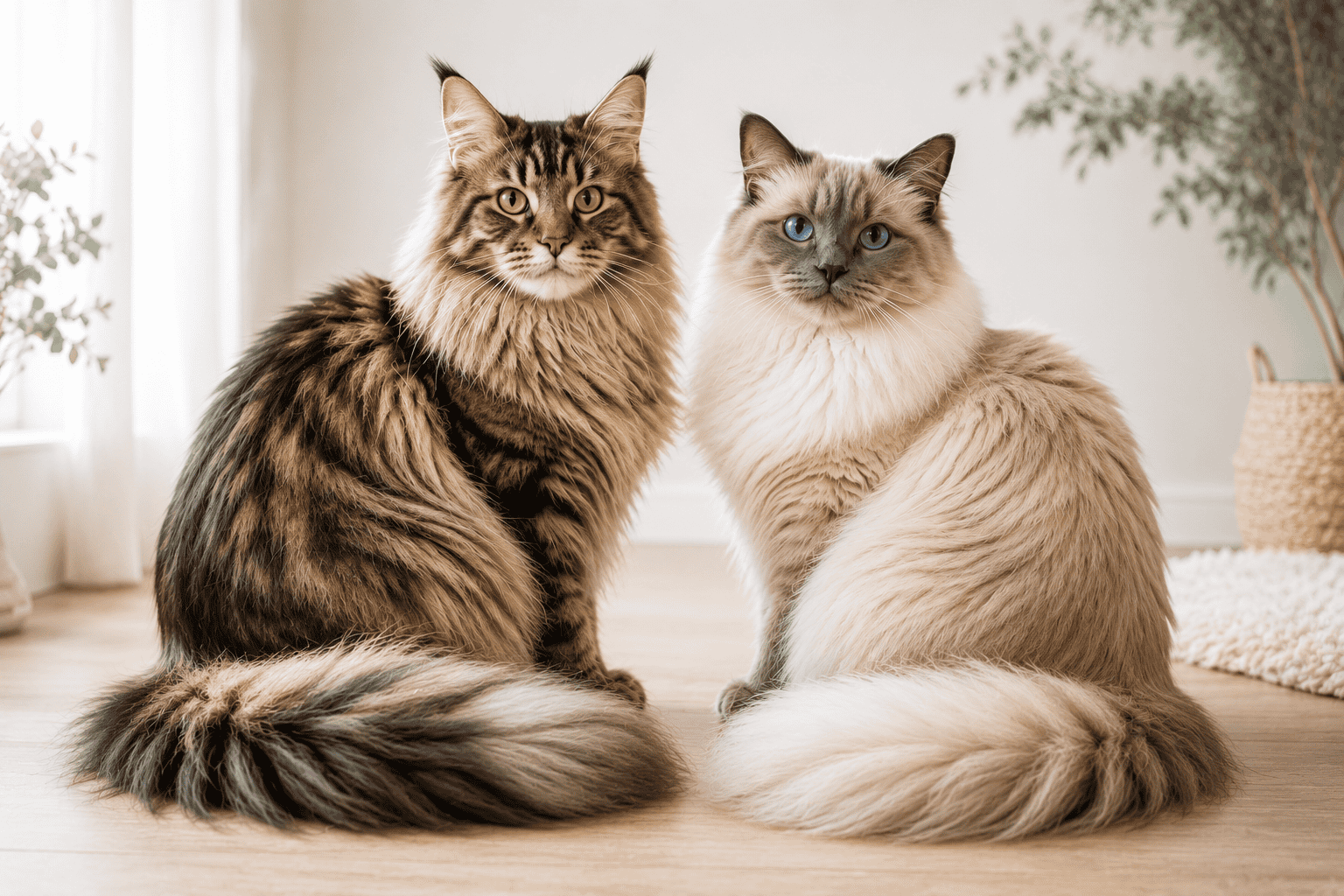
1. Maine Coon
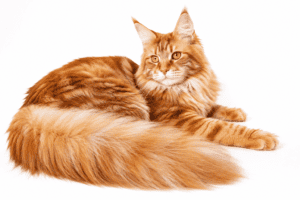 If there’s one breed that people think of the moment someone says “fluffy tail,” it’s the Maine Coon. That tail is not subtle. It’s long, thick, and so densely furred that Maine Coons have been known to wrap it around themselves like a scarf in cold weather — which is more or less what it evolved to do.
Maine Coons are one of the largest domestic cat breeds, and the tail tends to match the rest of the cat: outsized and impressive. But what makes them genuinely great to live with is that all that drama comes packaged with an easygoing, sociable personality. They get along with kids, dogs, and other cats better than most breeds manage. They’re chatty without being demanding, playful without being destructive. [7]
Grooming the tail needs attention — a slicker brush two to three times a week prevents mats from forming in the dense undercoat. The tail itself rarely knots as badly as the ruff or belly fur, but it’s worth checking the base regularly.
2. Norwegian Forest Cat
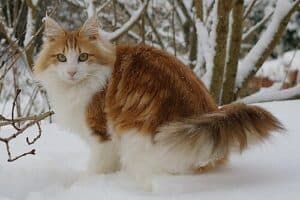 The Norwegian Forest Cat — “Wegie” to anyone who has owned one — carries a tail that looks like it belongs in a fairy tale. It’s full, tapered, and so thickly furred that in winter it fans out into something resembling a fox brush. These cats evolved in Scandinavian forests, and the coat reflects it: water-resistant outer layer, dense insulating undercoat, and a tail built to curl around a sleeping cat on a cold night. [8]
Wegies are independent without being aloof. They like people on their own terms — present, curious, occasionally affectionate, but not needy. They love to climb, which means a tall, sturdy cat tree is less optional than it might seem. Without vertical space to occupy, they’ll find their own.
The coat sheds heavily twice a year, and the tail needs regular brushing to prevent the dense undercoat from compacting into mats. Outside of shedding season, weekly brushing is usually enough. [8]
3. Siberian
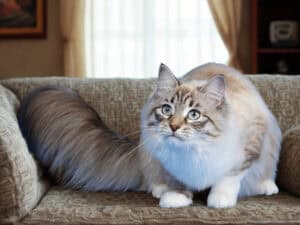 Russia’s native forest cat is built for survival, and the tail is part of that equation. Siberians carry a thick, rounded tail with a dense, water-resistant coat that can withstand temperatures most other breeds would refuse to acknowledge. Functionally, it’s a heat-trapping appendage. Practically, it’s one of the most beautiful tails in the cat world.
What distinguishes the Siberian from the Norwegian Forest Cat — which it superficially resembles — is temperament. Siberians are warmer, more dog-like, and more openly affectionate. They follow their people around the house, greet visitors with curiosity rather than suspicion, and have a soft, chirping vocalization that most owners find completely charming.
An added note for allergy-sensitive households: Siberians are often discussed as a potentially lower-allergen breed because researchers have studied genetic differences linked to Fel d 1 production in Siberian cats. That said, no cat is fully hypoallergenic, and individual cats can vary. [2]
4. Ragdoll
 The Ragdoll’s tail is an elegant, plume-like thing that moves slowly and deliberately, much like the cat itself. Ragdolls are famously unhurried. They go limp when you pick them up — hence the name — and they follow their owners from room to room with a quiet persistence that people either find deeply endearing or slightly unnerving. [9]
The coat is semi-long and silkier than it looks, which means it’s less prone to matting than breeds with a thicker undercoat. Two or three combings a week keeps the tail and ruff in good shape. For a long-haired cat, Ragdolls are genuinely on the lower end of grooming effort. [9]
They’re large cats — males routinely reach 15 to 20 pounds — but their personality is the opposite of intimidating. Good with children, good with other cats, tolerant of dogs, and almost universally calm. One caveat: their trust in people can make them vulnerable outdoors. Ragdolls are better suited to indoor living. [9]
5. Persian
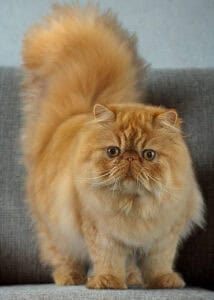 Persian cats carry their tails like accessories — slow, deliberate, and entirely aware of the effect. The tail itself is full and heavily furred, a natural extension of one of the most luxurious coats in the cat world. Persians move through a room with an unhurried confidence that makes them look permanently posed for a portrait.
The grooming commitment is real and non-negotiable. Persians require daily brushing to prevent their thick undercoat from matting, and the tail needs particular attention because mat formation near the base can go unnoticed until it’s become a problem. Many Persian owners also schedule professional grooming appointments every six to eight weeks. This is not a low-maintenance cat.
In exchange for that effort, Persians are exceptionally calm companions. They prefer quiet households, are content to spend long hours on a lap or a favourite cushion, and rarely cause the kind of chaos that more active breeds do. If you want a beautiful, serene cat and don’t mind the daily brushing, a Persian is hard to argue with.
6. Ragamuffin
 The Ragamuffin is essentially a Ragdoll with a wider range of colours and patterns, and a personality so agreeable it borders on comical. These cats want to be involved in everything — not loudly, but persistently.
They’ll sit beside you while you work, follow you to the kitchen, and then settle wherever you settle with the kind of contentment that’s genuinely soothing to be around.
Their tails are full and bushy, complementing a thick, plush coat that feels different from the Ragdoll’s silkier texture — denser and more rabbit-like. Despite the fullness, the coat is relatively tangle-resistant. Combing two or three times a week keeps it in good condition, with the tail needing a little extra attention at the base.
7. Birman
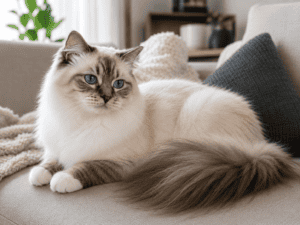 The Birman — known as the Sacred Cat of Burma — has a tail that moves with a particular quiet elegance. It’s fully furred and plumed, complementing the breed’s creamy coat and deep blue eyes in a way that manages to look effortless. One of the Birman’s most useful traits for owners: their semi-long coat lacks a dense undercoat, which means it almost never mats.
Birmans are gentle and sociable without being demanding. They like company, get along well with children and other pets, and have a soft, melodic voice they use sparingly. They’re not an especially active breed — content to follow their owner from room to room and settle nearby rather than requiring structured playtime. For someone who wants a beautiful long-haired cat without the grooming burden that usually comes with it, the Birman is one of the best answers.
8. Turkish Angora
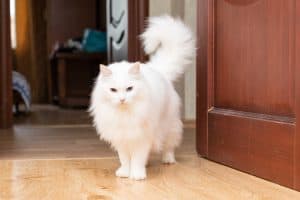 The Turkish Angora’s tail is one of the more unusual in this list — long, tapering, and covered in fine, silky hair that fans out at the tip rather than being uniformly dense. When a Turkish Angora carries its tail high (which is most of the time), it has the look of a very self-possessed animal who knows exactly how good it looks.
Angoras are one of the oldest natural breeds, originating in Turkey, and they’ve retained a liveliness that some more recently developed breeds have lost. They’re intelligent, interactive, and opinionated. They play hard, form strong bonds with their families, and can be surprisingly assertive about their preferences. Their single-layer coat, while silky and beautiful, is surprisingly low-maintenance — weekly brushing is usually sufficient, and shedding is moderate.
9. Somali
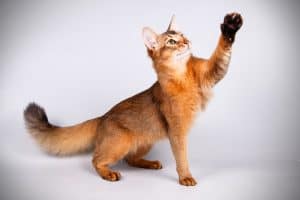 The Somali is the long-haired version of the Abyssinian, and the tail is where the breed really differentiates itself from its short-haired cousin. It fans out into a full plume — thick, richly coloured, and striking against the ticked, fox-like coat. Somalis are often compared to small foxes, and the tail is central to why.
Temperament-wise, Somalis are among the most active cats on this list. They’re curious, athletic, and highly intelligent — the kind of cat that will figure out how to open cupboards and then look you in the eye while doing it. They need stimulation: interactive toys, puzzle feeders, and regular playtime. A bored Somali will find something to do, and you may not love what it chooses.
Their semi-long coat needs weekly brushing to stay tangle-free, but the maintenance is lighter than it looks. The tail, despite its fullness, rarely mats.
10. Himalayan
 The Himalayan — often called a ‘Himmie’ — is what you get when you cross a Persian with a Siamese: the long, luxurious coat and full tail of the Persian, with the striking colour points and blue eyes of the Siamese. The tail is dense and heavily furred, sitting close to the body rather than arching upright, and it carries the same plush quality as the rest of the coat.
Himalayans have the Persian’s calm, gentle temperament rather than the Siamese’s vocal intensity — which makes them easier to live with for most people. They love lap time, prefer quiet environments, and are content in apartments. The grooming commitment mirrors the Persian’s: daily brushing is necessary to prevent matting, and the tail and face need particular attention.
11. Balinese
 The Balinese is, at its simplest, a long-haired Siamese — same elegant body, same colour points, same striking blue eyes, but with a silky, flowing coat and a tail that plumed out into something genuinely beautiful. It’s a single-layer coat with no undercoat, which is significant: less shedding, less matting, and far less grooming effort than most long-haired breeds.
The Siamese personality is well represented here. Balinese are chatty, opinionated, and deeply attached to their people. They’ll follow you around the house narrating their day, and they expect a response. If you want a quiet, self-contained cat, a Balinese is not it. If you want an engaged, affectionate, genuinely entertaining companion, they’re excellent.
12. American Curl Longhair
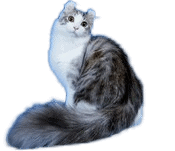 The American Curl Longhair is one of the more quietly distinctive cats on this list. Its backward-curling ears give it a permanently alert, slightly surprised expression, and its long-haired variety carries a beautifully plumed tail — silky, full, and tapered — that fans out when the cat is moving with any purpose. Unlike some of the dense-coated breeds here, the American Curl’s coat lies flat with minimal undercoat, which means the tail looks substantial without requiring the kind of grooming commitment you’d give a Maine Coon or Persian. [1]
The breed originated in California in 1981 from a single stray cat named Shulamith, and it remains relatively uncommon — which makes finding a reputable breeder worth extra effort. Temperamentally, American Curls are affectionate and playful without being demanding. TICA describes them as devoted companions with kitten-like energy that persists well into adulthood — the breed has been called the Peter Pan of cats. They get along well with children and other pets, and adapt readily to new situations. For a cat with such a striking appearance, they’re a genuinely easy-going choice.
The ear curl itself is worth understanding before you adopt. Kittens are born with straight ears that begin to curl within days and reach their final shape by about 16 weeks. Unlike folded-ear breeds associated with broader cartilage and joint problems, the American Curl’s ear shape is generally described as affecting the ear cartilage itself. Even so, the ears should always be handled gently and never bent or forced into position — the cartilage is firm but not indestructible. Weekly brushing keeps the silky coat and plumed tail in good shape. [1]
13. Nebelung
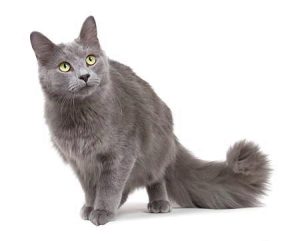 The Nebelung is a rare breed, and somewhat underappreciated for it. The name means ‘creature of the mist’ in German, which suits a cat with a shimmering blue-grey coat and a tail that moves like smoke. It’s a long-haired version of the Russian Blue, carrying the same vivid green eyes and reserved, thoughtful temperament.
Nebelungs form deep bonds with their people but take time to warm up to strangers — they’re not the cat who greets visitors at the door. They’re quiet, gentle, and observant, preferring calm environments and consistent routines. Their semi-long coat requires weekly brushing to prevent tangles, with the tail needing a little extra attention for knots near the base.
14. LaPerm
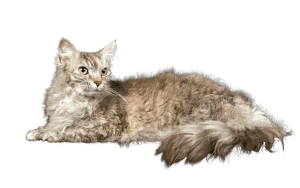 The LaPerm is the wild card of this list. Their coat is curly — loose ringlets or waves, depending on the individual — and the tail carries that texture into something genuinely unusual: a full, curly plume that has the look of a very elaborate bottle brush. It’s the kind of tail that makes strangers stop and ask what breed they’re looking at.
Despite the appearance, the LaPerm’s coat is lower maintenance than it looks. The curl structure prevents the kind of undercoat compaction that mats other long-haired breeds, and shedding is minimal. LaPerms are friendly, outgoing, and people-oriented — they like being involved in what’s happening and will readily climb into a lap given the opportunity.
15. British Longhair
 The British Longhair takes the British Shorthair’s already substantial build and adds a dense, plush coat and a tail that fans out like a thick brush. It’s a solidly constructed cat — broad-chested, round-faced, and carrying itself with the kind of unshakeable calm that British Shorthairs are famous for.
They’re affectionate without being demanding, happy to sit nearby rather than insisting on lap time, and adaptable to most home environments. The coat needs consistent grooming — two or three times per week — particularly during seasonal shedding when the undercoat comes out in quantity. The tail, being densely furred, benefits from a fine-tooth comb at the base to catch any mats early.